The Oratorical Titans of Brooklyn: Unpacking Reverend Talmage’s Enduring Legacy
Welcome to the first installment of our deep dive into the extraordinary life and impact of Reverend Dr. Thomas DeWitt Talmage, a figure whose presence profoundly shaped 19th-century Brooklyn. Before we fully immerse ourselves in the saga of Talmage and his iconic Tabernacle, it’s essential to understand the vibrant religious landscape of Brooklyn that fostered such towering personalities. This city, affectionately known as the “City of Churches,” earned its moniker not merely from the sheer number of magnificent ecclesiastical structures gracing its tree-lined streets, but equally from the powerful, charismatic voices that echoed from their pulpits, delivering sermons that captivated thousands and ignited social change.
In the bustling urban tapestry of 19th-century America, churches stood as more than just places of worship; they were the very heartbeats of their communities. They served as vital centers for social gathering, educational outreach, and moral guidance. Brooklyn, undergoing rapid growth and diversification, witnessed a flourishing of religious fervor that manifested in architecturally diverse churches and, crucially, in the rise of extraordinary preachers. These spiritual leaders were often public intellectuals, moral compasses, and even celebrities of their age, drawing immense crowds eager to hear their pronouncements on faith, ethics, and contemporary issues.
Henry Ward Beecher: The Unrivaled Voice of Brooklyn
Among these illustrious figures, the Reverend Henry Ward Beecher undeniably holds the title of the most famous 19th-century preacher. His name became synonymous with Brooklyn’s Plymouth Church, where he presided over an immense congregation and delivered sermons that resonated far beyond the borough’s borders. Beecher’s oratorical prowess was legendary; his eloquent and passionate delivery, combined with his progressive views, made him a national sensation. He was a master of persuasive rhetoric, capable of swaying public opinion and inspiring widespread moral action. His influence extended to the highest echelons of American society, making him one of the most recognizable and influential men of his time.
Beecher’s most enduring legacy, however, was his fervent anti-slavery stance. From his pulpit in Brooklyn Heights, he thundered against the injustices of chattel slavery, his sermons becoming rallying cries for the abolitionist movement. His impassioned speeches, often delivered to overflow crowds and widely circulated in print, played a significant role in shaping public consciousness and mobilizing support for the Union cause during the Civil War. His courage in challenging the status quo and his unwavering commitment to human dignity earned him both admiration and fierce opposition, cementing his place in American history as a trailblazer for social justice. The impact of his words reverberated across the nation, making Plymouth Church a crucial nexus in the fight for freedom.
The Age of Charismatic Oratory: Thomas DeWitt Talmage Emerges
While Henry Ward Beecher captivated the nation, the latter half of the 19th century witnessed the emergence of several other celebrated preachers who left indelible marks on Brooklyn’s spiritual landscape. Among them, the Reverend Dr. Thomas DeWitt Talmage stands as a titan, arguably second only to Beecher himself in terms of sheer popularity and the breathtaking size of his congregation. Talmage possessed a distinct and equally compelling style, a theatrical flair that distinguished him from his contemporaries. His sermons were vivid, dramatic spectacles, often employing elaborate metaphors and vivid imagery that held his audiences spellbound. He was a showman for the Lord, leveraging every rhetorical device to deliver his message with maximum impact.
Talmage’s ability to connect with a diverse audience, from the working class to the elite, was unparalleled. His sermons, known for their vivid storytelling and direct application to everyday life, were transcribed and syndicated, reaching millions worldwide. This made him an international figure, a testament to the power of his communication skills in an era before mass electronic media. People flocked from all corners of Brooklyn and beyond to witness his captivating sermons, creating a demand that necessitated an unusually grand and expansive place of worship: the Talmage Tabernacle. This iconic structure was not just a building; it was a testament to his immense popularity and the magnetic pull of his preaching.
The Talmage Tabernacle: A Monument to Ministry
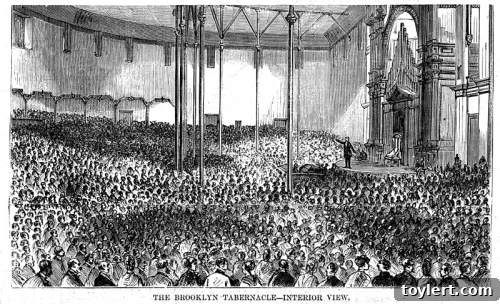
The Talmage Tabernacle, often pictured and now a subject of historical intrigue, was a marvel of its time. Designed to accommodate the vast numbers drawn by Reverend Talmage’s sermons, it was a colossal structure that broke away from traditional church architecture. Instead of steeples and stained glass typically associated with grand churches, the Tabernacle was built with functionality and audience capacity as its primary considerations. Its design was revolutionary for its time, eschewing conventional ornamentation for an open, airy structure that could seat thousands comfortably. It was a utilitarian cathedral, purpose-built for mass evangelism and the effective delivery of oratorical performances.
This immense auditorium served as the epicenter of Talmage’s ministry, a vibrant hub where spiritual upliftment and community engagement converged. Week after week, it was filled to capacity with congregants eager to absorb Talmage’s fiery rhetoric and comforting wisdom. The Tabernacle symbolized the era’s evangelical zeal, a physical manifestation of the boundless energy and ambition of its celebrated pastor. It was a place where faith was not merely observed but experienced with an almost theatrical intensity, reflecting Talmage’s dynamic approach to disseminating the Word of the Lord. The stories woven around this remarkable building and its charismatic leader form a compelling chapter in Brooklyn’s rich history.
The Enduring Resonance of Brooklyn’s Preachers
The legacy of preachers like Henry Ward Beecher and Thomas DeWitt Talmage extends far beyond the 19th century. They not only shaped the spiritual and moral fabric of Brooklyn but also influenced the broader American religious landscape. Their innovative approaches to preaching, their engagement with pressing social issues, and their ability to draw massive audiences laid the groundwork for modern evangelical movements and the concept of the “megachurch.” They demonstrated the power of charismatic leadership and effective communication in fostering vibrant communities of faith. Their lives and ministries offer invaluable insights into the social, cultural, and religious dynamics of Victorian America.
As we delve deeper into the narrative of Reverend Talmage, his challenges, triumphs, and the eventual fate of his legendary Tabernacle, we uncover not just a personal story but a significant piece of Brooklyn’s identity. These figures, with their powerful voices and their monumental churches, were integral to earning Brooklyn its distinctive title, and their stories continue to captivate and educate us about an era when the pulpit held immense sway over public life. Their contributions remind us that the “City of Churches” was indeed a place of profound spiritual and intellectual ferment, a crucible where powerful ideas were forged and disseminated by some of the greatest orators of their time.
Join us as we continue this fascinating journey into the past. Explore the unfolding drama and significant events surrounding Reverend Talmage by reading the subsequent parts of this compelling series:
Read Part 2, Part 3, Part 4, and Part 5 of this story.