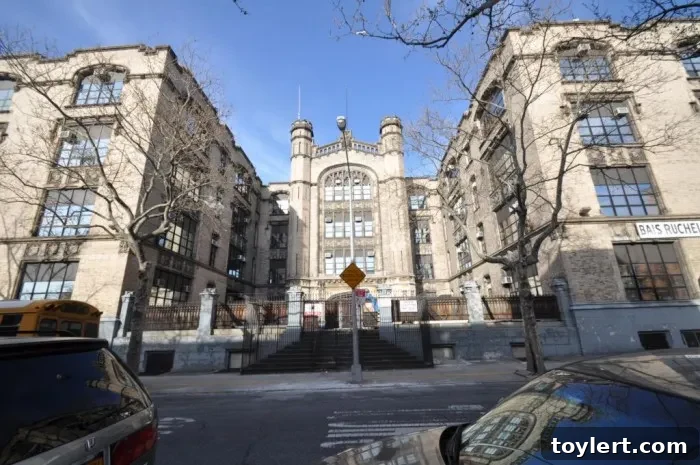
227 Marcy Avenue: A Brooklyn Landmark Transformed – From Eastern District High School to Bais Ruchel School for Girls
Brooklyn, a borough celebrated for its dynamic neighborhoods and rich architectural heritage, tells countless stories through its buildings. Among these, the structure at 227 Marcy Avenue stands out as a particularly compelling narrative of evolution, community, and enduring purpose. What once served as the venerable Eastern District High School now thrives as the Bais Ruchel School for Girls, embodying a profound journey of adaptation and continuous service to education within the heart of Williamsburg.
This magnificent edifice, an impressive example of early 20th-century institutional architecture, has witnessed over a century of change, both within its walls and in the bustling streets of Brooklyn outside. Its transformation reflects the shifting demographics and educational needs of a vibrant community, making it much more than just a building; it is a living monument to Brooklyn’s resilience and its deep commitment to learning.
The Architectural Grandeur of Eastern District High School
The building at 227 Marcy Avenue is an architectural marvel, commanding attention with its imposing and stately presence. Constructed at a time when public institutions were designed to inspire awe and convey permanence, the former Eastern District High School likely showcases hallmarks of Neoclassical or Beaux-Arts design, styles favored for their gravitas and classical allusions. These architectural movements often drew inspiration from ancient Greek and Roman temples, characterized by symmetry, monumental scale, and elaborate ornamentation.
Typical features might include a grand central entrance framed by colossal columns, often in the Corinthian or Ionic order, suggesting strength and academic rigor. The facade would likely be adorned with classical motifs such as pediments, decorative cornices, and detailed stonework that speaks to the craftsmanship of the era. Large, symmetrically placed windows would allow ample natural light into the vast classrooms and auditoriums, while robust brick or stone construction ensured durability and a formidable appearance. The sheer scale of the building itself, designed to accommodate a large student body, contributes to its iconic status on Marcy Avenue, establishing it as a landmark from its very inception.
Such architectural choices were not merely aesthetic; they conveyed a powerful message about the value placed on public education. Schools of this era were often seen as cathedrals of learning, built to last and to inspire civic pride. The design of 227 Marcy Avenue undoubtedly contributed to an environment of seriousness and scholarly pursuit, leaving an indelible mark on generations of students who passed through its formidable doors.
A Pillar of Education: Eastern District High School’s Legacy
Opened in an era of rapid urban growth and progressive educational reform, Eastern District High School quickly became a cornerstone of the Williamsburg community. Established in the early 20th century, it was one of the many grand high schools built across New York City to accommodate an exploding population and an increasing demand for secondary education. For decades, it served as a vital institution, shaping the minds and futures of countless young men and women from diverse backgrounds.
The curriculum would have been comprehensive, preparing students for both higher education and vocational careers, reflecting the industrial and social needs of the time. Beyond academics, the high school would have been a hub for extracurricular activities, fostering athletic teams, drama clubs, debate societies, and community events that helped forge a strong sense of identity and camaraderie among its students. It was a place where friendships were formed, aspirations were nurtured, and civic values were instilled.
As the neighborhood of Williamsburg evolved, so too did the student body and the challenges faced by the school. Yet, for many years, Eastern District High School remained a beacon of educational excellence and community integration, playing an instrumental role in the social fabric of Brooklyn’s Eastern District. Its legacy is not just one of academic achievement but also of providing a stable, enriching environment for thousands of teenagers during their formative years.
The Transformation: From Public High School to Private Girls’ School
Like many urban institutions, Eastern District High School eventually faced new challenges. Demographic shifts, changes in educational policy, and evolving community needs sometimes necessitate the repurposing of older, larger school buildings. In time, the public high school chapter at 227 Marcy Avenue concluded, marking a pivotal moment in the building’s history. This transition, however, was not an end but a new beginning.
The venerable structure was eventually acquired by the Bais Ruchel School for Girls, a significant institution within the local Hasidic community. This acquisition marked a remarkable example of adaptive reuse, a strategy vital for preserving historic buildings while meeting contemporary community needs. The transformation involved meticulous renovation and adaptation to suit the specific requirements of a modern girls’ school, while largely preserving the architectural integrity and grandeur of the original design.
The interior spaces, once bustling with a co-educational public high school population, were thoughtfully reconfigured to create classrooms, administrative offices, and communal areas conducive to the Bais Ruchel School’s unique educational philosophy. This careful transition ensured that the building’s historical essence was honored, even as it embraced a new mission and a new generation of students.
Bais Ruchel School for Girls: A New Chapter in Education
Today, 227 Marcy Avenue is home to the thriving Bais Ruchel School for Girls, a vital educational institution dedicated to providing a rich and comprehensive education rooted in traditional values. The school serves the vibrant Hasidic community of Williamsburg, offering an immersive learning experience that combines rigorous academic instruction with profound spiritual and moral guidance.
Bais Ruchel emphasizes a curriculum that nurtures intellectual growth alongside character development, preparing its students not only for academic success but also for meaningful lives grounded in their faith and community. The historic classrooms, once echoing with the sounds of a diverse public school population, now resonate with the focused learning and camaraderie of young women dedicated to their studies and spiritual development.
The school’s presence at this iconic address underscores the importance of continuity and adaptation in urban educational landscapes. By occupying and revitalizing such a significant structure, Bais Ruchel School for Girls not only preserves a piece of Brooklyn’s past but also actively contributes to its present and future, serving as a beacon of learning and community strength within Williamsburg. It exemplifies how historic buildings can continue to be dynamic, functional spaces that serve new generations and evolving societal needs.
227 Marcy Avenue: A Symbol of Brooklyn’s Enduring Spirit
The building at 227 Marcy Avenue stands as a powerful symbol of Brooklyn’s enduring spirit of transformation and renewal. Its journey from the Eastern District High School to the Bais Ruchel School for Girls encapsulates the borough’s dynamic history, marked by waves of immigration, demographic shifts, and continuous community development. It is a testament to the idea that buildings, like the communities they serve, can adapt and find new purpose without losing their inherent value or historical resonance.
This magnificent structure continues to define a significant portion of Marcy Avenue, its formidable facade bearing silent witness to the daily lives of countless Brooklynites. It reminds us of the profound role that educational institutions play in shaping individual lives and collective identities. Moreover, it serves as an excellent example of successful adaptive reuse, demonstrating how architectural heritage can be preserved and integrated into modern urban life, rather than being lost to decay or demolition.
In a city that is constantly reinventing itself, 227 Marcy Avenue offers a reassuring sense of continuity, linking Brooklyn’s past with its present. It stands as a powerful reminder that while names and purposes may change, the fundamental commitment to education and community well-being remains a constant, deeply etched into the very stones of its historic architecture.
Conclusion: A Legacy of Learning on Marcy Avenue
The story of 227 Marcy Avenue is a compelling chapter in the broader narrative of Brooklyn. From its origins as the distinguished Eastern District High School, a hub of public education, to its current incarnation as the vibrant Bais Ruchel School for Girls, this building has consistently served as a vital center for learning and community engagement. Its architectural grandeur and rich history make it far more than just a functional space; it is a cherished landmark that reflects the resilience and adaptability of Williamsburg and the entire borough.
As visitors and residents pass by its majestic facade, they are reminded of the layers of history embedded within its walls and the countless lives that have been shaped within its classrooms. The building at 227 Marcy Avenue truly embodies the spirit of Brooklyn: constantly evolving, deeply rooted in its heritage, and forever dedicated to fostering education and community, one generation at a time.