The Day the Sky Fell: Revisiting the Park Slope Plane Crash and Its Enduring Legacy
More than six decades have passed since a clear winter sky over New York City turned into a scene of unimaginable horror. Today, the vibrant intersection of Sterling Place and 7th Avenue in Brooklyn’s beloved Park Slope neighborhood hums with the rhythm of daily life. Bustling cafes, charming brownstones, and tree-lined streets offer no immediate suggestion of the unparalleled tragedy that unfolded here on a crisp December morning. However, on December 16, 1960, this tranquil urban landscape was transformed into a devastating inferno when two commercial airliners collided mid-air, raining flaming wreckage across the borough and claiming the lives of 134 souls. What transpired that fateful Friday afternoon would forever alter the lives of countless families, reshape the community, and ultimately trigger profound advancements in global aviation safety. At the time, this incident stood as the deadliest commercial aviation accident in U.S. history, a grim benchmark that underscored the urgent need for a new era of air traffic control and stringent flight safety protocols.
A Fateful Collision Above the Metropolis
The calamity began thousands of feet above the ground, a catastrophic collision of two aircraft on approach to New York’s Idlewild (now JFK International) and LaGuardia Airports. United Airlines Flight 826, a brand-new Douglas DC-8 jetliner, christened “Mainliner Will Rogers,” had departed from Chicago’s O’Hare International Airport carrying 76 passengers and 7 crew members, destined for LaGuardia. Concurrently, Trans World Airlines (TWA) Flight 266, a venerable Lockheed L-1049 Super Constellation propeller aircraft, was en route from Dayton and Columbus, Ohio, also heading to LaGuardia, with 39 passengers and 5 crew members onboard. Both flights were operating in a busy air corridor, navigating through a thick blanket of clouds and light snow. Unbeknownst to those aboard and below, the stage was set for an unforeseen disaster that would shock a nation increasingly reliant on the marvels of air travel.
Investigators painstakingly pieced together the harrowing sequence of events that led to the collision. United Flight 826, having been cleared for a holding pattern near Preston, New Jersey, had reportedly overshot its assigned holding point by more than 11 miles. This critical navigation error, potentially attributable to a faulty VOR receiver or a misinterpretation by the flight crew, inadvertently placed the high-speed DC-8 directly in the path of the inbound TWA Flight 266. At precisely 10:33 AM EST, over the borough of Staten Island, the two aircraft collided with devastating force. The DC-8, traveling at an estimated 350 miles per hour, struck the Constellation, tearing off a significant portion of its right wing and severing its tail section. The impact was instantaneous and catastrophic, turning two soaring metallic birds into plummeting fragments of fire and twisted debris.
Hell on Earth: The Devastation in Park Slope and Staten Island
The immediate aftermath of the mid-air collision was a scene of unparalleled devastation. The TWA Super Constellation, critically damaged and largely disintegrating in mid-air, rained its fuselage and scattered parts down onto a sparsely populated area of Miller Field, a former military airfield on Staten Island. All 44 people aboard perished instantly upon impact, their lives extinguished in a flash of wreckage and fire. There were no survivors from TWA Flight 266.
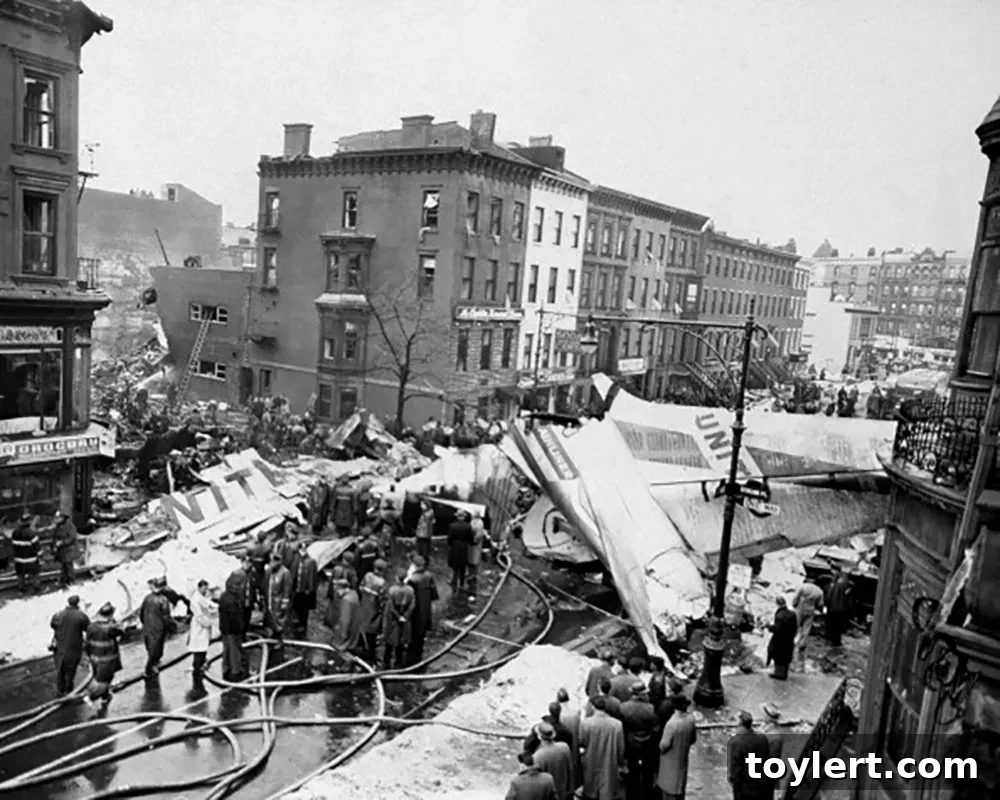
The United Airlines DC-8, despite its severe damage, remarkably continued to fly for several minutes, a silent, mortally wounded ghost of its former self. Its engines, compromised by the collision, eventually failed, sending the massive jetliner spiraling uncontrollably towards Brooklyn. Its descent was rapid and terrifying, witnessed by countless New Yorkers going about their routine Friday morning. The jetliner slammed into the very heart of Park Slope, a densely populated residential neighborhood, specifically at the intersection of Sterling Place and 7th Avenue. The force of the impact was immense, obliterating several historic brownstones, a dry cleaning business, and the cherished Pillar of Fire Church. The surrounding streets were instantly engulfed in a maelstrom of flames, thick black smoke, and shattered debris. Cars were incinerated, buildings collapsed, and the once-quiet neighborhood was transformed into an apocalyptic war zone, a scene that defied belief.
The ground impact of the DC-8 claimed the lives of everyone onboard – 83 passengers and crew – and tragically, six more people on the ground, bringing the total death toll to 134. Among the victims on the ground were residents going about their daily routines, shopkeepers, and pedestrians caught unaware by the horrific descent. The scale of the tragedy was overwhelming, and the images of burning buildings and smoldering wreckage relayed by news crews across the nation shocked and horrified the public. First responders, including police, firefighters, and emergency medical personnel, converged on the scene within minutes, facing an unprecedented challenge. They worked tirelessly amidst the raging flames and treacherous rubble, searching for survivors, recovering remains, and battling the inferno that threatened to consume more of the historic neighborhood. The heroic efforts of these brave individuals, often putting their own lives at risk, were a testament to the community’s resilience in the face of unimaginable horror and despair.
The Grueling Investigation and Its Transformative Legacy in Air Safety
In the wake of such a colossal disaster, a meticulous and exhaustive investigation was launched by the Civil Aeronautics Board (CAB), the federal agency responsible for aviation accident investigations at the time, and the precursor to the National Transportation Safety Board (NTSB). Teams of investigators scoured both crash sites, painstakingly collecting fragments of the aircraft, personal belongings, and any piece of evidence that could shed light on the cause. The sheer expanse of the debris fields, stretching from Staten Island across to Brooklyn, made this an exceptionally complex and challenging undertaking. Engineers, meteorologists, and aviation experts collaborated intensely to reconstruct the final moments of both flights, relying on precious radar data, countless witness testimonies, and the recovered wreckage, which often amounted to mere scraps.
The investigation ultimately concluded that the primary cause of the accident was United Flight 826’s significant deviation from its assigned airspace and holding pattern, which directly led to its collision with TWA Flight 266. Contributing factors included an alleged malfunction of the DC-8’s VOR (VHF Omni-directional Range) navigation receiver, which could have led the pilots astray, as well as potential miscommunication or misunderstanding between the flight crew and air traffic controllers. This disaster starkly exposed critical flaws in the existing air traffic control system of the era, particularly the limitations of radar coverage and the procedures for aircraft separation in congested airspace. Furthermore, the limited availability of standardized “black box” flight recorders (though some basic data recorders were onboard, they were primitive by today’s standards) severely hampered the investigation, underscoring the urgent need for more robust data collection technology in future aircraft designs.
The Park Slope Plane Crash, alongside other significant aviation incidents of the early jet age, served as a powerful and undeniable catalyst for monumental changes in air safety. It highlighted the urgent need for a modernized, unified air traffic control system across the United States. Consequently, this tragedy directly contributed to the accelerated development and widespread implementation of advanced radar systems, dramatically improved air traffic control procedures, and far stricter pilot training requirements. Moreover, it indelibly underscored the importance of universally mandated flight data recorders and cockpit voice recorders – the now-ubiquitous “black boxes” – which became indispensable tools for accident investigation and prevention worldwide. The disaster played a pivotal role in the eventual establishment of the National Transportation Safety Board (NTSB) in 1967, an independent agency solely dedicated to investigating transportation accidents and advocating for safety improvements across all modes of transport. This crucial shift moved accident investigation out of the hands of regulatory bodies, ensuring greater impartiality and a sole, unwavering focus on enhancing safety rather than balancing regulation with promotion.
Remembering, Rebuilding, and Brooklyn’s Enduring Spirit
The indelible scars left by the Park Slope Plane Crash ran deep within the community, affecting generations of residents. For years, the intersection of Sterling Place and 7th Avenue remained a poignant and painful reminder of the devastation. Yet, with remarkable resilience and collective determination, the people of Park Slope came together to rebuild, to heal, and to remember. New buildings rose from the ashes, and life gradually returned to the neighborhood, a testament to the indomitable spirit of Brooklynites. Today, subtle memorials and historical markers stand as solemn reminders of the lives lost, ensuring that the victims and the profound lessons learned are never forgotten. Anniversaries of the crash are often observed with quiet dignity, bringing together surviving family members, local historians, and community leaders to reflect on the past and honor those who tragically perished.
Brooklyn, a borough renowned globally for its historic architecture, vibrant communities, and unwavering spirit, has consistently found ways to overcome adversity and flourish. Even in areas untouched by such profound tragedy, the borough continues to evolve, showcasing its unique charm and diverse character. Whether it’s the stately brownstones of Park Slope, the bustling avenues of Williamsburg, or the picturesque streets of Bed-Stuy, Brooklyn’s architectural heritage speaks volumes about its rich past and its promising future, reflecting a continuous cycle of renewal and growth.

The resilience of neighborhoods like Bed-Stuy, with its magnificent rows of historic homes, exemplifies the continuous rebirth and enduring appeal of Brooklyn. While the plane crash forever changed a specific corner of Park Slope, leaving an indelible mark, the broader borough has consistently demonstrated its remarkable capacity for growth, innovation, and community building, continually drawing people from all walks of life to its dynamic urban landscape. The stark contrast between the horrific destruction of 1960 and the thriving, beautiful, and diverse neighborhoods of today highlights a profound testament to the human spirit’s ability to rebuild, restore, and preserve a deep sense of home and community, even in the face of historical calamity.
A Lasting Impression on Aviation and Society Worldwide
The Park Slope Plane Crash was far more than a localized tragedy; it was a national wake-up call that reverberated throughout the global aviation industry. The invaluable lessons extracted from the wreckage of that devastating December day fundamentally reshaped air travel, making it demonstrably safer for millions of passengers worldwide. From stricter adherence to flight plans and vastly improved communication protocols to the mandatory installation of sophisticated recording devices, virtually every aspect of commercial flight operations was rigorously scrutinized and, in many cases, revolutionized. The disaster served as a stark, unforgettable reminder of the immense power and potential inherent dangers of early jet age technology, and the critical importance of vigilant human oversight coupled with robust, fail-safe safety systems.
For a generation of New Yorkers, the crash left an indelible mark on their collective memory, fueling both understandable fear and a renewed appreciation for the sweeping safety measures that quickly followed. It stands as a somber monument to progress born from profound tragedy, a powerful testament to humanity’s capacity to learn from its most devastating mistakes and implement lasting change. As we look to the skies today, filled with aircraft operating with unparalleled levels of safety and efficiency, we are quietly reminded of the immense price paid by those 134 souls on December 16, 1960. Their sacrifice, however unintentional, tragically paved the way for a safer future in aviation, ensuring that the legacy of the Park Slope Plane Crash is not merely one of sorrow, but also one of enduring impact, profound transformation, and an unwavering commitment to protecting human lives.