Transforming Bed Stuy: How Community Input Reshaped 785 Dekalb Avenue’s Apartment Design
The urban landscape is a dynamic canvas, constantly evolving to reflect the needs, desires, and aesthetic preferences of its inhabitants. Rarely is this evolution as direct and impactful as the recent redesign of the 70-unit apartment building at 785 Dekalb Avenue in Brooklyn’s historic Bed Stuy neighborhood. This development stands as compelling proof that public opinion can, and often does, significantly influence building design, guiding projects from contentious concepts to community-integrated structures.
Initially, SSJ Development’s vision for 785 Dekalb Avenue stirred considerable debate, drawing attention for what many observers described as a “crazy space-age look.” This original design, characterized by its bold and unconventional aesthetic, quickly became a focal point of discussion among local residents and architectural critics alike. The strong public reaction prompted SSJ Development to rethink their approach, leading them to engage Durukan Design, a firm renowned for its innovative yet context-sensitive architectural solutions, to rein in the building’s avant-garde appearance.
The partnership with Durukan Design marked a pivotal moment for the project. The firm was tasked with transforming the building’s exterior into something that resonated more harmoniously with the established character of Bed Stuy, a neighborhood celebrated for its distinctive brownstones, tree-lined streets, and rich architectural heritage. This undertaking was not merely about aesthetic alteration but about fostering a dialogue between modern development and historical context, addressing the community’s desire for new constructions to complement rather than clash with their surroundings. The unveiling of new renderings by Durukan Design, accompanied by detailed plans, provided a clear glimpse into this revised vision, signaling a significant shift in the project’s direction.
The Genesis of Controversy: A “Space-Age” Vision Meets Bed Stuy’s Heritage
The initial design for 785 Dekalb Avenue was undeniably ambitious, pushing boundaries with a futuristic aesthetic that diverged sharply from the prevailing architectural styles of Bed Stuy. Described colloquially as “space-age” or even “hideous” by some publications, this design sparked a vigorous conversation. Critics argued that its stark modernism felt out of place, creating a visual discord with the classic brownstones and pre-war buildings that define the neighborhood’s charm. The project quickly became a lightning rod for broader discussions about gentrification, the preservation of neighborhood character, and the responsibilities of developers in rapidly changing urban areas.
Bed Stuy, short for Bedford-Stuyvesant, is a neighborhood steeped in history and known for its strong community identity. Residents often feel a deep connection to its architectural fabric, viewing new developments not just as buildings, but as additions to a cherished collective heritage. When a design appears to disregard this heritage, it can understandably generate significant opposition. The “crazy space-age” facade of 785 Dekalb Avenue, in its nascent form, was perceived by many as an imposition rather than an integration, challenging the visual harmony and established aesthetic norms of one of Brooklyn’s most beloved districts.
The Unifying Power of Public Opinion in Urban Planning
The saga of 785 Dekalb Avenue underscores a fundamental truth in contemporary urban development: public opinion holds considerable sway. In an era of heightened community awareness and accessibility to platforms for collective voice—ranging from local community board meetings to online forums and social media—developers are increasingly compelled to listen and adapt. The initial negative reception to the project served as a powerful reminder that while developers have the right to innovate, successful integration into an existing urban tapestry often requires a degree of compromise and a genuine effort to understand community sentiments.
SSJ Development’s decision to bring Durukan Design on board was a strategic move, demonstrating an acknowledgement of the public’s concerns and a commitment to refining their vision. This responsiveness is crucial for building trust and ensuring the long-term viability and acceptance of a project within its community. It highlights a growing trend where community engagement is not merely a formality but an essential component of the design process, capable of reshaping even advanced-stage projects.
Durukan Design’s Vision: Harmonizing Modernity with Tradition
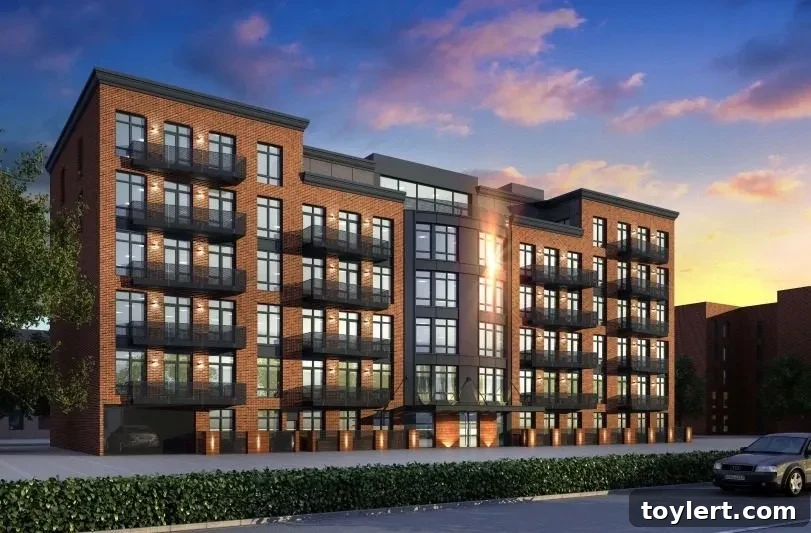
With Durukan Design at the helm, the 785 Dekalb Avenue project embarked on a significant aesthetic transformation. The firm’s objective was clear: to craft a design that, while contemporary, would seamlessly integrate into the architectural context of Bed Stuy. The new renderings provided by Durukan Design showcased a departure from the “space-age” original, leaning instead towards a more refined and understated modernism that pays homage to its surroundings.
Key to this redesign was a careful consideration of materials, massing, and fenestration. It is expected that the new approach involved replacing jarring, futuristic elements with more classic, durable materials such as brick, stone, or high-quality paneling that echo the textures and hues prevalent in the neighborhood. The aim was to reduce the visual impact of the building’s scale, breaking down its mass through thoughtful articulation and varied setbacks, ensuring it doesn’t overpower its neighbors.
Refined Facade and Strategic Integration
The revised facade for 785 Dekalb Avenue likely features a more conventional window pattern, possibly incorporating larger, more inviting windows that enhance natural light within the apartments while maintaining a cohesive street-level presence. Balconies or Juliet balconies could also be introduced, not only adding amenity value for residents but also breaking the monotony of a flat surface and contributing to a more residential feel. The overall architectural language now speaks to a desire for timeless elegance rather than fleeting trends, prioritizing integration over isolation.
The Intriguing Atrium: A Central Design Element
One particularly interesting detail highlighted in the new plans is the inclusion of an atrium. This feature, often employed to bring natural light deep into the core of a building and create a sense of openness, suggests a thoughtful approach to interior design and resident experience. An atrium can serve multiple functions: it can act as a communal gathering space, a natural ventilation shaft, or simply a dramatic architectural element that enhances the building’s aesthetic from within. For 785 Dekalb Avenue, an atrium could symbolize an inward focus on community and quality of life, contrasting with the previous outward-facing, assertive design. It offers a promise of light, air, and shared space, contributing to a more pleasant and sustainable living environment for future residents.
SSJ Development’s Strategic Pivot and Long-Term Vision
For SSJ Development, the decision to overhaul the design was a pragmatic one, demonstrating an understanding that successful real estate projects are not just about construction, but about community relationships and market acceptance. While an initial design might reflect a developer’s artistic vision, the ultimate success of a project in a dense urban environment often hinges on its ability to integrate socially and aesthetically. Investing in a redesign, though costly, can yield significant returns in terms of public goodwill, faster lease-ups, and long-term property value.
This pivot reflects a broader understanding within the development industry that a project’s success is intertwined with its social license to operate. By listening to feedback and collaborating with design firms like Durukan Design, developers can mitigate risks, avoid protracted battles with community groups, and ultimately deliver a product that is both economically viable and socially responsible.
The Evolving Landscape of Bed Stuy: A Case Study in Thoughtful Development
The transformation of 785 Dekalb Avenue serves as an important case study for the evolving landscape of Bed Stuy and other similar neighborhoods in flux. As areas like Bed Stuy continue to experience rapid growth and development, the interplay between new construction and existing urban fabric becomes increasingly critical. Projects that prioritize community input and architectural sensitivity are more likely to be embraced, contributing positively to the neighborhood’s character and quality of life.
This revised approach to 785 Dekalb Avenue offers a blueprint for future developments, emphasizing the value of contextual design, community engagement, and architectural diplomacy. It underscores the idea that urban renewal doesn’t have to erase the past but can instead build upon it, creating a vibrant future that respects the unique identity of its historical surroundings. The finished building, with its refined aesthetic and inviting atrium, is poised to become a testament to what can be achieved when innovation meets genuine community collaboration in the heart of Brooklyn.
In conclusion, the journey of 785 Dekalb Avenue from a contentious “space-age” concept to a thoughtfully redesigned apartment building illustrates the profound impact of public opinion on urban architecture. Through the collaborative efforts of SSJ Development and Durukan Design, informed by the community’s voice, the project now promises to be a harmonious addition to Bed Stuy, embodying a new standard for responsible and responsive urban development in Brooklyn.