St. Paul’s Episcopal Church: A Beacon of Gothic Architecture and Troy’s Enduring Legacy
Nestled in the heart of Troy, New York, St. Paul’s Episcopal Church stands as a magnificent testament to early American architectural ambition and spiritual dedication. For over two centuries, this venerable institution has anchored a vibrant community, its striking Gothic Revival design drawing eyes and inspiring awe. More than just a place of worship, St. Paul’s embodies a rich tapestry of history, connecting the bustling industrial city of Troy with the broader narrative of American architectural innovation and religious development.
In the nascent years of the 1890s, the rector of St. Paul’s Episcopal Church, the Reverend Dr. Edgar Enos, faced a daunting challenge. His beloved church was perilously close to structural failure, threatening its very existence. Dr. Enos had recently returned from an extensive European tour, a journey that immersed him in the grandeur of the continent’s monumental medieval Gothic cathedrals. His travels through France, England, Germany, and Italy filled him with inspiration and a renewed vision for his own parish. This period marked a critical juncture for St. Paul’s, prompting a re-evaluation of its structural integrity and future aesthetic direction, even as it celebrated a long and distinguished heritage in Troy.
The Genesis of Faith: Establishing Episcopalian Roots in Troy
The story of St. Paul’s Episcopal Church begins much earlier, rooted in the foundational years of Troy itself. Episcopalians in this bustling city on the Hudson River first gathered for worship as early as 1795, a mere decade after the city’s formal establishment. These early services laid the groundwork for a burgeoning spiritual community, reflecting the growing prosperity and population of Troy during the late 18th century. By 1804, the dedicated parish was formally established, marking a significant milestone in its development. The congregation’s initial brick church was subsequently constructed a block away from the present-day site, serving as its spiritual home for over two decades. This original structure, while humble by later standards, was crucial in solidifying the Episcopalian presence in Troy and fostering a sense of community among its parishioners.
The parish’s growth and vision soon outstripped the capacity and aspirations of its first building. By 1826, the ambitious decision was made to embark on the construction of a grander church edifice, the very one that continues to grace the Troy skyline today. This new undertaking was not merely an expansion; it was a deliberate architectural statement, intended to reflect the rising prominence of both the parish and the city. The choice of architectural style and the specific design inspiration for this new St. Paul’s would prove profoundly significant, setting a precedent for Gothic architecture in the United States.
An Architectural Blueprint: The Influence of Trinity Church, New Haven
The design of St. Paul’s Episcopal Church was no accident; it was a meticulously planned replication, drawing its profound inspiration from Trinity Church in New Haven, Connecticut. This connection is vital to understanding St. Paul’s place in American architectural history. Trinity Church, strategically situated on the picturesque town green of New Haven, commenced its construction in 1813 and was consecrated in 1816. What makes Trinity truly revolutionary is its distinction as the very first true Gothic-style church in the United States. This predates the more widely recognized English Gothic Revival period by a remarkable twenty years, positioning Trinity as a pioneering beacon of a style that would later sweep the nation.
Trinity’s groundbreaking design was the brainchild of Ithiel Town, a figure of immense importance in early American architecture. Town was one of the nation’s first professional architects, known for his innovative spirit and keen understanding of structural principles. When the committee in Troy sought to build their new Episcopal church, they recognized the unparalleled beauty and symbolic power of Trinity’s design. They formally requested permission from Ithiel Town to copy his masterful plans. While Town himself may not have been directly on-site in Troy to oversee every detail of St. Paul’s construction, the striking similarities between the two churches leave architectural historians and experts confident that he indeed provided Troy with his original plans. This direct lineage not only speaks to Town’s generosity and influence but also to the profound impact of his work on religious architecture across the young American nation.
Ithiel Town: A Visionary Architect’s Enduring Legacy
Ithiel Town’s contribution to American architecture extends far beyond Trinity Church and its replications like St. Paul’s. Born in Thompson, Connecticut, in 1784, Town was a self-taught architect who rose to national prominence through his innovative designs and engineering prowess. He was particularly celebrated for his “Town Lattice Truss” bridge design, an ingenious solution that allowed for the construction of long, sturdy wooden bridges across rivers, revolutionizing transportation infrastructure in the early 19th century. His architectural career, however, was equally impactful.
Town played a pivotal role in establishing the architectural profession in the United States. He was a prolific designer, responsible for numerous significant public and private buildings across the East Coast. His understanding of classical forms, combined with his pioneering embrace of Gothic elements, showcased a versatility that was rare for his time. His work on Trinity Church in New Haven was groundbreaking, demonstrating how European architectural styles could be adapted and reinterpreted for an American context. The fact that the Troy committee explicitly sought his plans for St. Paul’s underscores his reputation and the widespread admiration for his aesthetic vision. His later return to Troy to co-design the Cannon Building, another one of the city’s most historically and architecturally important structures, further cements his enduring connection to and influence on the cityscape of Troy, solidifying his legacy as a true architectural titan of the early American republic.
St. Paul’s in the Embrace of Gothic Revival: A Movement Defined
While St. Paul’s in Troy, like its progenitor Trinity in New Haven, predated the full explosion of the English Gothic Revival in the United States, its design was unequivocally a harbinger of the movement. The Gothic Revival, which gained immense popularity in America from the 1830s through the 1880s, was far more than just a stylistic choice; it was a philosophical and spiritual reclamation. Architects and patrons were drawn to the perceived moral purity, spiritual elevation, and historical grandeur of medieval Gothic cathedrals, often in stark contrast to the perceived coldness and secularism of Neoclassical architecture.
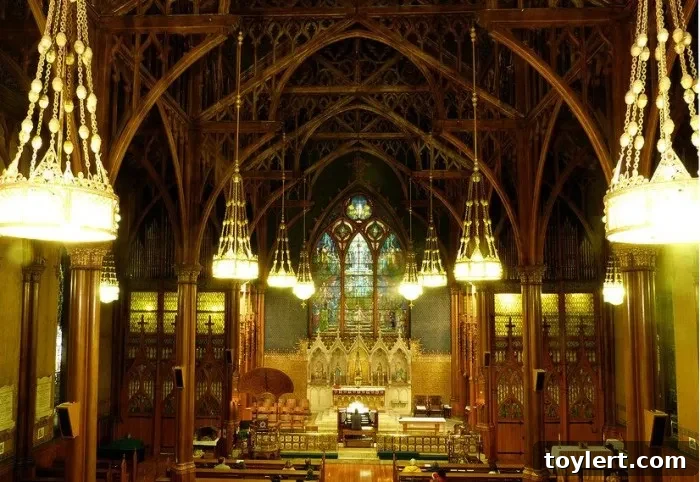
Key features of this style, evident in St. Paul’s, include pointed arches, ribbed vaults, buttresses, and an emphasis on verticality, all designed to draw the eye and the spirit skyward. The use of stained glass, intricate carvings, and an overall sense of dramatic scale contributed to creating an atmosphere of reverence and awe. For Episcopalians, in particular, the Gothic style resonated deeply with their liturgical traditions and their connection to the Church of England, which had its roots in medieval European Christianity. St. Paul’s, with its thoughtful replication of Trinity’s early Gothic form, stood as an early and prominent example of how American congregations sought to connect with a timeless spiritual aesthetic, ensuring that the visual experience of worship was as profound as the sermon itself. This architectural choice wasn’t just about beauty; it was about identity, history, and a spiritual yearning for transcendence that shaped the ecclesiastical landscape of the young nation.
Rev. Dr. Enos and the Church’s Evolution: Preserving a Legacy
The structural predicament faced by Rev. Dr. Edgar Enos in the 1890s highlights a common challenge for historic buildings: the relentless march of time and the need for continuous preservation. The “danger of caving in” could have stemmed from various factors: foundational issues, aging timber, inadequate original construction techniques, or even stresses from subsequent alterations. Dr. Enos’s tour of Europe, filled with the inspiration of centuries-old Gothic cathedrals, undoubtedly instilled in him a deep desire not only to preserve St. Paul’s but also, perhaps, to enhance its spiritual and architectural grandeur, drawing on lessons from the masters of the past.
This period often saw significant renovations and expansions in American churches. While the specific details of St. Paul’s 1890s challenges and subsequent rectifications are part of its unique narrative, it’s plausible that Dr. Enos spearheaded efforts to not only shore up the church’s structure but also to introduce elements of the High Victorian Gothic style, popular at the time, or to reinforce the existing early Gothic elements with modern (for the era) techniques. Such interventions would have ensured the church’s survival and its continued ability to serve its growing congregation. These adaptations, while preserving the original intent, often add layers to a building’s history, reflecting different eras of faith, architectural trends, and community needs.
St. Paul’s Today: A Pillar of Troy’s Community and Heritage
Today, St. Paul’s Episcopal Church remains a vibrant and essential part of Troy’s historical and spiritual landscape. It is not merely a museum piece but a living, breathing house of worship that continues to serve its community with regular services, outreach programs, and cultural events. Its iconic silhouette contributes significantly to the visual character of downtown Troy, a city renowned for its rich architectural heritage and commitment to preservation. Recognized as a significant landmark, St. Paul’s stands as a physical link to the ambitions and artistic visions of America’s past, particularly the groundbreaking work of Ithiel Town and the early adoption of Gothic Revival aesthetics.
The church has endured numerous challenges throughout its long history, from structural concerns in the 1890s to the ebb and flow of urban development and societal change. Each challenge overcome has only deepened its roots and strengthened its story. Its enduring presence serves as a reminder of the resilience of faith, the power of architectural ingenuity, and the importance of preserving historical treasures for future generations. St. Paul’s Episcopal Church is more than just a building; it is a repository of memories, a beacon of hope, and a lasting symbol of Troy’s unique contribution to American history and architecture, inviting all who pass by to admire its beauty and reflect on its profound legacy.