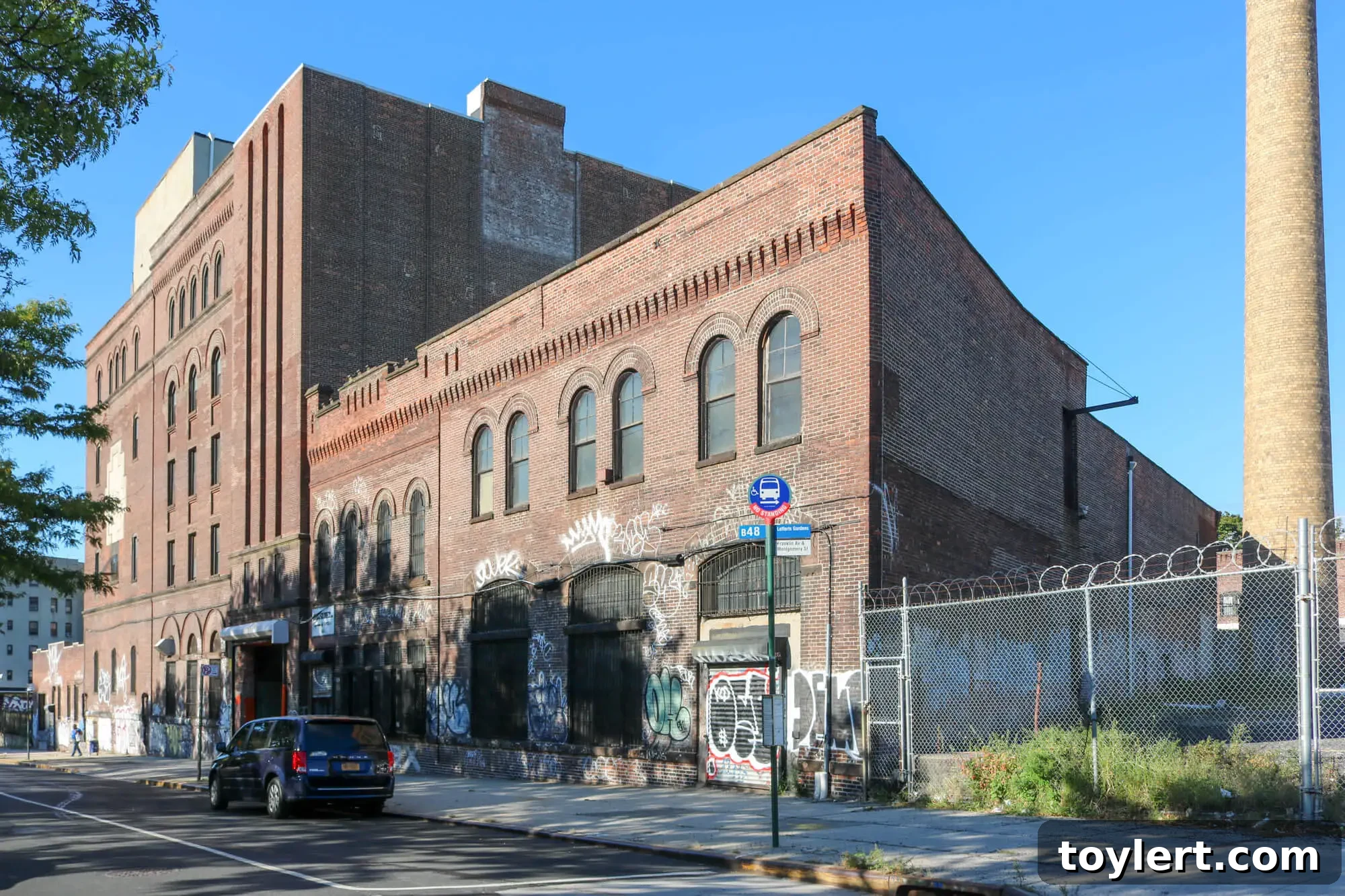
Crown Heights Residents Unanimously Oppose Franklin Avenue Redevelopment Plan
A palpable sense of unity, even if born from discontent, filled the Crown Gardens Community Room on a recent Tuesday evening. Residents of Crown Heights, gathering for Community Board 9’s Uniform Land Use Review Procedure (ULURP) Committee meeting, expressed their collective and unmistakable opposition to the proposed redevelopment of a historically significant site: the old spice factory at 960 Franklin Avenue. This pivotal property, once the renowned Consumer’s Park Brewery, is now at the heart of a contentious rezoning application that could dramatically reshape south Crown Heights.
The developer behind the ambitious project is seeking a rezoning of the site under the city’s Mandatory Inclusionary Housing (MIH) Program. While proponents argue that MIH is a vital tool for creating much-needed affordable housing, the community views the proposed development at 960 Franklin Avenue with deep skepticism, fearing it will exacerbate existing issues of gentrification, strain local infrastructure, and erode the unique character of their vibrant neighborhood.
The Contested Heart of South Crown Heights: 960 Franklin Avenue’s Legacy
The property at 960 Franklin Avenue carries a rich and storied past, distinguishing it from many other development sites in Brooklyn. Before its tenure as a spice factory, it stood as the grand Consumer’s Park Brewery. Established in the late 19th century, the brewery was a significant industrial landmark, reflecting Brooklyn’s robust manufacturing history. It was not merely a building but an economic engine, providing employment and contributing to the local identity for decades. Imagine the bustling activity, the delivery wagons, the aroma of malt – a stark contrast to the quiet industrial shell it became in more recent times. While the brewery ceased operations long ago, and its structures have undergone transformations, the echoes of its industrious past resonate deeply within the community.
Located in south Crown Heights, the site sits in a neighborhood grappling with immense development pressure. Crown Heights is renowned for its beautiful brownstones, diverse community, and cultural vibrancy. However, its attractive qualities have also made it a prime target for developers seeking to capitalize on its proximity to Manhattan and its relatively lower property values compared to neighboring areas. This dynamic has created a continuous tension between preserving neighborhood charm and accommodating urban growth, with 960 Franklin Avenue becoming a focal point in this ongoing debate.
Unpacking the Proposed Development and Mandatory Inclusionary Housing
The developer’s proposal for 960 Franklin Avenue is ambitious. While specific architectural details are still subject to revision and approval, the plan generally calls for the demolition of the existing structures to make way for a significant residential complex, likely comprising multiple high-rise towers. These towers are envisioned to house hundreds of new residential units, potentially including retail or commercial space at the ground level, transforming the current industrial footprint into a dense, mixed-use environment.
Understanding Mandatory Inclusionary Housing (MIH)
Central to the developer’s strategy is the application for rezoning under the Mandatory Inclusionary Housing (MIH) program. Introduced as a cornerstone of the city’s housing policy, MIH aims to ensure that when a developer receives a zoning change that allows for increased density or height, a portion of the newly created housing units must be permanently affordable. This program typically requires 25% to 30% of residential units to be designated as affordable for households earning a certain percentage of the Area Median Income (AMI).
From the developer’s perspective, MIH provides a pathway to unlock greater development potential. By agreeing to include affordable housing, they can gain the necessary zoning changes to build taller, denser projects that might otherwise be prohibited. The argument is that this program helps address New York City’s severe housing shortage by creating both market-rate and affordable units, thereby contributing to a more equitable and diverse urban landscape. Developers often frame these projects as a crucial step towards modernizing underutilized industrial sites and contributing to the city’s economic vitality.
Community Voices: A Chorus of Concerns and Displeasure
Despite the developer’s arguments and the stated goals of MIH, residents at the Community Board 9 meeting voiced nearly unanimous opposition. Their concerns are multifaceted and deeply rooted in the lived experiences of Crown Heights locals. The community’s displeasure extends far beyond mere resistance to change; it encompasses a complex web of anxieties about their neighborhood’s future.
Threats to Neighborhood Character and Affordability
A primary fear is the acceleration of gentrification and displacement. Residents expressed worries that the influx of hundreds of new, primarily market-rate units would inevitably drive up property values and rents in the surrounding area, making it increasingly difficult for long-time residents to remain in their homes. While MIH guarantees a percentage of affordable units, many residents argue that the income thresholds for these units are often still too high for existing low- and middle-income families, effectively failing to serve the very population most vulnerable to displacement.
Moreover, the sheer scale of the proposed development is seen as incompatible with the existing architectural fabric and human scale of Crown Heights. Tall towers, many fear, would loom over historic brownstones, casting shadows and irrevocably altering the aesthetic and communal feel of the neighborhood.
Infrastructure Strain: A Growing Burden
Another significant concern revolved around the already strained local infrastructure. Crown Heights is a densely populated area, and residents highlighted existing challenges that would only be exacerbated by a massive influx of new inhabitants:
- Transportation: The existing subway lines (2, 3, 4, 5 trains) are often overcrowded during peak hours. Hundreds of new residents would place an unbearable additional burden on an already struggling transit system.
- Schools: Local public schools are operating at or beyond capacity. An increase in school-aged children without corresponding educational infrastructure development would lead to larger class sizes and diminished resources.
- Parks and Green Spaces: Access to green space is crucial for urban well-being. Crown Heights residents expressed concern that the existing parks, already heavily utilized, would become even more congested, with no plans for expanding recreational areas to match the population growth.
- Sanitation and Emergency Services: Increased population density inevitably puts more pressure on sanitation services, waste management, and vital emergency services like fire and police departments, potentially leading to slower response times and diminished service quality.
The ULURP Process and Community Empowerment
The Community Board 9 ULURP Committee meeting serves as a critical, albeit advisory, step in New York City’s land use review process. Under ULURP, proposals like the 960 Franklin Avenue rezoning are reviewed by Community Boards, the Borough President, the City Planning Commission, and ultimately, the City Council. While Community Boards’ votes are not binding, they carry significant weight as they represent the immediate interests and concerns of the affected local population.
Residents at the meeting urged their Community Board to issue a strong recommendation against the rezoning, emphasizing the need for development that is truly community-driven and equitable, rather than solely developer-driven. They called for a more comprehensive approach to urban planning that considers the holistic impact on existing communities, including the preservation of historic sites and the provision of genuinely affordable housing tailored to local needs.
The Road Ahead: Balancing Growth and Preservation in Brooklyn
The debate surrounding 960 Franklin Avenue encapsulates a broader struggle playing out across rapidly developing neighborhoods in Brooklyn and beyond. It highlights the inherent tension between the city’s need to accommodate a growing population and provide housing, and the deep-seated desire of long-term residents to protect their communities from what they perceive as unsustainable and harmful development.
The future of the former spice factory and Consumer’s Park Brewery at 960 Franklin Avenue remains uncertain. The developer will continue to navigate the ULURP process, facing scrutiny at each stage. However, the unanimous displeasure voiced by Crown Heights residents at the Community Board 9 meeting sends a clear and unequivocal message: the community is organized, vocal, and determined to have a meaningful say in the shaping of their future. This battle over a single parcel of land is more than just a zoning dispute; it is a testament to the power of community activism in the face of relentless urban change, and a crucial test for how New York City balances growth with the preservation of its diverse neighborhoods.
The outcome of this rezoning application will undoubtedly set a precedent for future development projects in Crown Heights and other similar communities across New York City. It will demonstrate whether the voices of established residents can effectively influence land use decisions or if developer interests, even those tied to mandatory affordable housing initiatives, will ultimately prevail despite significant local opposition.