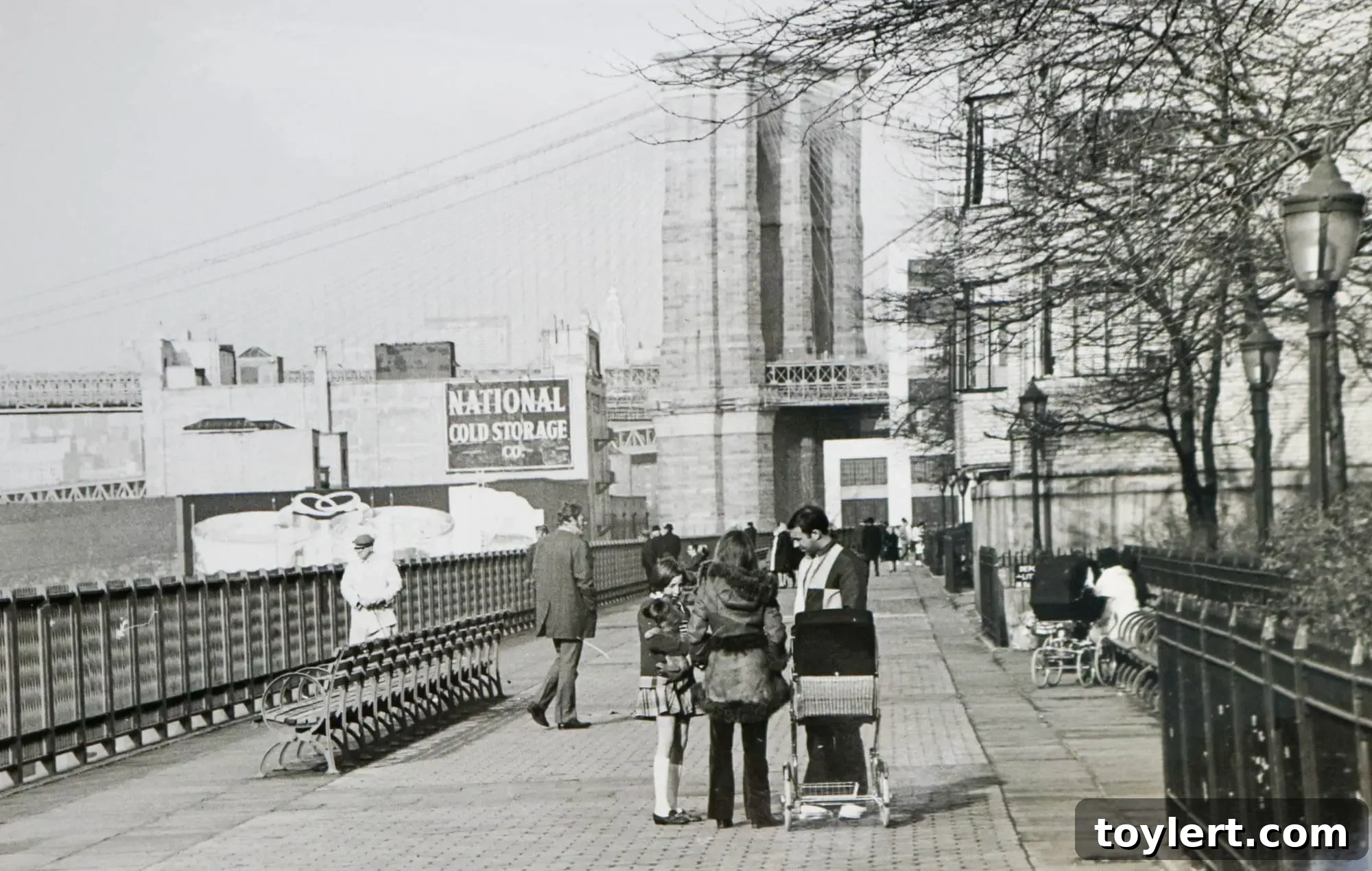
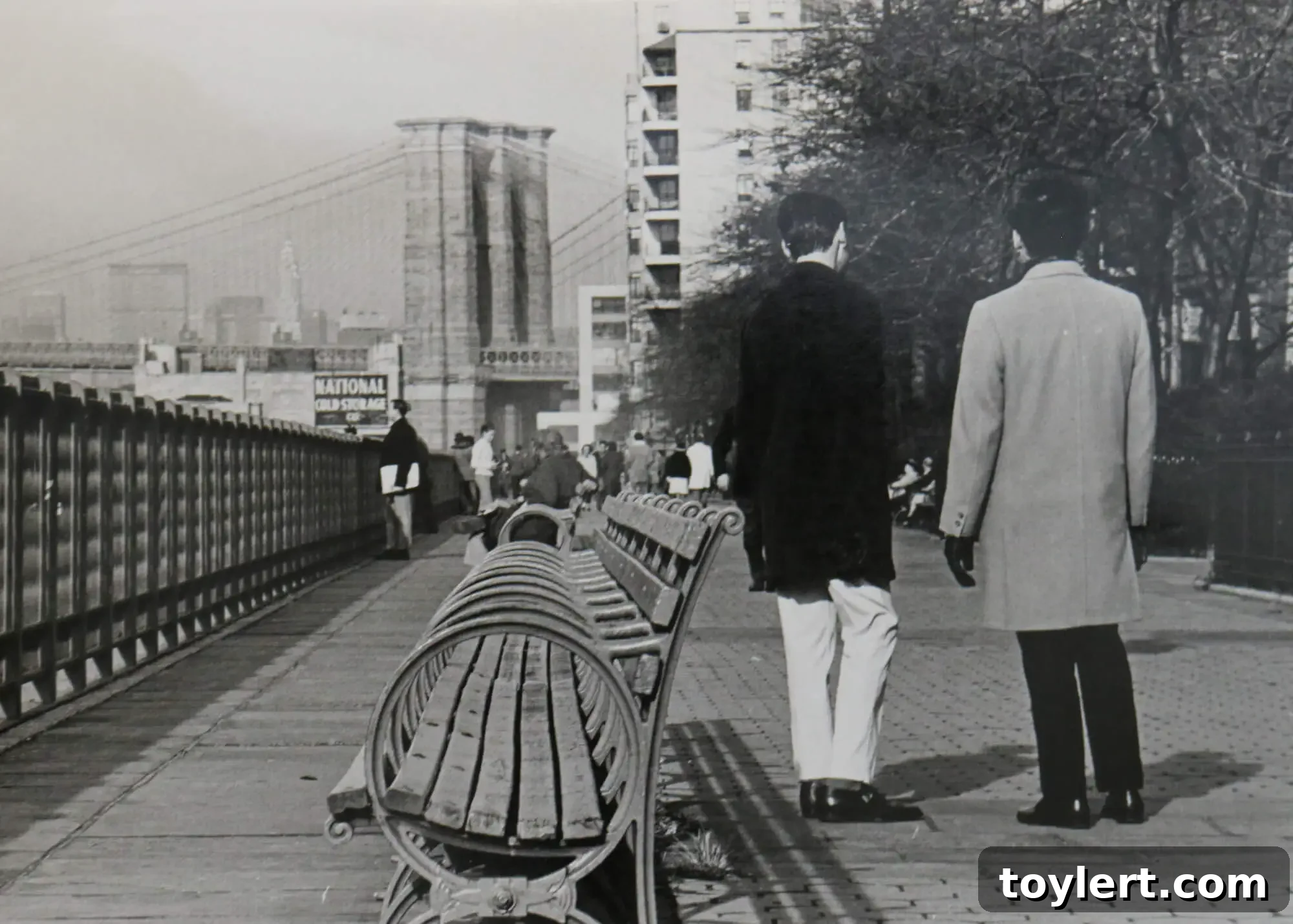
Step back in time to an era of classic charm and breathtaking vistas, vividly captured in a collection of vintage photographs. These remarkable images transport us to the Brooklyn Heights Promenade in the early 1970s, offering a captivating glimpse into the daily lives of Brooklynites and discerning tourists alike. Sourced from the esteemed photo morgue of the Brooklyn Reporter and dated circa 1971, these evocative snaps immortalize a period when the promenade, though still relatively young, had already cemented its status as a cherished cornerstone of the borough’s identity. They capture casual moments of people strolling, pausing, and simply soaking in the magnificent panoramic views, with the iconic Brooklyn Bridge serving as a majestic and ever-present backdrop.
The Brooklyn Heights Promenade, an architectural marvel and a beloved public space, invites contemplation and appreciation for urban beauty. These historical images are more than just pictures; they are windows into the past, revealing the fashion, attitudes, and serene atmosphere that characterized Brooklyn over five decades ago. They remind us that while times change, the allure of a stunning waterfront view and a vibrant community gathering place remains timeless. For anyone interested in the rich tapestry of New York City’s history, these photographs provide an invaluable connection to a bygone era.
The Brooklyn Heights Promenade: A Historic Jewel
When these vintage photos were taken around 1971, the Brooklyn Heights Promenade had only been in existence for approximately two decades. Opened officially with a dedication ceremony on October 7, 1950, this spectacular urban overlook quickly transformed into one of Brooklyn’s most iconic features. Its unique design and unparalleled views of the Manhattan skyline, the Statue of Liberty, and the harbor made it an instant favorite for residents seeking tranquility and tourists eager for quintessential New York City panoramas. The promenade’s significance extends beyond its aesthetic appeal; it represents a triumph of community activism and thoughtful urban planning, a story worth delving into.
From Threat to Triumph: The Genesis of the Promenade
The creation of the Brooklyn Heights Promenade is inextricably linked to one of New York City’s most ambitious and controversial infrastructure projects of the mid-20th century: the Brooklyn-Queens Expressway (BQE). Spearheaded by the powerful and often autocratic urban planner Robert Moses, the BQE was conceived to facilitate vehicular traffic flow across the boroughs. Initial plans for the expressway threatened to carve a destructive path directly through the historic, brownstone-lined streets of Brooklyn Heights, potentially demolishing numerous architecturally significant buildings and disrupting the fabric of a tightly-knit community.
Robert Moses and the Expressway Plan
Robert Moses envisioned a robust network of highways crisscrossing New York City, prioritizing automobile travel above almost all other considerations. His initial proposals for the BQE through Brooklyn Heights called for an elevated highway that would have irrevocably altered the neighborhood’s character, effectively severing it from its waterfront and destroying its serene residential charm. The prospect of such a massive, noisy, and visually intrusive structure sparked immediate and fierce opposition from the residents of Brooklyn Heights, who were fiercely protective of their historic district.
A Community Rises: The Fight for Brooklyn Heights
The residents of Brooklyn Heights, renowned for their civic engagement and determination, mounted a formidable campaign to save their neighborhood. Community leaders, local organizations, and individual citizens rallied together, leveraging their collective voice to challenge Moses’ plans. They advocated for an alternative solution that would accommodate the necessary infrastructure while preserving the unique historical and aesthetic value of their beloved district. This period of intense activism became a landmark case in urban planning, showcasing the power of organized community resistance against large-scale, top-down development.
The Elegant Compromise: Birth of the Cantilevered Promenade
The sustained efforts of the Brooklyn Heights community ultimately led to a groundbreaking compromise. Instead of an elevated highway directly through the neighborhood, a revolutionary design was adopted: a triple-decker, cantilevered structure that would elegantly stack the BQE lanes beneath a new, elevated public space. This ingenious solution, championed by community groups, allowed the expressway to pass through without devastating the historic streets above. Construction of this complex overlook and the underneath cantilevered section of the BQE commenced in 1946 and was completed in 1950. The upper deck of this innovative structure was dedicated to the public as the Brooklyn Heights Promenade, transforming a potential environmental and aesthetic disaster into a celebrated urban amenity.
An Enduring Panorama: The Brooklyn Bridge and Manhattan Skyline
The enduring appeal of the Brooklyn Heights Promenade lies undeniably in its breathtaking panoramic views. From this elevated vantage point, visitors are treated to an unobstructed spectacle of the Manhattan skyline, stretching from Lower Manhattan’s iconic Financial District to the midtown towers, all shimmering across the East River. Dominating the foreground is the magnificent Brooklyn Bridge, a marvel of 19th-century engineering and an enduring symbol of New York City. Its majestic cables and Gothic arches frame the busy waterways, where ferries and barges navigate, adding a dynamic layer to the serene vista.
The view also encompasses Governors Island, the Statue of Liberty in the distance, and the vibrant activity of New York Harbor. It’s a scene that has inspired countless artists, photographers, and poets, offering a uniquely profound perspective on one of the world’s greatest cities. The 1970s photographs perfectly capture this timeless beauty, reminding us that while the skyline has evolved, the fundamental majesty of the vista from the Brooklyn Heights Promenade remains undiminished.
Vintage Charms: Life on the Promenade in the 1970s
The circa-1971 images provide a charming snapshot of life on the Promenade during an era of significant social and cultural transition. One can observe the distinct fashion of the time – flared trousers, wide collars, and more relaxed hairstyles – reflecting the shifting trends of the early 1970s. The atmosphere depicted is one of leisurely enjoyment, a stark contrast to the bustling energy often associated with other parts of New York City. People are seen strolling at a relaxed pace, some seated on benches, reading or simply gazing out at the water, lost in thought. Children might be playing, while couples hold hands, reinforcing the Promenade’s role as a communal backyard for the Brooklyn Heights neighborhood.
The relative youth of the Promenade at the time means its trees and plantings might have been less mature than they are today, yet its foundational design and purpose were already fully realized. These photographs offer a poignant reminder of how public spaces serve as vital arteries within urban environments, facilitating connection, relaxation, and a shared appreciation for natural and man-made beauty. They show a simple, unhurried side of city life, a valuable historical record for generations to come.
The Promenade’s Lasting Legacy
Today, the Brooklyn Heights Promenade continues to be an integral part of Brooklyn’s identity and a cherished destination for millions. It stands as a testament to effective community advocacy and innovative urban design. More than just a pathway, it functions as an open-air museum, a tranquil park, and an unparalleled observatory, drawing both local families and international visitors. Its enduring popularity underscores its vital role in urban life, proving that even amidst the relentless pace of a major city, spaces for quiet contemplation and appreciation of beauty are not only desired but essential.
The Promenade has adapted over the decades, witnessing countless sunrises and sunsets, seasonal changes, and the ebb and flow of city life. Its well-maintained paths, lush greenery, and comfortable benches invite respite, offering a constant backdrop for daily routines and special moments alike. It embodies a successful integration of infrastructure and public amenity, a model for urban planning that prioritizes human experience alongside functional necessity.
The vintage photographs from the Brooklyn Reporter’s morgue are invaluable treasures, preserving the initial decades of this magnificent Brooklyn landmark. They serve as a powerful reminder of the Promenade’s storied past, its origins rooted in a community’s fight for preservation, and its evolution into the beloved, iconic feature it remains today. As we look at these images, we not only see Brooklyn in 1971 but also gain a deeper appreciation for the enduring legacy of the Brooklyn Heights Promenade, a timeless jewel overlooking one of the world’s most dynamic skylines.