The Vanishing Legacy: A Historic Clinton Hill Mansion Makes Way for Modern Living
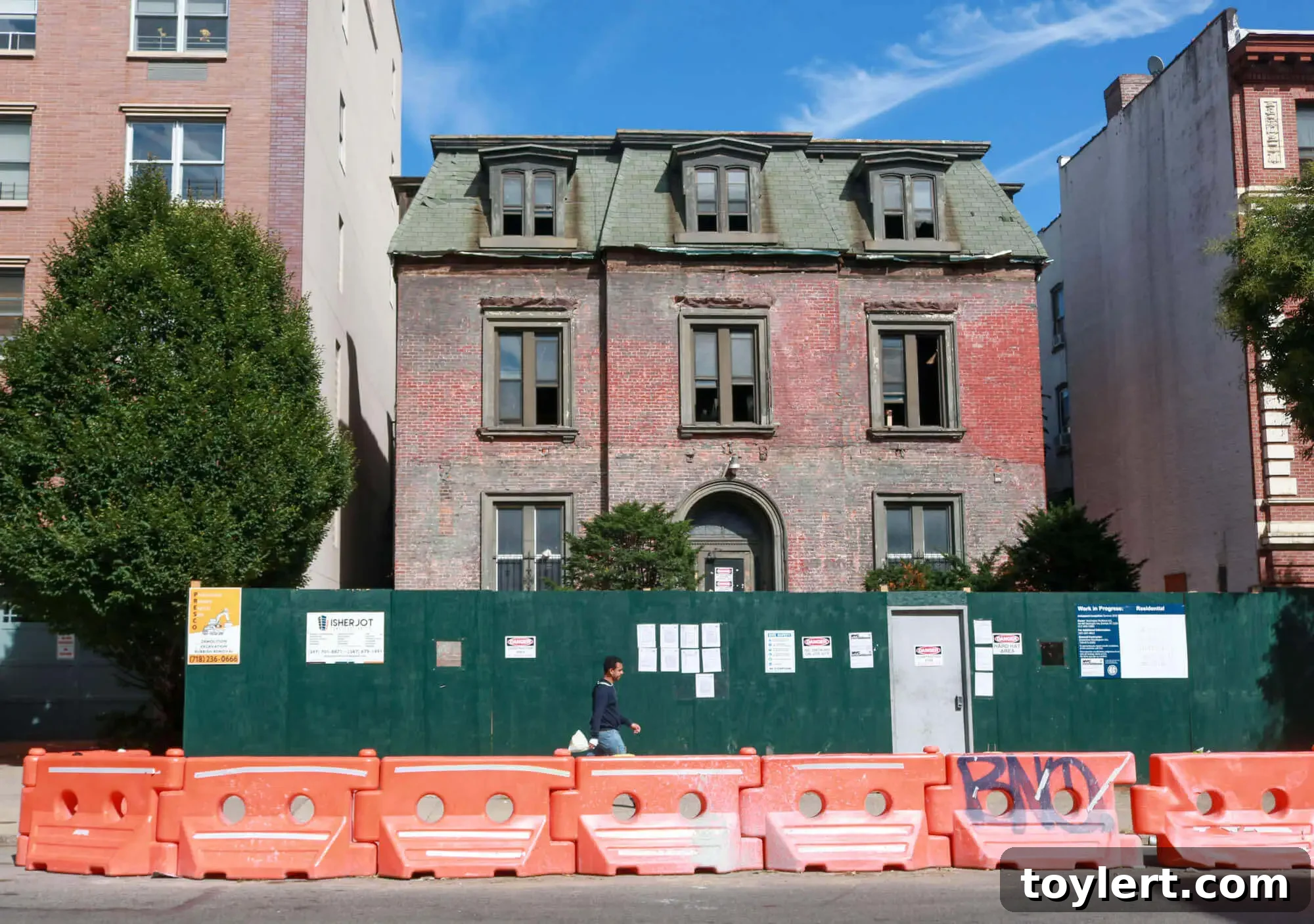
Clinton Hill, Brooklyn, a neighborhood celebrated for its tree-lined streets and architectural splendor, is witnessing a significant transformation. At the heart of this evolving landscape, a landmark stands poised for erasure: the stately Second Empire mansion at 489 Washington Avenue. Once a proud testament to a bygone era and a poignant gathering spot for Civil War veterans, this historic edifice is currently undergoing demolition, its intricate details and storied past crumbling to make way for a new apartment complex. The sight of workers systematically dismantling its upper floors, gutting its interiors, and puncturing its roof and walls signals the end of an era, highlighting the persistent tension between preserving urban history and accommodating contemporary growth.
An Architectural Gem: The Second Empire Style in Brooklyn
The mansion at 489 Washington Avenue was more than just a large house; it was a prime example of Second Empire architecture, a style that swept across France during the reign of Emperor Napoleon III and subsequently found favor in the United States, particularly in the post-Civil War boom. Characterized by its distinctive mansard roof, often punctuated with dormer windows, this architectural trend exuded grandeur and opulence. Features typically included ornate cornices, decorative ironwork, classical columns, and elaborate window detailing. These homes were designed to impress, signaling the wealth and status of their owners during an era of significant industrial and economic expansion.
In Brooklyn, particularly in neighborhoods like Clinton Hill, Fort Greene, and Park Slope, Second Empire homes added a unique European flair to the urban fabric. They stood apart from the more common Italianate or Neo-Grec brownstones, with their taller profiles and more complex rooflines. The mansion at 489 Washington Avenue, freestanding and prominent, likely boasted an array of these features, from its robust stone facade to its elaborate entryways, serving as a silent sentinel to the neighborhood’s rich history. Its demolition marks not just the loss of a building, but the diminishing presence of a specific architectural period that once defined parts of Brooklyn’s elite residential areas.
A Civil War Legacy: More Than Just a Residence
Beyond its architectural significance, the mansion held a deeply resonant historical role: it served as a gathering place for Civil War veterans. While the exact nature of its function – whether a permanent residence, a meeting hall, or a temporary shelter – remains a subject for further historical inquiry, its association with those who fought in America’s most defining conflict imbues it with profound meaning. During the decades following the Civil War (1861-1865), communities across the nation grappled with the task of honoring and supporting returning soldiers. Organizations like the Grand Army of the Republic (GAR) emerged, providing camaraderie, assistance, and a political voice for Union veterans. It is conceivable that 489 Washington Avenue was a hub for such activities, a place where veterans could share their experiences, seek aid, and maintain a vital connection with one another.
For Clinton Hill, a neighborhood that flourished in the post-war industrial boom, the presence of such a veterans’ spot would have been a significant civic asset. It would have served as a tangible link to a pivotal moment in American history, reminding residents of the sacrifices made for national unity. The mansion, therefore, wasn’t merely a private dwelling; it was a public space of memory and community, a site where the echoes of a defining struggle reverberated. Its removal severs a direct, physical connection to this vital chapter in American and Brooklyn history, leaving a void that no new structure, however modern, can truly fill.
The “Curious Survivor”: A Lasting Anomaly
The description of 489 Washington Avenue as a “curious survivor” speaks volumes about its unique status within the rapidly developing urban landscape of Brooklyn. For decades, it managed to evade the fate of many other historic structures, standing as an anomaly amidst a sea of brownstones and later, modern constructions. Its freestanding nature, perhaps a testament to a larger original lot or an earlier period of development, allowed it to maintain a distinct presence. In a borough where space is at a premium and every square foot holds immense value, such a large, intact, and relatively untouched historic property becomes increasingly rare.
Its survival until now could be attributed to various factors: perhaps a long-term owner committed to its preservation, a lack of immediate development pressure in a specific micro-area, or simply the complexities involved in acquiring and redeveloping such a site. Regardless of the reasons, its continued existence offered a rare glimpse into Brooklyn’s opulent past, a stark contrast to the continuous march of modernization. The very fact that it stood for so long, defying the pressures that claimed similar buildings, only intensifies the sense of loss accompanying its final demise. It was a tangible link to a different scale of urban living, a reminder of a time when grand estates occupied more generous plots of land.
The Inevitable March of Development: Replacing History with Housing
The demolition of 489 Washington Avenue is not an isolated incident but rather a microcosm of larger trends sweeping across Brooklyn. The borough has experienced an unprecedented real estate boom in recent decades, driven by a surging population, escalating demand for housing, and a desire for urban living. Clinton Hill, with its attractive architecture, proximity to Manhattan, and vibrant cultural scene, has become an increasingly desirable location, leading to intense development pressure.
The decision to replace the historic mansion with an apartment building reflects the prevailing economic realities. Developers often find it more financially viable to erect new, multi-unit residential structures that can house more people and generate higher returns, compared to the potentially costly and complex process of restoring and maintaining a single, aging historic property. While new housing is undeniably needed to address Brooklyn’s housing crisis, the question inevitably arises: at what cost to the borough’s irreplaceable historical fabric?
The transformation of 489 Washington Avenue into apartments will undoubtedly provide new homes, contributing to the city’s housing stock. However, it also signifies a permanent alteration to the character of Washington Avenue and Clinton Hill. New buildings, even when designed with sensitivity to their surroundings, often struggle to replicate the intricate craftsmanship, the unique materials, and the inherent patina of age that define truly historic structures. The loss of the mansion means not just the loss of bricks and mortar, but the loss of a unique architectural expression and a tangible piece of local history.
Preservation vs. Progress: A Perennial Urban Dilemma
The demolition of the Clinton Hill mansion encapsulates a perennial dilemma faced by rapidly growing urban centers: how to balance the imperative of progress and development with the vital need for historical preservation. On one hand, cities must evolve to accommodate new populations and economic demands. This often necessitates new construction, modern infrastructure, and sometimes, the replacement of older structures. Without such development, cities risk stagnation and an inability to meet the needs of their residents.
On the other hand, historic buildings and neighborhoods are not merely old structures; they are repositories of collective memory, cultural identity, and architectural excellence. They provide a sense of place, continuity, and an irreplaceable connection to the past. Losing these assets can erode a city’s unique character, transforming diverse, historically rich areas into generic landscapes dominated by new, often uniform, constructions. For many residents, the aesthetic and historical value of buildings like 489 Washington Avenue far outweighs the benefits of additional housing units on that specific site.
The case of 489 Washington Avenue serves as a stark reminder of the ongoing debate. Was there an alternative? Could the mansion have been adaptively reused, perhaps converted into apartments or commercial spaces while retaining its exterior and historical integrity? Such solutions, while often more challenging and expensive, represent a middle ground that seeks to honor the past while serving present needs. The path chosen for 489 Washington Avenue, however, signals a prioritization of new construction over the preservation of a distinct historical landmark.
Clinton Hill’s Evolving Identity: A Neighborhood in Transition
Clinton Hill itself has long been a neighborhood defined by its rich history and architectural heritage. From the grand mansions built by industrialist Charles Pratt and his family to the charming brownstones that line its residential streets, the area has always boasted a distinctive character. However, like many other parts of Brooklyn, Clinton Hill has been undergoing significant demographic and economic shifts. Property values have soared, attracting new residents and stimulating a wave of redevelopment.
While this revitalization has brought new businesses, amenities, and investment to the area, it has also placed immense pressure on its historic fabric. The demolition of the Second Empire mansion at 489 Washington Avenue is a highly visible manifestation of these changes. It underscores the ongoing challenge for Clinton Hill to maintain its unique identity and charm amidst the relentless forces of urban development. As new buildings rise, they will inevitably alter the streetscapes and vistas that have long defined this beloved Brooklyn neighborhood, sparking conversations among residents about the future they envision for their community.
A Moment of Reflection
As the final vestiges of the historic mansion at 489 Washington Avenue disappear, making way for its modern successor, it leaves behind not just an empty lot, but a potent symbol. It represents the accelerating pace of change in Brooklyn, the ever-present tension between the old and the new, and the complex choices cities face in shaping their future. The loss of this particular “curious survivor,” with its architectural grandeur and its poignant connection to Civil War veterans, is a moment for reflection on what is gained and what is irretrievably lost in the relentless march of urban progress.