Calvert Vaux and the Genesis of Prospect Park: Brooklyn’s Green Jewel (Part 3)
This is Part 3 of our series exploring the architectural genius of Calvert Vaux and his profound impact on Brooklyn’s landscape. You can catch up on the previous installments here: Part 1, Part 2. Stay tuned for Part 4.
The mid-19th century marked an era of unprecedented urban growth across America, and New York City’s burgeoning borough of Brooklyn was no exception. As its population swelled with immigrants and industry flourished, the need for public green spaces became increasingly evident, not merely for recreation, but as vital elements for public health, social cohesion, and civic pride. It was against this backdrop that the ambitious vision for what would become Prospect Park began to take shape, cementing Brooklyn’s status as a forward-thinking urban center.
Brooklyn’s Quest for a Grand Urban Oasis
By 1859, Brooklyn was rapidly transforming from a collection of quaint villages into a bustling metropolis. The city’s streets were becoming denser, its air often thick with the smoke of burgeoning factories, and its residents, particularly those without private gardens, yearned for respite. Public health advocates championed the idea of large parks as “the lungs of the city,” believing they could purify the air, provide healthful exercise, and offer moral uplift for the working classes. This burgeoning demand for a grand public space mirrored the civic ambitions of a city eager to establish its own identity, distinct yet equal to its illustrious neighbor across the East River, Manhattan.
Recognizing this critical need, the New York State Legislature took decisive action. In 1859, a specialized commission was formally established, tasked with the momentous responsibility of identifying suitable locations for expansive public parks within the fast-growing city of Brooklyn. This was not a minor undertaking; it was a strategic investment in the future well-being and aesthetic appeal of one of America’s most dynamic urban centers, signaling a profound commitment to quality of life for its citizens.
The Guiding Hand: James S. T. Stranahan and the Park Commission
At the helm of this newly formed Brooklyn Board of Park Commissioners was a figure whose name would become synonymous with Prospect Park’s very existence: James S. T. Stranahan. A wealthy and influential Brooklyn businessman, Stranahan was a visionary who understood the transformative power of public works. He was a prominent civic leader with a deep commitment to Brooklyn’s development, and his passionate advocacy was instrumental in moving the park project forward. Under his presidency, the commission embarked on a meticulous search, driven by the desire to create a park that would not only serve as a recreational haven but also stand as a monument to Brooklyn’s progress and cultural sophistication.
Stranahan’s relentless dedication, political acumen, and ability to galvanize support often earned him the honorific “Father of Prospect Park,” a testament to his pivotal role in bringing this urban masterpiece to life. His leadership was crucial in navigating the political complexities, securing necessary funding, and fostering public enthusiasm for a project of such unprecedented scale. Stranahan’s vision extended beyond mere aesthetics; he believed in the social and economic benefits a grand park would confer upon the entire borough, making it a more desirable place to live, work, and thrive.
Beyond Washington Park: The Central Park Inspiration
Brooklyn already had Washington Park, located in Fort Greene. This earlier park, now known as Fort Greene Park, held historical significance and provided a green space for its surrounding community. However, its scale and design were simply not enough to satisfy the broader ambitions of a rapidly expanding city. What Brooklyn truly desired was something on par with Central Park, Manhattan’s recently completed monumental greensward. Central Park, designed by the brilliant duo Frederick Law Olmsted and Calvert Vaux, had revolutionized urban planning.
Its vast, meticulously planned landscapes offered a picturesque escape from the city grid, blending natural beauty with recreational and cultural amenities. It was a testament to the power of thoughtful design to shape public experience and enhance urban living. The success and public adoration of Central Park created an irresistible precedent. Brooklyn’s leaders, including Stranahan and the commission, observed Central Park’s immense popularity and recognized its profound impact on Manhattan’s prestige and property values. They aspired to replicate this success, envisioning their own grand park as a similar source of pride, health, and beauty for Brooklynites. The commission wasn’t just looking for “a park”; they were seeking an “enormous greensward,” a monumental landscape that would define Brooklyn for generations to come.
The Exhaustive Search for the Ideal Location
The task of finding the perfect site was monumental and fraught with challenges. The commission diligently investigated no less than six different locations across Brooklyn, each presenting its own unique set of advantages and challenges. Their criteria were stringent: the site needed to be large enough to accommodate the ambitious vision, possess varied topography suitable for picturesque landscaping, be relatively accessible to a growing population, and ideally, not be excessively developed, to minimize the cost of land acquisition and demolition. They scoured maps, walked undeveloped tracts, and debated the merits of each potential parcel with great care.
After extensive deliberation, a particular site captured their attention and enthusiasm. It was a sprawling area south of Flatbush Avenue, encompassing varied terrain – from rolling hills formed by ancient glacial moraines to low-lying meadows and natural woodlands. This chosen location possessed an inherent natural beauty and a topographical diversity that promised endless possibilities for design. Unlike some other proposed sites that were flat and featureless, or already densely built up, this area offered a canvas ripe for transformation by the hands of skilled landscape architects. The commission, convinced by its natural potential, strategic position, and the ability to integrate diverse features, believed they had indeed found just the place for Brooklyn’s grand park.
Laying the Groundwork for a Masterpiece
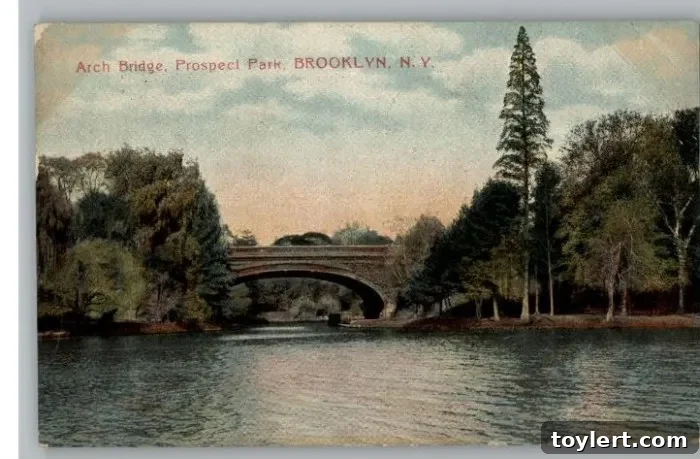
The selection of the site was a pivotal moment, but it was just the beginning of a multi-year endeavor. The next crucial step would be to translate this raw potential into a living masterpiece. This is where the collaborative genius of Frederick Law Olmsted and Calvert Vaux would become indispensable. While Olmsted brought his unparalleled vision for landscape planning and social commentary, Vaux, a trained architect, offered the structural and aesthetic finesse that would imbue the park with its iconic architectural elements, bridges, and buildings – including structures like the majestic Arch Bridge pictured above, which elegantly frames views within the park’s carefully crafted scenery.
The initial years of the commission were spent not only on site selection but also on navigating the complex political landscape, securing funding, and beginning the arduous process of land acquisition. This phase, often overlooked in the grand narrative, was critical in establishing the legal and financial foundations upon which Prospect Park would eventually rise. It required considerable negotiation, public persuasion, and a steadfast belief in the long-term benefits such a park would bring to the borough. The dream of Prospect Park was firmly planted in the soil of Brooklyn’s ambition, nurtured by the foresight of its leaders and the burgeoning needs of its people.
A Legacy Forged in Green
The commitment shown by figures like James S. T. Stranahan and the tireless work of the Brooklyn Board of Park Commissioners laid the indelible groundwork for one of America’s most beloved urban parks. Their decision to pursue a large-scale, thoughtfully designed green space was a testament to progressive urban planning and a deep understanding of human needs. Prospect Park, from its very conception, was destined to be more than just a patch of green; it was envisioned as a democratic landscape, a place where all citizens, regardless of wealth or social standing, could find beauty, recreation, and a profound connection to nature. This early vision, culminating in the selection of its magnificent site, set the stage for the design brilliance of Calvert Vaux and Frederick Law Olmsted, ensuring that Brooklyn would indeed possess its own unparalleled green jewel for generations to come.