Barclays Center’s Grand Opening Amidst Waves of Protest: A Battle Over Brooklyn’s Future
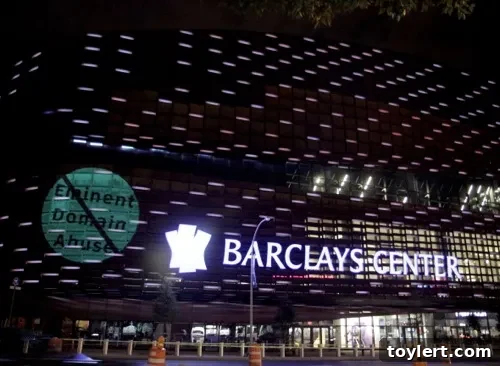
The highly anticipated opening of the Barclays Center in Brooklyn, home to the relocated NBA team, the Brooklyn Nets, was not merely a celebration of sports and entertainment but also a focal point for intense community activism. As the iconic arena prepared to host its inaugural event, a star-studded Jay-Z concert, a coalition of activist groups, spearheaded by the Occupy movement, launched a series of formidable protests. Their core grievances revolved around accusations of “eminent domain abuse” and “crony capitalism” that plagued the multi-billion dollar Atlantic Yards development, of which the Barclays Center is the centerpiece.
These protests, characterized by their creativity and unwavering resolve, brought to light a long-standing battle between powerful developers and displaced residents, highlighting the profound social and economic costs of large-scale urban development projects. The controversy surrounding Barclays Center’s construction has resonated deeply within Brooklyn, stirring debates about public land use, corporate influence, and the true meaning of community progress.
The Genesis of Controversy: Atlantic Yards and its Discontents
The Atlantic Yards project, rebranded as Pacific Park Brooklyn, was conceived as a massive mixed-use development comprising residential towers, commercial spaces, and a sports arena. Spearheaded by developer Bruce Ratner and his company, Forest City Ratner, the project promised economic revitalization, thousands of jobs, and much-needed affordable housing for Brooklyn. However, these promises came with a heavy price and ignited fierce opposition from the moment of their announcement.
Eminent Domain: A Contentious Tool for Public Good?
One of the most contentious aspects of the Atlantic Yards project was the use of eminent domain. This legal principle allows the government to seize private property for public use, even if the owner does not wish to sell, provided “just compensation” is paid. Critics argued vehemently that the application of eminent domain for the Atlantic Yards project constituted an abuse of power. They contended that seizing homes and businesses to facilitate a privately-owned sports arena and commercial development did not truly serve a “public use” but rather private profit. Many long-time residents and small business owners were forcibly displaced, their communities shattered, and their lives uprooted, often feeling that the compensation offered was inadequate and failed to account for the emotional and social impact of their loss.
Crony Capitalism: Accusations of Unfair Advantage
Alongside eminent domain abuse, protestors decried “crony capitalism,” alleging that the project benefited from undue political favoritism and substantial public subsidies. Activists pointed to significant tax breaks, low-cost loans, and other financial incentives provided to Forest City Ratner, arguing that these public funds were diverted from essential community services to line the pockets of powerful developers. The term “crony capitalism” was used to symbolize a system where political connections and influence, rather than fair competition, dictated the allocation of resources and opportunities, ultimately at the expense of ordinary citizens.
The project’s lengthy gestation period was marked by numerous lawsuits filed by community groups such as Develop Don’t Destroy Brooklyn, challenging the environmental review, zoning changes, and the legality of the eminent domain proceedings. While many of these legal challenges ultimately failed, they effectively delayed the project and brought national attention to the contentious issues at play, fueling a persistent and vocal opposition movement.
A Symphony of Protests: Amplifying Community Voices
The week leading up to the Barclays Center’s grand opening was a crescendo of organized resistance, demonstrating the enduring power of grassroots activism. The Occupy movement, known for its focus on economic inequality and corporate accountability, found a powerful local platform in the Barclays controversy.
The Illuminator’s Visual Dissent
Central to the protests was The Illuminator, an Occupy-affiliated group renowned for its impactful projection art. On the eve of the opening, The Illuminator transformed the gleaming facade of the Barclays Center into a canvas for dissent, projecting powerful messages such as “eminent domain abuse” and “crony capitalism.” This creative form of protest, which had previously been utilized to support workers’ rights (as seen in Kensington with “Justice for Felix” for Golden Farm grocery workers), visually underscored the activists’ core message, making the building itself a billboard for their grievances.
Weekend of Action: Diverse Tactics, United Message
The planned weekend of protests was a multi-faceted demonstration designed to maximize visibility and impact during the highly publicized opening. The schedule included:
- Candlelight Vigil: On the opening night, a solemn candlelight vigil circled the perimeter of the arena twice, a poignant symbol of remembrance for displaced residents and lost communities.
- Occupy Guitarmy: Following the vigil, the Occupy Guitarmy led participants in protest songs, marking the official start of the weekend-long “occupation” and injecting a spirited, musical element into the demonstrations.
- Press Conference with Local Residents: On Friday morning, local residents directly impacted by the Atlantic Yards project held a press conference. Their testimonies offered powerful, personal accounts of displacement, community disruption, and the broken promises of the development, putting a human face on the abstract concepts of eminent domain and crony capitalism.
- Afternoon Performances: From noon to 4 pm on Friday, the area around the arena hosted a series of performances, featuring artists like the Reverend Billy and the Tax Dodgers. These artistic expressions served as another avenue for critique and solidarity.
- “Battle for Brooklyn” Screening: Friday evening culminated in a free outdoor screening of “Battle for Brooklyn,” a documentary film that chronicled the years-long struggle against the Atlantic Yards project from the perspective of the affected community members. This cinematic event provided crucial historical context to the ongoing protests.
- FUREE’s March for Justice: On Saturday afternoon, Families United for Racial and Economic Equality (FUREE) led a permitted march. Their call for “housing, jobs, and justice” resonated deeply with the project’s unfulfilled promises, winding through downtown development sites before concluding at the arena. This march underscored the continuing fight for equitable development and social justice within Brooklyn.
Media Spotlight: Diverse Perspectives on a Pivotal Opening
The opening of the Barclays Center, coupled with the intense protests, naturally attracted significant media attention, each outlet offering a unique lens on the unfolding events:
- The New York Times featured a lengthy front-page article, delving into the role of developer Bruce Ratner, the complex history of the project, and the enduring controversies surrounding it. This comprehensive piece provided historical context to the protests.
- The Wall Street Journal noted the philanthropic gesture of Brooklyn Nets owner Mikhail Prokhorov and his sister, who donated $1 million to the nearby Brooklyn Academy of Music. This mention highlighted the cultural ties and potential community investments associated with the arena, even amidst the protests.
- Other prominent outlets like the New York Post (“Barclays Blast-off”) and the NY Daily News (“Barclays Set to Dazzle”) focused more on the spectacle and excitement of the arena’s debut, often contrasting with the activist narratives.
- Blogs like the Atlantic Yards Report provided in-depth, critical analysis, such as articles questioning the stability of an Atlantic Yards supporter (“Atlantic Yards Supporter BUILD on Shaky Ground”) and highlighting the volume of lawsuits filed by critics (“Critics Filed ‘200 Lawsuits'”). These independent voices were crucial in providing an alternative, often more critical, perspective than mainstream media.
The Broader Impact and Unanswered Questions
The opening of the Barclays Center and the surrounding protests encapsulate a larger narrative about urban development in America. While the arena brought a professional sports team back to Brooklyn and served as a catalyst for further development, it did so at a significant cost, both social and financial. The promised affordable housing units, for instance, were delivered years behind schedule and in far fewer numbers than initially touted, leaving many to question the ultimate beneficiaries of such large-scale projects.
The enduring legacy of the Atlantic Yards project, therefore, remains complex. It represents a modern architectural marvel and a vibrant entertainment hub, yet it also stands as a potent symbol of unresolved conflicts over community rights, economic justice, and the ethics of urban planning. The protests during its opening week were not just about a building; they were about the very soul of Brooklyn and the fundamental questions of who benefits from progress, and at whose expense.
The fight for “housing, jobs and justice” continues to resonate within the community, long after the initial opening fanfare faded. The lessons learned from the Atlantic Yards saga continue to inform debates about future development across New York City and beyond, serving as a powerful reminder of the importance of community voice in shaping the urban landscape.