Controversial Changes Ahead: South Slope’s 20th Street Truck Route Reroute
A significant development is stirring discussions and debates within the vibrant South Slope community of Brooklyn. Years of persistent advocacy by residents of 20th Street are finally culminating in a concrete proposal from the New York City Department of Transportation (DOT). This proposal, based on an extensive study, aims to fundamentally alter the flow of heavy vehicle traffic through the neighborhood, with wide-ranging implications for safety, noise, pollution, and overall quality of life. The upcoming community unveiling of these plans marks a pivotal moment for all stakeholders involved, promising a lively discourse with strong opinions on both sides.
For years, 20th Street in South Slope has borne the brunt of a high volume of truck traffic, serving as a critical but often overburdened artery for commercial vehicles navigating the borough. Residents have consistently raised concerns about the detrimental effects of this continuous stream of heavy trucks, citing issues ranging from excessive noise and air pollution to safety hazards for pedestrians and cyclists. The wear and tear on residential streets, coupled with the constant vibrations, has also been a persistent source of frustration, prompting calls for reevaluation and relief. These collective grievances have fueled a sustained lobbying effort targeting both Community Board 7 (CB7) and the DOT, demanding a comprehensive review of the existing truck route and the exploration of viable alternatives.
The Genesis of Change: DOT’s Comprehensive Study
Responding to years of community pressure, the Department of Transportation initiated a thorough study into the traffic patterns and environmental impacts along 20th Street and its surrounding areas. Such studies are standard practice in urban planning, designed to collect data on vehicle counts, types of vehicles, speed, noise levels, air quality, and existing infrastructure capacity. The DOT’s objective is to analyze traffic flow, identify bottlenecks, assess safety risks, and ultimately devise solutions that balance the needs of commercial transport with the imperative of residential quality of life. The findings from this detailed analysis are now set to be presented to the community, offering a data-driven basis for the proposed changes.
Unveiling the Proposal: A Community Meeting on May 30th
The DOT will officially unveil its study and proposed modifications to Community Board 7 and the broader public on May 30th. This meeting is anticipated to be a highly attended event, drawing residents, local business owners, advocacy groups, and city officials. Community Board meetings serve as crucial forums for public engagement, allowing residents to hear directly from city agencies, ask questions, and voice their opinions. The atmosphere is expected to be charged, as any proposal involving significant traffic rerouting in a dense urban environment inherently generates both support from those who stand to benefit and opposition from those who foresee potential negative impacts.
Key Elements of the Proposed Rerouting Plan
The core of the DOT’s proposal revolves around several interconnected changes designed to alleviate the burden on 20th Street while optimizing overall traffic flow in the area. Understanding these elements is crucial for grasping the potential ramifications for the South Slope community and beyond.
1. Rerouting Trucks to 7th Avenue: A Dual-Edged Sword
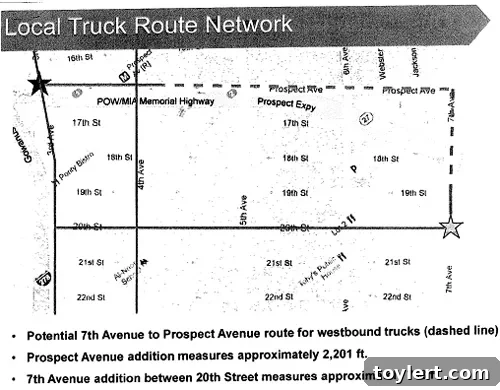
Perhaps the most significant and potentially controversial aspect of the proposal is the redirection of truck traffic from 20th Street onto 7th Avenue. This move, while offering respite to 20th Street residents, raises immediate concerns for those along 7th Avenue. This bustling thoroughfare is home to several schools, residential buildings, and a diverse array of local businesses. The prospect of increased truck volume on 7th Avenue brings with it fears of heightened noise, air pollution, and, critically, increased safety risks for schoolchildren and pedestrians. Moreover, 7th Avenue serves as a primary access point for the on/off ramps of the Prospect Expressway, especially for trucks needing to head west towards the Gowanus Expressway via Prospect Avenue. The addition of substantial truck traffic in this already busy interchange could exacerbate congestion and create new navigational challenges for drivers and potential hazards for local traffic trying to merge or exit.
Proponents of the 7th Avenue reroute argue that, as a wider arterial road, 7th Avenue is better equipped to handle heavy vehicles than the narrower, more residential 20th Street. They might also point to the fact that major roadways are often designed with more robust infrastructure to withstand the wear and tear associated with heavy vehicle traffic. However, balancing this functional efficiency with the protection of residential tranquility and pedestrian safety, particularly in areas surrounding schools, remains a significant challenge that will undoubtedly be at the forefront of community discussions.
2. Change of Direction on 21st Street
Another component of the plan involves a proposed change of direction on 21st Street. While specific details about the new orientation (e.g., becoming one-way east or west) are yet to be fully elucidated, such changes are typically implemented to improve local traffic flow, reduce confusion, and enhance safety at intersections. This modification could serve to complement the rerouting of trucks by creating a more logical and less congested network for local vehicular movement, potentially reducing cut-through traffic on other side streets.
3. 20th Street Becomes One-Way Eastbound
To further transform 20th Street from a truck conduit into a more resident-friendly corridor, the DOT proposes making it a one-way eastbound street. This conversion aims to significantly reduce the volume and speed of traffic, especially heavy trucks, that currently traverses the street in both directions. A one-way designation can simplify traffic patterns, improve safety for residents and pedestrians, and potentially open up opportunities for traffic calming measures or even green infrastructure. For residents of 20th Street, this change represents a substantial improvement in their daily lives, promising a quieter, safer, and cleaner environment after years of advocacy.
Community Reactions: Pros, Cons, and Complexities
The forthcoming changes have understandably generated a spectrum of reactions across the South Slope community. On one hand, residents of 20th Street are likely to welcome the proposals with immense relief. The promise of reduced truck traffic, noise, and pollution on their street represents a long-awaited victory for their sustained efforts. They envision a significant improvement in their quality of life, with safer streets for children and a more peaceful residential atmosphere.
Conversely, property owners and residents along 7th Avenue, particularly those living near schools or the Prospect Expressway ramps, are expressing considerable apprehension. Their concerns are multifaceted: the potential for increased noise and exhaust fumes, compromised air quality, and, most importantly, the elevated risk of accidents involving children due to heavier truck presence. Local businesses on 7th Avenue might also worry about potential disruption to customer access or deliveries, although the long-term impact could vary. Parents whose children attend schools on 7th Avenue are particularly vocal about pedestrian safety, urging the DOT to implement robust mitigating measures if the reroute proceeds.
Community Board 7 plays a critical role in this process, acting as a liaison between the city agency and the residents. Its function is not only to listen to the DOT’s plans but also to gather public feedback, deliberate on the merits and drawbacks, and ultimately issue recommendations that reflect the community’s consensus, or highlight areas of significant disagreement. The board’s decision-making process is a vital part of New York City’s urban planning and public engagement framework.
The Broader Context of Urban Traffic Management
The challenges faced by the South Slope community are emblematic of larger urban planning dilemmas in densely populated cities like New York. Balancing the necessity of efficient commercial logistics with the imperative of creating livable, safe, and healthy residential neighborhoods is an ongoing tightrope walk. Truck routes are essential for delivering goods, supporting businesses, and fueling the city’s economy. However, when these routes intersect directly with residential areas, schools, and parks, conflicts inevitably arise. The DOT’s role is to seek innovative solutions that minimize these conflicts, often requiring trade-offs and careful consideration of all affected parties.
This case highlights the importance of data-driven decision-making, community input, and adaptive urban design. Solutions rarely satisfy everyone, but the goal is to achieve the greatest good for the greatest number while mitigating negative impacts on vulnerable populations and areas. The 20th Street proposal is a testament to the power of community advocacy and the city’s commitment to addressing local concerns through comprehensive studies and public discourse.
Next Steps and Future Implications
Following the May 30th community meeting, the DOT will consider all feedback received from Community Board 7 and the public. Based on this input, the proposal may undergo further modifications before a final plan is approved and implemented. The implementation phase itself would involve detailed engineering, signage changes, and public awareness campaigns to ensure a smooth transition for both drivers and residents. The long-term success of these changes will depend on continuous monitoring and potential adjustments based on real-world outcomes.
Residents of South Slope are strongly encouraged to attend the upcoming meeting on May 30th to gain a full understanding of the proposed changes and to contribute their perspectives to this crucial discussion. Community participation is paramount in shaping the future of local transportation and urban development.
20th Street Study-2