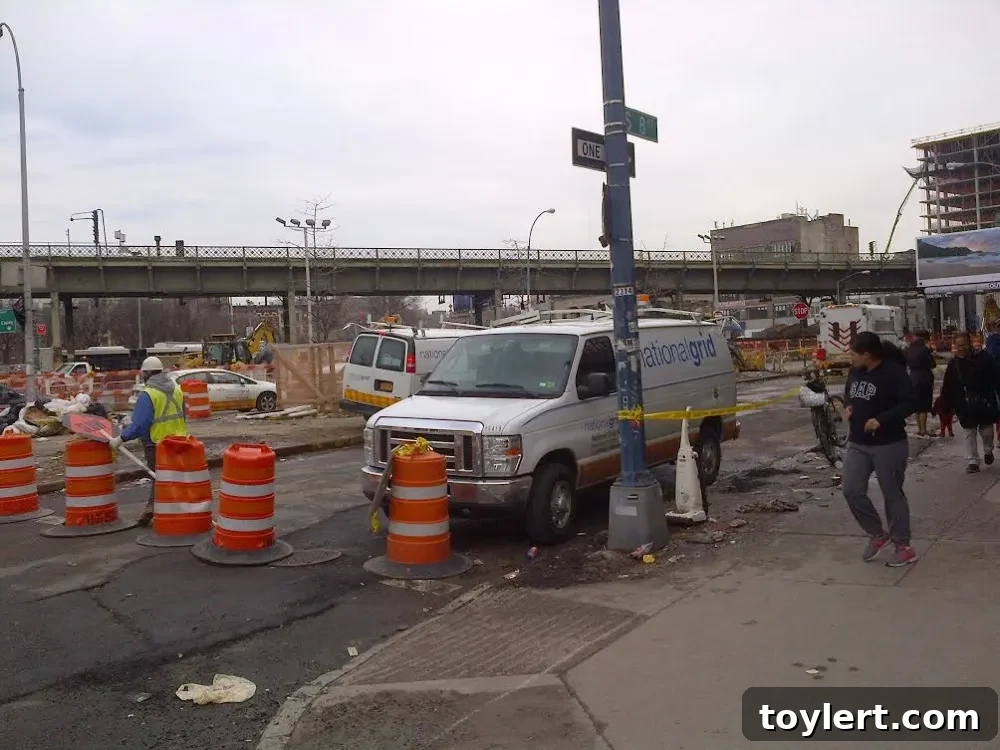
Emergency Response: Gas Main Break Forces Evacuation in Williamsburg, Brooklyn
A significant incident unfolded in the heart of Williamsburg, Brooklyn, this morning as city workers accidentally struck and broke a gas main. The rupture, located on Broadway between Roebling Street and Havemeyer Street, triggered an immediate and critical response, leading to the full evacuation of the affected block. This unforeseen event quickly transformed a bustling morning into a scene of emergency management, highlighting the intricate challenges of urban infrastructure and the paramount importance of public safety.
The incident, first reported by a Brownstoner reader working within the evacuated zone, caused widespread disruption. Eyewitness accounts and photographic evidence revealed a rapidly deployed perimeter, with the entire block sealed off to traffic and pedestrians. The immediate blocking of access points led to substantial traffic congestion, affecting commuters and local businesses throughout the vibrant Williamsburg neighborhood.
The Incident Unfolds: A Sudden Infrastructure Challenge
The gas main break occurred during routine city work, an unfortunate yet not uncommon occurrence in densely populated urban areas where a complex web of underground utilities lies beneath busy streets. While details regarding the exact nature of the work being conducted were not immediately available, the accidental striking of the gas line quickly escalated into a serious hazard. Natural gas, while essential for heating and cooking, poses significant risks when it leaks, primarily due to its flammability and potential for explosion, as well as the danger of asphyxiation in confined spaces.
Upon detection of the leak, emergency protocols were activated without delay. The rapid response by local authorities and utility companies was crucial in mitigating the potential for a catastrophic event. Residents and workers within the immediate vicinity were instructed to evacuate, a measure taken to ensure their safety from the invisible but potent threat posed by escaping gas.
Immediate Aftermath: Evacuation and Traffic Chaos in Williamsburg
The decision to evacuate an entire block is never taken lightly and underscores the severity of the situation. Emergency services, including the Fire Department of New York (FDNY), the New York City Police Department (NYPD), and representatives from Con Edison (the utility provider for gas in the area), converged on Broadway. Their coordinated efforts focused on securing the perimeter, ensuring the safe exit of all individuals from the danger zone, and establishing a command center to manage the crisis.
The impact on traffic flow was immediate and far-reaching. Broadway, a major thoroughfare in Williamsburg, became impassable in the affected section. This led to significant diversions, with vehicles rerouted onto smaller, already busy side streets, exacerbating congestion across the neighborhood. Commuters relying on public transportation, particularly bus routes that traverse Broadway, experienced delays and rerouted services, adding to the morning’s disruptions. The ripple effect extended beyond vehicle traffic, affecting pedestrian movement and access to local businesses.
Emergency Protocol: Responding to a Hazardous Situation
Responding to a gas main break is a multi-faceted operation demanding precision and speed. The first priority for emergency responders is always public safety. This involves:
- Securing the Area: Establishing a safe perimeter to prevent unauthorized access and protect the public from potential hazards.
- Evacuation: Systematically moving people away from the immediate danger zone to a safer location.
- Leak Detection and Isolation: Using specialized equipment to pinpoint the exact location and severity of the leak, and then working to shut off the gas supply to the compromised section of the main.
- Ventilation: Monitoring gas levels in the air, including inside nearby buildings, and initiating ventilation if necessary to disperse accumulated gas.
- Repairs: Once the gas supply is shut off, utility crews move in to excavate the site, assess the damage, and begin the complex process of repairing or replacing the broken section of the pipe.
- Post-Repair Checks: After repairs are complete, the system is thoroughly tested for integrity before gas service is gradually restored and the area is declared safe.
This structured approach ensures that all potential risks are addressed methodically and efficiently.
Understanding the Risks: Why Gas Leaks Are Dangerous
The necessity for immediate and extensive emergency measures during a gas main break stems from the inherent dangers associated with natural gas. It is odorless in its pure form, but utility companies add a distinctive sulfur-like smell (mercaptan) to make leaks detectable. Despite this additive, significant leaks can still pose a substantial threat:
- Explosion Hazard: Natural gas is highly flammable. When it mixes with air in certain concentrations, even a small spark (from a light switch, cell phone, or static electricity) can trigger a powerful explosion, causing severe structural damage and injuries.
- Asphyxiation: While natural gas is not toxic, it can displace oxygen in an enclosed space. Inhalation of large amounts can lead to oxygen deprivation, causing dizziness, confusion, loss of consciousness, and potentially death.
- Health Effects: Exposure to natural gas, even without asphyxiation, can cause headaches, nausea, and fatigue.
These risks underscore why authorities act with extreme caution and prioritize evacuation when a significant gas leak is confirmed.
Impact on the Vibrant Williamsburg Community
Williamsburg is known for its dynamic mix of residential areas, thriving businesses, and cultural venues. An incident like a gas main break inevitably creates a ripple effect across this community. Local businesses, from cafes and boutiques to offices, faced unexpected closures and a loss of revenue during the evacuation period. Many rely on daily foot traffic, which was severely curtailed. For residents, temporary displacement meant inconvenience, uncertainty, and the disruption of daily routines.
However, such emergencies often bring out the resilience and cooperative spirit of a community. Neighbors may offer assistance, local organizations might provide support, and businesses, once cleared, typically work hard to resume operations quickly. The efficiency of the emergency response and the clear communication from authorities play a vital role in minimizing the long-term negative impacts on community life.
Root Causes: Preventing Future Incidents
While this particular gas main break was attributed to city workers, infrastructure damage can stem from various causes:
- Construction Accidents: As seen in this case, excavation work without proper awareness of underground utilities is a leading cause of gas line ruptures. The “Call Before You Dig” (811) service is a national initiative to prevent such incidents by requiring excavators to contact local utility companies to mark underground lines.
- Aging Infrastructure: Many urban areas, including parts of Brooklyn, have gas pipelines that are decades old. These older pipes, often made of cast iron or unprotected steel, are more susceptible to corrosion, cracks, and general wear and tear, making them prone to leaks and breaks.
- Ground Movement: Shifting soil due to heavy rains, freezing and thawing cycles, or seismic activity can put stress on underground pipes, leading to fractures.
- Third-Party Damage: Sometimes, damage can result from non-city-affiliated contractors, private property owners, or even natural forces like tree roots growing around pipes.
Understanding these root causes is essential for developing effective prevention strategies and enhancing infrastructure resilience.
Proactive Measures and Infrastructure Investment
To mitigate the risks of future gas main breaks, utility companies and city governments are continuously investing in proactive measures:
- Pipeline Replacement Programs: Con Edison, like many other utility providers, has ongoing programs to replace older, more vulnerable pipelines with modern, durable materials like plastic (polyethylene) or cathodically protected steel. This enhances safety and reduces leaks.
- Advanced Mapping and Monitoring: Utilizing GIS (Geographic Information System) technology for accurate mapping of underground utilities and employing advanced leak detection technologies, including drone-based surveys and continuous monitoring systems.
- Enhanced Training: Providing rigorous training for construction crews and city workers on safe excavation practices and the importance of identifying and avoiding underground infrastructure.
- Public Awareness Campaigns: Educating the public and contractors about the “Call Before You Dig” (811) hotline and the signs of a gas leak (smell, hissing sound, bubbling water, dying vegetation).
These investments are critical for ensuring the safe and reliable delivery of natural gas, especially in densely populated urban environments where the consequences of a breach can be severe.
Lessons Learned and Moving Forward
The gas main break on Broadway in Williamsburg serves as a potent reminder of the fragility of urban infrastructure and the continuous need for vigilance. While inconvenient and potentially hazardous, such incidents also demonstrate the effectiveness of emergency response systems and the dedication of first responders. The swift evacuation, containment, and repair efforts underscore a commitment to public safety that is paramount in any major metropolitan area.
Moving forward, the focus remains on strengthening preventative measures, accelerating infrastructure upgrades, and ensuring that communication channels are robust during emergencies. For residents and businesses in Williamsburg, today’s events were a stark reminder that preparedness and cooperation are key to navigating unexpected challenges and maintaining the safety and vitality of their beloved community.