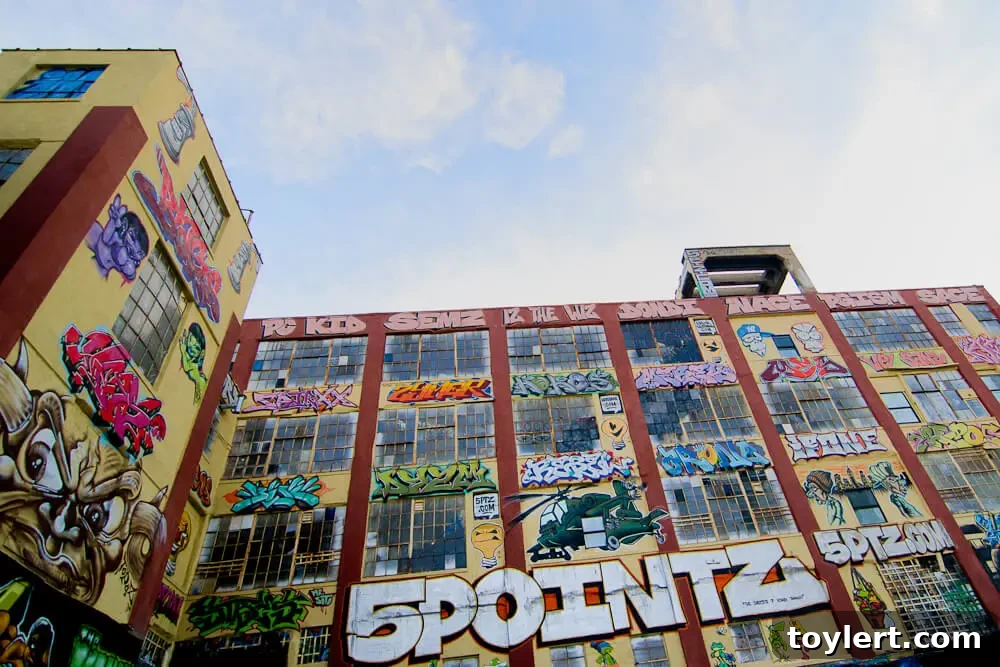
5Pointz: A Landmark Verdict Upholds Artists’ Rights and Redefines Urban Art Preservation
In a monumental decision that sent ripples through the art world and the real estate industry, a Brooklyn jury found developer Jerry Wolkoff acted illegally when he controversially whitewashed the iconic 5Pointz graffiti art mecca in Long Island City, Queens, back in 2013. After approximately three weeks of intense deliberations, the jury’s verdict delivered a significant victory to the artists whose vibrant works adorned the exterior of the former warehouse, effectively recognizing the artistic and cultural value of street art under federal law.
This landmark ruling came after years of legal battles, providing a beacon of hope for artists advocating for the protection of their creations in an ever-evolving urban landscape. The artists, who had transformed the sprawling industrial complex into an internationally renowned open-air gallery, had previously scored a crucial win in March when a Brooklyn judge ruled that they had the legal standing to sue the developers for the destruction of their work without proper advance notification—a key provision under the Visual Artists Rights Act (VARA) of 1990.
The Genesis of a Graffiti Mecca: 5Pointz’s Enduring Legacy
The story of 5Pointz began long before the legal skirmishes. Since 1993, the building located at 45-46 Davis Street in Long Island City served as an unofficial, then officially sanctioned, canvas for aerosol artists from around the globe. What started as a desolate industrial structure gradually transformed into a dynamic, living museum of contemporary street art, evolving with each stroke of paint and every passing year. Its unique status as a haven for uncensored artistic expression fostered a vibrant community and attracted tourists and art enthusiasts alike.
The site gained particular prominence in 2002, when artist Jonathan Cohen, known as Meres One, took on the role of curator and unofficial guardian. Under Meres One’s guidance, 5Pointz: The Institute of Higher Burnin’—as it was formally known—flourished, becoming a globally recognized epicenter for graffiti culture. It was more than just a collection of murals; it was a testament to the power of public art, offering a platform for thousands of artists to display their talents, hone their skills, and connect with a broad audience. The building’s walls became a rotating gallery, constantly refreshed with new pieces, offering an ephemeral yet impactful visual experience that celebrated creativity and individuality.
For two decades, 5Pointz transcended its physical form, becoming a symbol of artistic freedom, urban renewal, and cultural significance. It represented a unique symbiotic relationship between a private property owner, Jerry Wolkoff, who initially allowed and even encouraged the art, and a passionate community of artists. This arrangement fostered an environment where art could thrive, creating a distinct identity for Long Island City itself, drawing visitors from across the world and cementing its place in the annals of street art history.
The Developer’s Vision and the Artists’ Valiant Fight
The future of 5Pointz took a dramatic turn in 2013 when G&M Realty, owned by Jerry Wolkoff and his son David, announced plans to demolish the beloved art space. Their vision was to replace the iconic warehouse with two gleaming high-rise luxury apartment buildings, a common trajectory for properties in rapidly gentrifying areas like Long Island City. While urban development is an undeniable force, the abruptness and perceived disregard for the site’s cultural heritage sparked outrage among the artist community and art lovers globally.
Artists and supporters rallied, launching petitions, organizing protests, and engaging in intense advocacy campaigns to save 5Pointz. They argued that the site represented an irreplaceable cultural asset, a vibrant testament to the power of community-driven art. Their efforts aimed to secure landmark status for the building, hoping to protect it from demolition and preserve its artistic integrity. Despite their passionate pleas and widespread public support, these efforts ultimately proved unsuccessful in halting the developers’ plans for redevelopment.
The conflict reached its tragic crescendo on a chilly night in November 2013. Without any prior warning to the artists, Jerry Wolkoff ordered the entire 5Pointz complex to be whitewashed overnight. Nearly 50 vibrant pieces of graffiti art, some of which were recognized masterpieces, were obliterated under layers of white paint. This act of “pre-emptive” destruction, carried out under the cover of darkness, was widely condemned as an act of cultural vandalism. It left artists heartbroken and the public stunned, transforming the colorful façade into a stark, blank canvas, erasing years of collective artistic endeavor in a single, devastating stroke.
The Legal Battle: VARA at the Forefront of Artistic Integrity
The whitewashing ignited a fierce legal battle, pitting the artists against the powerful real estate developer. At the heart of the artists’ case was the Visual Artists Rights Act (VARA) of 1990. VARA is a federal law that grants certain “moral rights” to visual artists in the United States, allowing them to protect their works of “recognized stature” from intentional distortion, mutilation, or other modification that would be prejudicial to their honor or reputation, and in certain circumstances, to prevent any destruction of a work of “recognized stature.”
The artists, led by Meres One, contended that their works at 5Pointz clearly met the criteria for “recognized stature,” given the site’s international fame and critical acclaim. They argued that Wolkoff’s decision to paint over the artworks without adequate notice not only violated their rights under VARA but also demonstrated a willful disregard for the cultural significance of their creations. The developers, on the other hand, argued that the building was private property, and the art was inherently temporary, therefore not subject to VARA’s protections. They also claimed that their actions were justified given the impending demolition.
The legal proceedings were complex and protracted, involving intricate arguments about the definition of “recognized stature,” the temporary nature of street art, and the specific notification requirements outlined in VARA for works incorporated into buildings. A crucial turning point came when a Brooklyn judge ruled that the artists’ lawsuit could proceed, recognizing the potential validity of their VARA claims. This decision paved the way for the jury trial, focusing squarely on whether Wolkoff’s actions constituted an illegal destruction of art under federal law, specifically the provisions designed to protect artistic integrity.
A Landmark Verdict: A Resounding Win for Artistic Integrity
The Brooklyn jury’s final verdict was a resounding affirmation of the artists’ position. They found Jerry Wolkoff acted illegally by painting over nearly 50 pieces of graffiti art at 5Pointz without providing the legally required 90 days’ notice as stipulated by VARA. This finding underscored the critical importance of artists’ rights, even when their works are created on privately owned property, particularly when those works achieve “recognized stature.”
The jury’s decision was significant because it emphasized the “willful” nature of Wolkoff’s act. This finding typically allows for statutory damages, which can be considerably higher than actual damages, serving as a deterrent against similar future actions. By acknowledging the illegality of the developer’s actions, the court effectively sent a strong message: even in the face of redevelopment, cultural assets, especially those with recognized artistic merit, cannot be unilaterally destroyed without legal consequence. The verdict cemented the idea that graffiti and street art, when they achieve a certain level of recognition and permanence, are deserving of the same protections as traditional forms of art.
This ruling set an important precedent, affirming that property ownership does not automatically grant the right to destroy art of recognized stature that resides on that property, particularly without following specific legal procedures. It validated the artistic contributions of the 5Pointz artists, whose works were often dismissed as mere vandalism, and elevated their creations to a protected status under federal law. The verdict became a testament to the persistent advocacy of the artists and their legal team, who fought tirelessly to protect the legacy of 5Pointz and the broader rights of street artists.
Implications and the Aftermath of a Pivotal Decision
The jury’s verdict in the 5Pointz case carries profound implications for artists, developers, and urban planners across the country. First and foremost, it underscores the enforceability of VARA, demonstrating that the law can indeed protect ephemeral or site-specific art, challenging previous interpretations that often favored property owners. This ruling serves as a powerful reminder to developers that while they have rights over their property, these rights are not absolute when artistic works of recognized stature are involved.
Financially, the verdict led to a subsequent ruling by the judge to award the artists significant statutory damages. The court ultimately ordered Wolkoff to pay $6.7 million to the artists, an amount intended to compensate for the willful destruction of their art. This substantial monetary award not only provides some measure of justice for the artists but also acts as a powerful financial deterrent for any future developers contemplating similar actions. It highlights the potential economic risks associated with disregarding artists’ rights and cultural preservation.
Beyond the legal and financial aspects, the case has ignited a broader conversation about cultural heritage and urban development. It compels cities and communities to consider the intangible value of public art and street art, which often contribute immensely to a neighborhood’s identity and vibrancy. The destruction of 5Pointz was not just the loss of paint on walls; it was the erasure of a cultural landmark, a community hub, and a significant chapter in the history of global street art. The verdict emphasizes that such cultural losses, once gone, are often irreplaceable, and the law can provide recourse for their destruction.
The Enduring Legacy of 5Pointz and the Future of Urban Art Spaces
While the physical structures of 5Pointz are gone, replaced by luxury apartments, its legacy continues to resonate strongly. The legal victory for the artists has immortalized 5Pointz not just as a lost art space but as a symbol of artistic resilience and the fight for creative expression. It has fundamentally altered the landscape of artists’ rights, particularly for those working in public and semi-public spaces. The case has educated countless individuals about VARA and the protections it affords, potentially leading to more informed decisions by artists and developers alike.
The 5Pointz saga also serves as a poignant reminder of the ongoing tension between urban development and cultural preservation. As cities continue to grow and evolve, iconic sites often become targets for redevelopment. This case highlights the necessity for dialogue, negotiation, and a clear understanding of legal frameworks to ensure that cultural assets are not inadvertently or willfully destroyed. It encourages communities to proactively identify and protect their unique artistic and cultural contributions before they are threatened.
Moving forward, the verdict could inspire new policies and collaborations aimed at protecting urban art. It might lead to more formal agreements between property owners and artists, clearer guidelines for temporary art installations, and potentially even specialized zoning or landmark designations for significant street art sites. The legacy of 5Pointz is a powerful narrative about art, ownership, and the law, and it will undoubtedly influence how future generations perceive, create, and protect art in the public sphere. The 5Pointz artists’ courageous fight has transformed a local dispute into a global landmark, safeguarding the rights of visual artists for years to come.