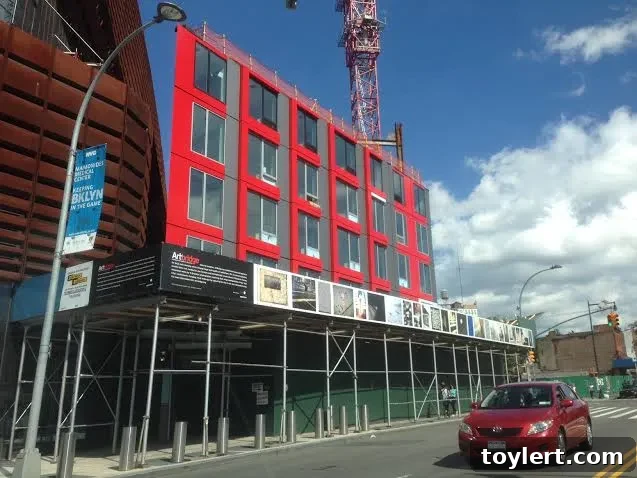
Modular Dream or Construction Nightmare? B2 Tower’s Leakage Fears Revealed Ahead of Skanska-Forest City Court Battle
The ambitious vision for the B2 modular tower at Atlantic Yards, a cornerstone of Brooklyn’s Pacific Park development, has taken a troubling turn. As construction giants Skanska and Forest City prepare to face off in court, a trove of recently unearthed documents shines a harsh light on a litany of critical issues plaguing the innovative modular skyscraper. The most alarming revelation? The building, once hailed as a triumph of modern construction, faces a significant risk of leaks, threatening its structural integrity and future viability.
The Promise and Peril of Modular Construction in Urban Development
The B2 tower, located on Flatbush Avenue in the heart of Brooklyn, was envisioned as the world’s tallest modular residential building at the time of its conception. Proponents of modular construction champion its potential for efficiency, speed, cost-effectiveness, and environmental benefits. By manufacturing building sections, or “modules,” in a controlled factory environment, developers aim to achieve higher quality control, reduce waste, and accelerate construction timelines on-site. For large-scale urban developments like Atlantic Yards (now known as Pacific Park), a sprawling project bringing thousands of new residences and commercial spaces to Brooklyn, modular methods promised to fast-track housing delivery in a rapidly growing city. Forest City Ratner (now Greenland Forest City Partners), the primary developer, partnered with Skanska, a global construction powerhouse, to bring this groundbreaking vision to life, with Skanska specializing in the modular manufacturing and assembly process.
Critical Flaws Uncovered: A Deep Dive into B2’s Construction Woes
However, the journey from ambitious blueprint to tangible structure appears to have been fraught with challenges. Revelations from documents unearthed by Atlantic Yards Report detail a series of severe construction defects that point to fundamental problems in the manufacturing and assembly of the B2 tower’s modules. Skanska, in its defense, has outlined numerous issues that led to significant delays and cost overruns, central among them being the critical problem of module alignment.
The Alignment Enigma: From Precision to Potential Peril
The core of the issue lies in the precise alignment of the building’s prefabricated modules. In modular construction, each unit must fit together with exacting precision to ensure structural stability, proper load distribution, and, crucially, a weather-tight building envelope. According to Skanska, the difficulties began with the “match plates” – critical components designed to tie the modules together. These plates require bolt holes with specific tolerances to allow for seamless integration.
The original architectural drawings specified a tolerance of 1/4 inch (approximately 6.35 mm) for these bolt holes, allowing for a small margin of error during assembly while ensuring a snug fit. However, the reality on the construction site was starkly different. Field conditions reportedly revealed that the bolt holes initially only permitted a tolerance of a mere 1/16th of an inch (approximately 1.59 mm). Such a minuscule tolerance made accurate assembly extraordinarily difficult, if not impossible, leading to significant delays and frustrations as workers struggled to connect modules that simply wouldn’t align as intended.
In an attempt to rectify this flaw and proceed with construction, the bolt holes were enlarged. However, this seemingly practical solution led to an even graver problem. The documents suggest that these holes were over-enlarged, reaching an astonishing 1 and 3/4 inches (approximately 44.45 mm). While intended to facilitate assembly, such oversized holes dramatically compromise the integrity of the connections. An excessive gap of this magnitude “created the potential” for severe misalignment, as modules could shift and settle improperly, introducing unwanted movement and stress points throughout the structure. This level of misalignment is not merely an aesthetic concern; it has profound implications for the building’s long-term performance and safety.
Factory Constraints: A Bottleneck in Production Quality
Beyond the on-site assembly challenges, the reports also highlight inefficiencies at the Navy Yard factory where the B2 modules were being manufactured. Skanska contended that the factory itself was “too small to allow for efficient production.” A cramped production facility can severely impact workflow, logistics, and quality control. In a modular factory, adequate space is crucial for the sequential movement of modules through various stages of construction, from frame assembly to interior fit-out and exterior finishing. Limited space can lead to bottlenecks, rushed work, compromised material handling, and ultimately, a decline in the quality of the manufactured modules. Such conditions can directly contribute to the inaccuracies and misalignments observed on the construction site, creating a cascading effect of problems from the factory floor to the final installation.
The Threat of Leakage: A Building Envelope Compromised
The cumulative effect of these alignment issues and oversized connections is the grave potential for the B2 tower to leak. A building’s envelope – its roof, walls, windows, and foundation – serves as its primary defense against the elements. A robust and properly sealed envelope is essential to protect the interior from water infiltration, air drafts, and pest intrusion. When modules are misaligned or joined with excessively large, improperly sealed bolt holes, the continuity of this protective barrier is compromised.
Water infiltration, if it occurs, can lead to a host of devastating consequences. Structurally, it can cause the premature deterioration of building materials, leading to rot in wooden components, corrosion of metal elements, and weakening of the overall structure. Internally, persistent leaks can foster the growth of hazardous mold and mildew, posing significant health risks to residents and requiring expensive remediation. Furthermore, water damage can ruin interior finishes, insulation, and electrical systems, necessitating costly repairs and ongoing maintenance. For a residential tower, the prospect of leaks not only diminishes property value but also creates an uncomfortable and potentially unhealthy living environment for its inhabitants, undermining the very purpose of creating high-quality urban housing.
Legal Battle Looms: Skanska vs. Forest City
The immediate consequence of these revelations is the escalating legal battle between Skanska and Forest City. With a court meeting scheduled, both parties are likely to present their arguments regarding responsibility for the construction delays, defects, and associated financial damages. Skanska’s detailed documentation of the problems suggests they aim to demonstrate that the issues stemmed from design flaws or unworkable conditions, potentially shifting blame away from their execution. Forest City, conversely, will likely contend that Skanska, as the modular contractor, failed to deliver on its contractual obligations to produce and assemble a sound structure. The stakes are incredibly high, involving millions of dollars in claims, reputational damage, and the future viability of the B2 tower itself.
Broader Implications for the Modular Construction Industry
The challenges faced by the B2 tower project cast a long shadow over the broader modular construction industry. While modular building offers undeniable advantages, this case highlights the critical importance of meticulous planning, rigorous quality control, and realistic expectations. The B2 saga serves as a cautionary tale that underscores the need for thorough prototyping, robust design specifications, and flexible but stringent manufacturing processes. Should the B2 tower prove to be a compromised structure, it could temporarily dampen enthusiasm for modular approaches, forcing developers and contractors to re-evaluate their strategies and invest even more heavily in pre-construction validation and quality assurance. The industry must learn from these setbacks to refine its practices, ensuring that the promise of modular construction can be consistently delivered without compromising safety or quality.
The Future of B2 and Pacific Park
As the legal battle unfolds, the future of the B2 tower remains uncertain. Regardless of the court’s verdict, the project has already incurred significant delays and cost overruns. Extensive remedial work may be required to address the identified defects, potentially delaying occupancy and further escalating expenses. For the larger Pacific Park development, the B2 controversy represents a significant hurdle, potentially affecting public confidence and future phases of construction. The ability of Skanska and Forest City to navigate this crisis, either through legal resolution or cooperative efforts to rectify the defects, will be crucial not only for the B2 tower but for the reputation of innovative construction methods in major urban centers.
The B2 modular tower, once a symbol of innovation, now stands as a complex reminder of the challenges inherent in pushing the boundaries of construction. The dream of rapid, high-quality, and cost-effective modular housing in Brooklyn is currently overshadowed by the very real threat of leakage and the legal showdown between its key architects. How this saga concludes will undoubtedly shape the narrative for modular construction projects for years to come.