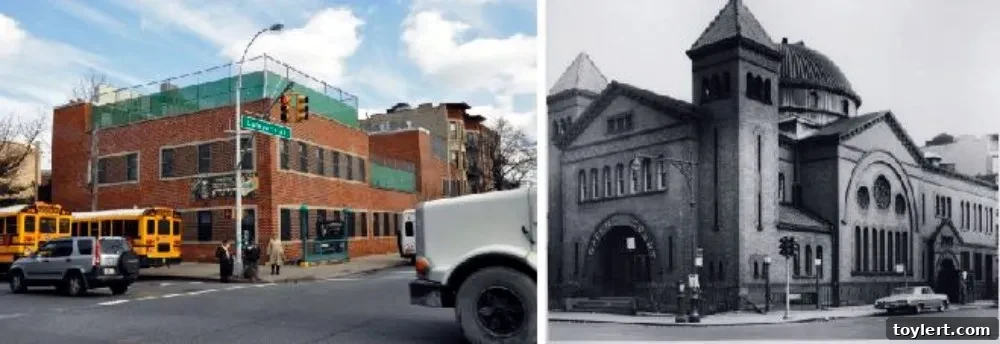
1005 Bedford Avenue: A Brooklyn Landmark’s Enduring Legacy
A captivating journey through Brooklyn’s architectural and cultural evolution, seen through the lens of one remarkable building.
Standing majestically at the corner of Lafayette Avenue in the vibrant heart of Bedford-Stuyvesant, 1005 Bedford Avenue possesses a profound history that far surpasses its current, highly functional appearance as a governmental facility. While today it might resemble an exceptionally grand traffic court building, its original purpose was imbued with a far more sacred and communal calling. This edifice was once the revered home of Temple Israel, a cornerstone of Brooklyn’s Jewish community and one of its oldest and most significant congregations.
The story of 1005 Bedford Avenue is more than just a tale of changing facades; it is a vivid narrative of Brooklyn itself – a testament to shifting demographics, architectural innovation, and the continuous reimagining of urban spaces. From its inception as a spiritual beacon to its present-day role, this building serves as a tangible link between Brooklyn’s rich past and its dynamic present, offering invaluable insights into the borough’s historical tapestry.
The Genesis of Temple Israel: A Spiritual Heartbeat in Brooklyn
Temple Israel’s journey began long before the construction of its magnificent Bedford Avenue home. Founded in the mid-19th century, it quickly established itself as a pivotal institution within Brooklyn’s burgeoning Jewish population. As Jewish immigrants flocked to New York City, seeking new opportunities and freedom, Brooklyn emerged as a significant hub. Congregations like Temple Israel provided not only spiritual guidance but also a crucial sense of community, identity, and support for newcomers adapting to a new land.
By the late 19th and early 20th centuries, Bedford-Stuyvesant was transforming into a desirable residential neighborhood, attracting affluent families from various backgrounds, including a thriving Jewish middle class. As the congregation grew in size and prominence, the need for a larger, more permanent, and architecturally distinguished home became evident. This desire for a landmark structure that reflected the congregation’s stature and optimism for the future led to the commissioning of 1005 Bedford Avenue.
The decision to build such an impressive synagogue underscored the confidence and integration of the Jewish community within Brooklyn society. It was a statement of faith, permanence, and cultural contribution, signifying their deep roots in the borough and their aspiration to contribute to its vibrant urban fabric. Temple Israel wasn’t just a place of worship; it was a cultural center, a school, and a symbol of Jewish life flourishing in Brooklyn.
An Architectural Masterpiece by the Parfitt Brothers
The design and construction of 1005 Bedford Avenue were entrusted to none other than the legendary Parfitt Brothers, a prolific architectural firm that left an indelible mark across Brooklyn. Known for their intricate detailing, robust construction, and ability to blend various architectural styles, the Parfitt Brothers were responsible for many of Brooklyn’s most iconic residential, commercial, and institutional buildings. Their work on Temple Israel further cemented their reputation as masters of their craft, producing what many considered an architectural masterpiece.
Completed in [date – research suggests late 1880s/early 1890s for Parfitt and Temple Israel], the building likely embodied a grand style popular at the time for significant public structures, perhaps Romanesque Revival or a blend of Neo-Classical elements, characterized by its impressive scale, elaborate stonework, and distinctive ornamentation. Its façade would have featured intricate carvings, dramatic arched windows, and possibly a grand entrance portico, all designed to inspire awe and convey the sanctity of the space within.
Inside, the synagogue would have been equally breathtaking, with high ceilings, stained-glass windows depicting biblical scenes or abstract patterns, and a majestic ark housing the Torah scrolls. The craftsmanship would have been meticulous, utilizing the finest materials and skilled artisans of the era. The Parfitt Brothers’ vision for Temple Israel was not just to create a functional house of worship but to erect a monument that would stand the test of time, reflecting the spiritual aspirations and cultural richness of its congregation.
The building’s imposing presence and elegant design served as a beacon in the neighborhood, drawing attention not just from its congregants but from all residents, contributing significantly to the architectural beauty of Bedford-Stuyvesant. Its design spoke volumes about the prosperity and artistic sensibilities of the community it served, making it a prominent landmark long before it transitioned to its current role.
Bedford-Stuyvesant: A Dynamic Urban Canvas
The history of 1005 Bedford Avenue is inextricably linked to the broader narrative of Bedford-Stuyvesant. When Temple Israel was constructed, Bed-Stuy was a burgeoning, largely affluent neighborhood. Its wide, tree-lined streets were graced with elegant brownstones and grand mansions, attracting a diverse array of families, including a significant Jewish population, alongside Irish, German, and later, African American residents.
However, the 20th century brought profound changes to Brooklyn and its neighborhoods. Economic shifts, suburban migration, and evolving immigration patterns led to significant demographic transformations. By the mid-20th century, many established Jewish families, like other European ethnic groups, began moving to other parts of Brooklyn, Long Island, or the suburbs, seeking new housing and changing social landscapes. This outward migration gradually impacted the membership and financial stability of long-standing institutions like Temple Israel.
Concurrently, Bedford-Stuyvesant was becoming a vital center for the African American community in Brooklyn, experiencing both challenges and periods of immense cultural vibrancy. The physical landscape remained, but the people inhabiting and shaping the community were changing. This ongoing evolution meant that institutions built for one era or demographic often had to adapt, relocate, or cease to exist in their original form.
From Sanctuary to Civic Space: A Building Reimagined
As Temple Israel’s congregation diminished in size and relocated to other areas, the grand building at 1005 Bedford Avenue faced an uncertain future. Many historic religious structures across New York City have met various fates, from demolition to conversion into luxury condos or community centers. Fortunately for this architectural gem, it was spared from destruction and found a new purpose, albeit one far removed from its sacred origins.
The building was eventually acquired by the City of New York and repurposed to serve civic functions. The mention of it resembling “the world’s fanciest traffic-court building” points directly to its long-standing role as a municipal court or administrative facility, likely housing the Department of Motor Vehicles or a local court branch. This transformation, while stark, speaks to the adaptability of classic architecture and the city’s commitment to preserving historical structures by giving them new life.
The conversion process would have involved significant interior renovations to accommodate offices, waiting areas, and courtrooms, but often, the exterior grandeur and many structural elements are preserved. This adaptive reuse is a common strategy for maintaining the integrity of historic buildings, allowing them to continue contributing to the urban fabric while serving contemporary needs. It’s a pragmatic approach to preservation that honors the past without being strictly confined by it.
Preserving Brooklyn’s Heritage: Then and Now at 1005 Bedford Avenue
The journey of 1005 Bedford Avenue stands as a powerful metaphor for Brooklyn’s own enduring spirit. It reminds us that cities are not static entities but living organisms, constantly evolving, shedding old skins, and embracing new identities. The building represents a critical piece of Brooklyn’s Jewish heritage, a testament to the ingenuity of the Parfitt Brothers, and a symbol of the ever-changing face of Bedford-Stuyvesant.
Today, visitors and residents passing by might not immediately recognize the building’s spiritual past. However, a closer look at its architectural details – the quality of the masonry, the classical proportions, the remnants of what was once an elaborate façade – hints at a grander history. These subtle cues serve as silent storytellers, connecting the present-day bustling civic center to its origins as a sacred space for one of Brooklyn’s oldest Jewish congregations.
The existence of structures like 1005 Bedford Avenue underscores the importance of historical preservation. These buildings are not merely old bricks and mortar; they are repositories of memory, culture, and community narratives. They offer tangible links to previous generations, helping us understand how our neighborhoods were built, who lived there, and what values they held dear. By appreciating these historic landmarks, we gain a deeper appreciation for the complex and rich tapestry that makes Brooklyn one of the most unique places in the world.
A Legacy Continues
From a cherished synagogue to a prominent civic building, 1005 Bedford Avenue has witnessed over a century of Brooklyn’s unfolding story. It stands not only as an architectural marvel but as a resilient symbol of transformation and continuity. Its ability to adapt and endure, while retaining its inherent grandeur, mirrors the spirit of Brooklyn itself – a borough that constantly reinvents itself while honoring its profound historical roots. This landmark continues to serve the community, embodying the dynamic legacy of Brooklyn, then and now.