25 Kent Avenue: Brooklyn Borough President Eric Adams Approves Major Williamsburg Office Complex Amidst Job Creation Debate
In a significant and widely discussed decision, Brooklyn Borough President Eric Adams recently gave his affirmative nod to a substantial, block-long office complex proposed for 25 Kent Avenue in Williamsburg. This approval marks a pivotal moment for the burgeoning Brooklyn neighborhood, situated in what is officially designated as a protected industrial zone but has rapidly transformed into a vibrant hub for trendy hotels, upscale eateries, and popular nightlife establishments, including renowned venues like Brooklyn Bowl and the luxurious Wythe Hotel.
The proposed development, spearheaded by Toby Moskovits of Heritage Equity Partners, has ignited a fervent debate across the borough. At the heart of the controversy lies a fundamental question: will this ambitious project truly generate high-paying jobs in Brooklyn, as proponents argue, or will it instead lead to the displacement of existing industries and a decline in the diverse job landscape of Williamsburg? Borough President Adams has firmly stated his belief in the former, asserting that 25 Kent Avenue will be a catalyst for economic growth and opportunity within Brooklyn.
Beyond the contentious job creation discussion, an intriguing secondary aspect adds another layer of complexity to the 25 Kent Avenue proposal: its potential to facilitate the long-awaited expansion of Bushwick Inlet Park. This environmental and recreational benefit offers a unique counterpoint to the development’s commercial aspirations, presenting a multifaceted challenge for urban planners, community advocates, and decision-makers alike as they weigh the project’s overall impact on North Williamsburg and the wider Brooklyn community.
The Evolving Landscape of Williamsburg’s Waterfront and 25 Kent Avenue
Williamsburg, once a predominantly industrial and working-class neighborhood, has undergone a dramatic metamorphosis over the past two decades. Its waterfront, in particular, has become a prime canvas for ambitious development projects, blending its historical roots with a modern, upscale identity. The site at 25 Kent Avenue perfectly encapsulates this dichotomy. Officially categorized as an Industrial Business Zone (IBZ), these areas are typically safeguarded to preserve manufacturing and industrial jobs, preventing their conversion into residential or purely commercial spaces that might not align with their original purpose. The intent behind IBZs is to protect a vital sector of the city’s economy and ensure a diversity of job types.
However, the reality on the ground in North Williamsburg, especially around Kent Avenue, tells a different story. The neighborhood now pulses with the energy of a thriving hospitality and entertainment sector. Where factories and warehouses once stood, boutique hotels like the Wythe and The William Vale now offer stunning Manhattan skyline views. Former industrial buildings have been reimagined as trendy event spaces, art galleries, and acclaimed restaurants, attracting visitors and residents alike. This rapid gentrification and shift in neighborhood character have created a unique tension: how to honor the area’s industrial heritage while accommodating its undeniable evolution into a cultural and economic magnet for Brooklyn and beyond.
The 25 Kent Avenue project seeks to bridge this gap, proposing a modern office complex that, while commercial, aims to attract tech companies, creative agencies, and other “innovation economy” businesses that align with Williamsburg’s contemporary vibe. This strategic positioning is central to the developer’s vision and Borough President Adams’ endorsement, suggesting a new paradigm for industrial zones in rapidly developing urban cores, where traditional manufacturing might be replaced by modern, high-tech enterprises.
Unpacking the 25 Kent Avenue Proposal: Vision and Details
Vision by Heritage Equity Partners for a Modern Brooklyn Workplace
The developer, Heritage Equity Partners, led by the astute Toby Moskovits, has established a reputation for navigating complex development challenges in Brooklyn. Their vision for 25 Kent Avenue is not merely to construct another office building but to create a vibrant ecosystem designed to foster collaboration and innovation within the borough. The proposed complex is massive, spanning an entire block, and is envisioned as a state-of-the-art facility featuring flexible office spaces, ground-floor retail, and potentially even public access areas designed to integrate with the vibrant street life of Williamsburg.
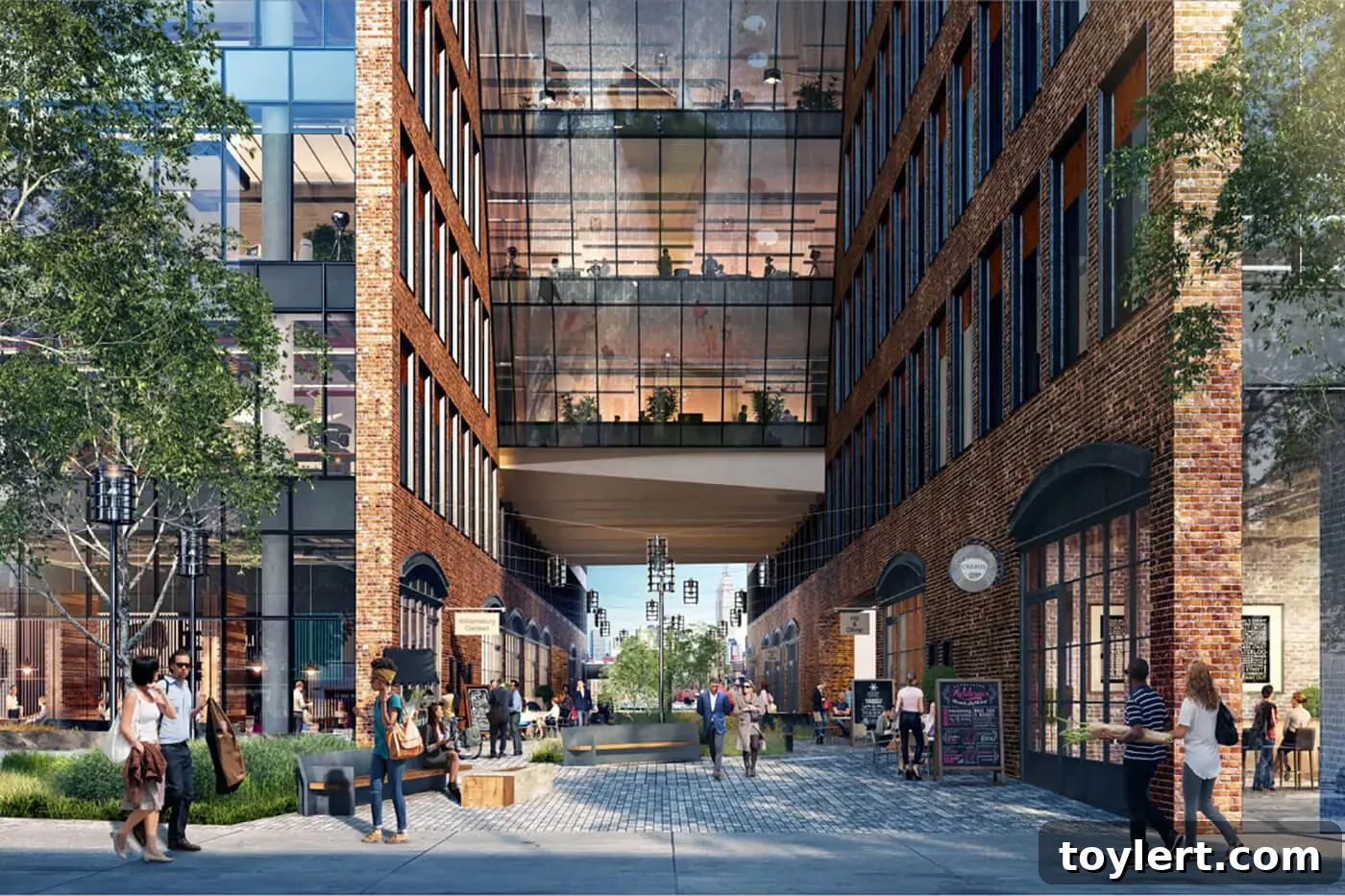
Renderings and architectural plans suggest a contemporary design that aims to integrate seamlessly with the surrounding industrial aesthetic while offering modern amenities expected by today’s businesses. The complex is designed to attract a diverse range of tenants, from startups and entrepreneurs to established firms looking for a dynamic location with excellent connectivity and a distinctive neighborhood character that only Williamsburg can offer. This focus on “new economy” jobs – particularly in sectors like technology, media, and creative industries – is a crucial component of the project’s appeal to city officials and its promise of high-value employment opportunities for Brooklyn residents.
The Core Debate: Job Creation vs. Displacement in Williamsburg
The most contentious aspect of the 25 Kent Avenue development revolves around its potential impact on Brooklyn’s job market. Borough President Eric Adams, a staunch advocate for economic development and job growth across the borough, views the project as a significant boon. His argument posits that the complex will draw in high-paying tech, creative, and professional service jobs that might otherwise gravitate towards Manhattan or other urban centers. These are the kinds of jobs, Adams suggests, that offer substantial career growth and contribute significantly to the local tax base, ultimately uplifting the broader Brooklyn economy.
Proponents of the 25 Kent Avenue project emphasize the urgent need for new, modern office spaces in Brooklyn. They argue that the borough currently lacks sufficient high-quality commercial real estate to accommodate its burgeoning creative and tech sectors, forcing many companies and talented individuals to leave Brooklyn for more suitable workspaces. By providing such spaces, 25 Kent Avenue could serve as an anchor, attracting companies and talent that will, in turn, create a ripple effect of ancillary jobs in services, retail, and hospitality, further stimulating the local economy.
However, critics express deep skepticism regarding these claims. Many community groups and urban planning advocates fear that while “high-paying” jobs might indeed be created, they will largely benefit an incoming, wealthier demographic, potentially at the expense of existing industrial workers and small businesses that have traditionally occupied IBZs. The concern is that the project, despite its commercial nature, contributes to the ongoing gentrification that prices out long-time residents and businesses, eroding the very fabric of Williamsburg’s diverse and historically working-class economy.
There’s also a nuanced argument about the nature of the “high-paying” jobs. While some roles within these companies might be technical or creative, many support roles could be lower-wage, and the overall impact on the existing blue-collar workforce remains a significant concern. The debate highlights a persistent tension in urban development: how to foster economic growth and attract new industries without sacrificing affordability and the unique character of established communities. For many, the question isn’t just about job numbers, but about who benefits from these new opportunities and at whose expense.
The Bushwick Inlet Park “Wrinkle”: A Green Opportunity for Brooklyn?
Perhaps the most intriguing and potentially redeeming feature of the 25 Kent Avenue proposal is its unexpected connection to the expansion of Bushwick Inlet Park. This long-promised waterfront park has been a focal point for environmentalists and community advocates in Williamsburg and across Brooklyn for decades. The vision for the park includes converting former industrial sites into much-needed green space, providing public access to the East River, and enhancing the quality of life for thousands of Brooklyn residents who currently lack sufficient parkland.
The “wrinkle” here refers to the potential for the 25 Kent Avenue development to help finance or facilitate the acquisition of adjacent parcels needed to complete the park. While the exact mechanism is often complex and subject to negotiation, large-scale developments sometimes involve land swaps, significant financial contributions to public projects, or other agreements that can benefit public infrastructure. For instance, a developer might agree to contribute funds specifically earmarked for park development or relinquish certain development rights in exchange for obtaining necessary approvals on their private commercial project, creating a mutually beneficial arrangement.
The expansion of Bushwick Inlet Park is not just about adding green space; it’s about fulfilling a long-standing commitment to the community. The park represents a crucial piece of public infrastructure that mitigates the impacts of dense development, provides essential recreational opportunities, improves ecological health along the waterfront, and offers critical flood protection. If the 25 Kent Avenue project can genuinely contribute to this expansion, it could sway public opinion and provide a compelling reason for its approval beyond mere economic metrics, demonstrating a project that can balance commercial aspirations with significant public good.
However, linking a private commercial development to a public park’s completion also raises questions for some critics. They might argue that park expansion should not be held hostage to private development interests, and that the city should independently fund and secure these critical public assets regardless of private projects. Nevertheless, the potential for a symbiotic relationship between commercial growth and environmental preservation at 25 Kent Avenue offers a unique case study in urban planning, where complex trade-offs and unexpected partnerships shape the future of urban landscapes.
Community Response and the ULURP Process for 25 Kent Avenue
The Uniform Land Use Review Procedure (ULURP) is the city’s formal process for reviewing proposed changes to zoning and land use, designed to ensure public input and accountability. Borough President Adams’ approval of 25 Kent Avenue is a crucial step in this lengthy process, but it is by no means the final one. His recommendation, while carrying significant weight and influence, is advisory. The proposal must still undergo further review by the City Planning Commission and ultimately face a vote by the City Council, where the local Council Member’s stance often plays a decisive role in the final outcome, reflecting the needs and concerns of their constituents.
Community Board 1, which represents Williamsburg and Greenpoint, had previously voted against the 25 Kent Avenue proposal, citing substantial concerns about its impact on existing industrial jobs, the character of the neighborhood, and the potential for increased gentrification. This opposition highlights the deep divisions within the community regarding the pace and nature of development. Residents express worries about increased traffic congestion, strain on public transportation infrastructure, and the ongoing erosion of affordable housing and business opportunities for long-term residents and local entrepreneurs.
Borough President Adams’ decision to override the Community Board’s recommendation underscores his broader vision for Brooklyn’s economic future. He often emphasizes the need for Brooklyn to compete on a global stage, attracting innovative industries and creating opportunities for its diverse population across all sectors. His support for 25 Kent Avenue aligns with this narrative, positioning the project as a cornerstone of a modern, economically robust Brooklyn that can provide cutting-edge workspace and foster new industries.
Williamsburg’s Future: Balancing Growth and Identity at the Waterfront
The approval of 25 Kent Avenue is more than just a single development; it’s a microcosm of the larger challenges facing Williamsburg and other rapidly developing urban areas across New York City. How does a city manage explosive growth and attract new capital while preserving its unique identity, historical fabric, and the diverse communities that make it vibrant? How do policymakers balance the demands of economic progress with the needs of existing communities, ensuring equitable benefits for all residents?
The transformation of Williamsburg’s waterfront from a gritty industrial hub to a sophisticated blend of residential, commercial, and recreational spaces is undeniable. Projects like 25 Kent Avenue contribute to this ongoing evolution, signaling a continued shift towards an economy driven by technology, creativity, and services. The success of this project, in the eyes of its proponents, will be measured by the high-quality jobs it creates, the economic vitality it brings to the area, and its ability to attract innovative businesses to Brooklyn.
For its critics, success will hinge on whether Williamsburg can maintain its character, support its diverse population, and ensure that the benefits of development are shared equitably across all income levels and demographics. The future of 25 Kent Avenue, therefore, is not just about a building; it’s about the future trajectory of one of New York City’s most dynamic and sought-after neighborhoods, grappling with the complexities of urban progress.
Conclusion: A Defining Moment for North Williamsburg’s Development
Brooklyn Borough President Eric Adams’ approval of the 25 Kent Avenue office complex represents a defining moment for North Williamsburg and a significant statement on the future direction of development in Brooklyn. The project, proposed by Heritage Equity Partners and Toby Moskovits, is poised to bring a substantial commercial presence to an area known for its unique blend of industrial heritage and trendy modern culture, promising a new era of economic activity.
While the debate over job creation versus displacement continues to resonate intensely within the community, Adams’ decision signals a clear intent to foster new economic engines within the borough, envisioning a Brooklyn capable of competing in the global innovation economy. Furthermore, the potential for the complex to aid in the expansion of Bushwick Inlet Park adds a layer of public benefit that warrants careful consideration and could mitigate some of the development’s perceived drawbacks.
As 25 Kent Avenue moves forward through the remaining stages of the ULURP process, it will undoubtedly remain a subject of intense scrutiny and discussion. Its ultimate impact on Williamsburg – economically, socially, and environmentally – will serve as a crucial benchmark for future urban development projects, showcasing the complex interplay between growth, preservation, and community aspirations in one of New York City’s most iconic and rapidly transforming neighborhoods.