Discovering Brooklyn’s Enduring Charm: An Ode to Historic Row Houses
Brooklyn, one building at a time – a journey through architectural heritage.
The Unmistakable Allure of Brooklyn’s Row Houses
Brooklyn is a borough defined by many things: its vibrant culture, diverse communities, and stunning waterfront views. Yet, for many, the very soul of Brooklyn resides within its historic row houses. These architectural marvels, often referred to as brownstones or brick houses, stand as enduring testaments to a bygone era of craftsmanship and urban development. More than just buildings, they are the very fabric of iconic neighborhoods like Park Slope, Cobble Hill, Fort Greene, and Boerum Hill, each telling a story of the city’s rich past.
From the moment one steps onto a tree-lined street in Brooklyn, the charm of these residences is palpable. Their stately facades, intricate details, and welcoming stoops invite exploration and admiration. This article celebrates these magnificent structures, exploring their history, architectural styles, and the profound impact they have had on shaping Brooklyn’s unique identity. We delve into what makes these homes so coveted, not just as real estate, but as cultural landmarks that embody the spirit of New York City’s most dynamic borough.
A Glimpse into History: The Rise of Brooklyn’s Residential Gems
The proliferation of row houses in Brooklyn began in earnest during the 19th century, a period of rapid growth and urbanization. As New York City expanded beyond Manhattan, Brooklyn emerged as a desirable residential area, attracting a burgeoning middle class. Developers and architects responded to this demand by constructing thousands of uniform yet distinct homes, creating cohesive streetscapes that continue to define the borough today.
These homes were built with efficiency and practicality in mind, designed to maximize space on narrow urban lots while providing comfortable, multi-story living. The choice of materials, predominantly local brownstone and brick, gave the buildings their characteristic warmth and durability. The architectural styles evolved through the decades, reflecting popular trends from the Federal period to the ornate Victorian era, leaving behind a rich tapestry of design for us to appreciate today.
Each block of row houses represents a chapter in Brooklyn’s expansion, from its days as an independent city to its integration into Greater New York. They were homes to merchants, artisans, and professionals, witnessing countless family histories unfold within their walls. Understanding this historical context enriches our appreciation for these buildings, revealing them as living museums that chronicle the growth and evolution of one of the world’s greatest cities.
Architectural Splendor: Diverse Styles of Brooklyn Row Houses
While often generically referred to as “brownstones,” Brooklyn’s row houses exhibit a fascinating array of architectural styles, each with its distinctive characteristics. Identifying these styles adds another layer of appreciation for the streetscapes:
- Federal Style (Late 18th – Early 19th Century): Characterized by simplicity, symmetry, and often flat facades with delicate cornices. Windows are typically double-hung with small panes, and entrances might feature fanlights.
- Greek Revival (1830s – 1850s): Marked by bold, classical elements inspired by ancient Greek temples. Look for prominent entryways with heavy lintels, fluted columns or pilasters, and often a grand stoop.
- Gothic Revival (1840s – 1860s): Though less common for full row houses, elements like pointed arches, steep gables, and intricate ironwork can be found, adding a romantic, medieval flair.
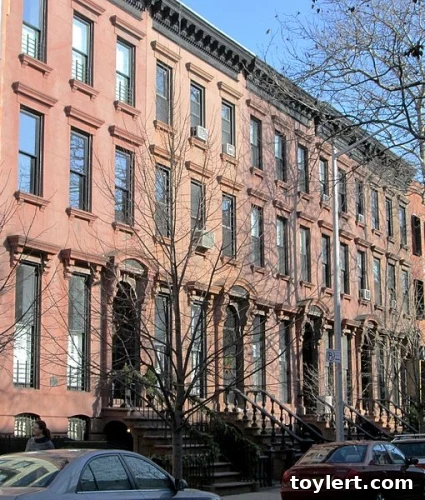
- Italianate (1850s – 1880s): One of the most popular styles, Italianate brownstones are identifiable by their characteristic deep cornices with decorative brackets, tall windows (often with segmental or round arches), and elaborate stoops featuring ornate newel posts and balustrades. The example image, possibly at 291-299 State Street, likely exhibits strong Italianate influences.
- Neo-Grec (1870s – 1880s): A more restrained and linear interpretation of classical motifs, featuring incised geometric ornamentation, heavy window surrounds, and a focus on crisp lines over florid decoration.
- Romanesque Revival (1880s – 1890s): Influenced by the work of H.H. Richardson, these homes feature rough-faced stone (often rusticated brownstone), round arches over windows and doorways, and massive, imposing forms.
- Queen Anne (1880s – 1900s): Characterized by asymmetry, varied textures (often combining brick, terra cotta, and wood shingles), turrets, bay windows, and highly decorative details like spindle work and stained glass. More prevalent in detached homes but elements appear in row houses.
The juxtaposition of these styles creates dynamic and engaging visual narratives along Brooklyn’s avenues and side streets, making a simple walk a journey through architectural history. The skill of the original artisans and builders is evident in every carved detail, every brick laid, and every cast-iron embellishment.
State Street: A Paradigm of Brooklyn Brownstone Living
State Street, particularly in areas like Boerum Hill and Cobble Hill, epitomizes the grandeur and enduring appeal of Brooklyn’s row houses. The stretch of buildings, including those around 291-299 State Street, showcases the quintessential brownstone aesthetic that has captivated residents and visitors for generations. These particular addresses, if typical of their surroundings, would feature the robust construction and ornate detailing characteristic of mid-19th century Brooklyn architecture.
Imagine the detailed cornices extending above the third or fourth story, often adorned with modillions or dentils, catching the light as they frame the skyline. The grand stoops, often made of stone, rise gracefully from the sidewalk, providing a semi-private transition from the bustling street to the home’s entry. These stoops are not merely functional; they are social spaces, historically serving as gathering points for neighbors and offering elevated views of the vibrant street life below. Ornate iron railings, often custom-crafted, line these stoops, adding a layer of delicate artistry to the robust stone.
The windows themselves are features of architectural interest, frequently tall and narrow on the parlor floor, adorned with decorative lintels and sills. The primary entrance, usually beneath the stoop or at the parlor level, is often framed by elaborate door surrounds featuring pilasters, carved panels, and sometimes transom windows or sidelights that allow natural light into the entry hall. These elements collectively contribute to a cohesive and dignified street presence, making State Street a cherished example of urban residential design.
The interiors, though not visible from the street, often reflect the exterior’s elegance with high ceilings, original hardwood floors, intricate plasterwork, and marble fireplaces. Many of these homes have been lovingly preserved or meticulously restored, blending historical accuracy with modern amenities, offering a unique living experience that marries past and present.
The Art of Preservation: Maintaining Brooklyn’s Legacy
The enduring beauty of Brooklyn’s row houses is not accidental; it is the result of dedicated preservation efforts by homeowners, community groups, and historic district commissions. Many of Brooklyn’s most iconic neighborhoods are designated historic districts, meaning that exterior renovations and changes must adhere to strict guidelines to maintain the architectural integrity of the area.
This commitment to preservation ensures that the unique character of these neighborhoods is safeguarded for future generations. Homeowners of row houses often embark on extensive restoration projects, meticulously repairing brownstone facades, replacing original windows with historically accurate reproductions, and conserving intricate interior details. This work requires a deep appreciation for history, a keen eye for detail, and often, the expertise of specialized artisans and architects.
Beyond individual homes, community groups play a vital role in advocating for the protection of historic streetscapes, educating the public about the value of preservation, and organizing tours that highlight the architectural treasures of their neighborhoods. These efforts underline a collective understanding that Brooklyn’s row houses are more than just private residences; they are a public heritage, contributing immeasurably to the city’s cultural landscape.
Modern Living in Historic Settings: A Unique Brooklyn Experience
Living in a Brooklyn row house offers a unique blend of historical ambiance and contemporary urban convenience. While these homes boast rich histories, they are also continually adapted to meet the demands of modern life. Many feature renovated kitchens, updated bathrooms, and integrated smart home technologies, all while retaining their original charm through restored details like fireplaces, moldings, and staircases.
The vertical layout of row houses often provides distinct living zones, with parlor floors ideal for entertaining, upper floors for private bedrooms, and garden levels offering direct access to often charming backyard spaces – a rare commodity in New York City. This configuration lends itself well to various lifestyles, from growing families to individuals seeking a quiet urban sanctuary.
Beyond the individual homes, living in a row house typically means becoming part of a close-knit community. The walkable nature of these neighborhoods, coupled with local shops, cafes, and parks, fosters a strong sense of belonging. Residents enjoy easy access to cultural institutions, acclaimed restaurants, and efficient public transportation, making Brooklyn row house living an ideal choice for those who desire both historical elegance and modern dynamism.