Unearthing Brooklyn’s Buried Past: The Profound Legacy of Slavery Revealed at the Center for Brooklyn History
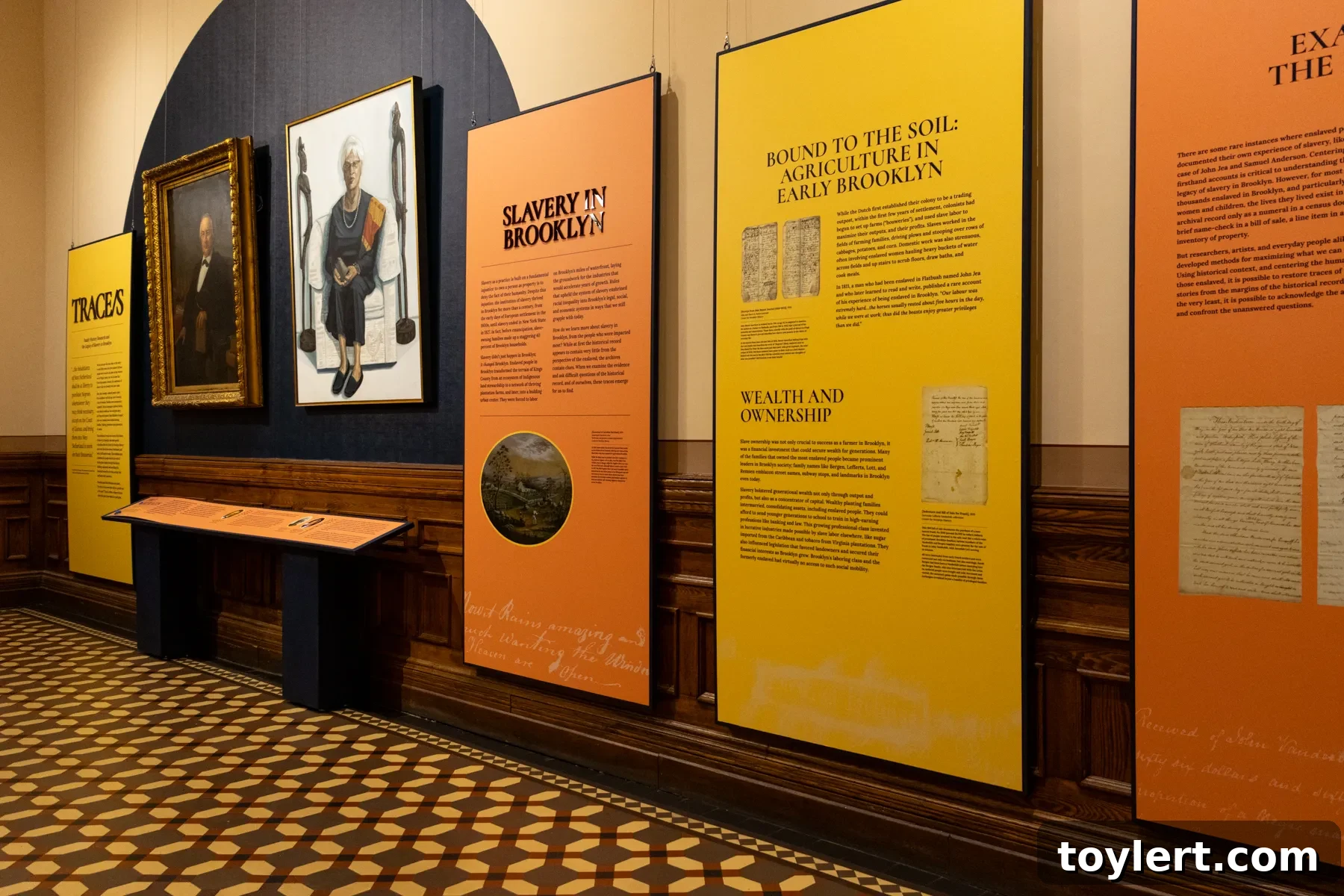
A pivotal new exhibition at the esteemed Center for Brooklyn History is compelling visitors to confront the nuanced and often difficult history of slavery within the borough. Titled “Trace/s: Family History Research and the Legacy of Slavery in Brooklyn,” this carefully curated display shares groundbreaking new research, poses deeply thought-provoking questions, and provides a rare opportunity for the public to view significant 18th and 19th-century documents that are not frequently accessible. More than just an academic exercise, the exhibition skillfully intertwines rigorous historical scholarship with the powerful, personal narratives unearthed through dedicated family history research, offering a comprehensive and deeply human picture of slavery’s enduring generational impact on Brooklyn.
Though modest in scale, concentrated primarily within the entry area and two prominent display cases outside the library, “Trace/s” possesses an undeniable weight and resonance. Its profound impact is amplified by its strategic location within an institution dedicated to preserving and interpreting Brooklyn’s rich and complex past. The exhibition’s unique strength lies in its balanced approach, giving equal consideration to the invaluable work of academic historians and the transformative insights gained from individuals meticulously tracing their own family roots. This synergy between macro historical analysis and micro personal discovery is crucial for presenting a full, empathetic understanding of slavery’s pervasive reach and its lasting consequences on the community.
Bridging Eras: Portraits that Connect Past and Present
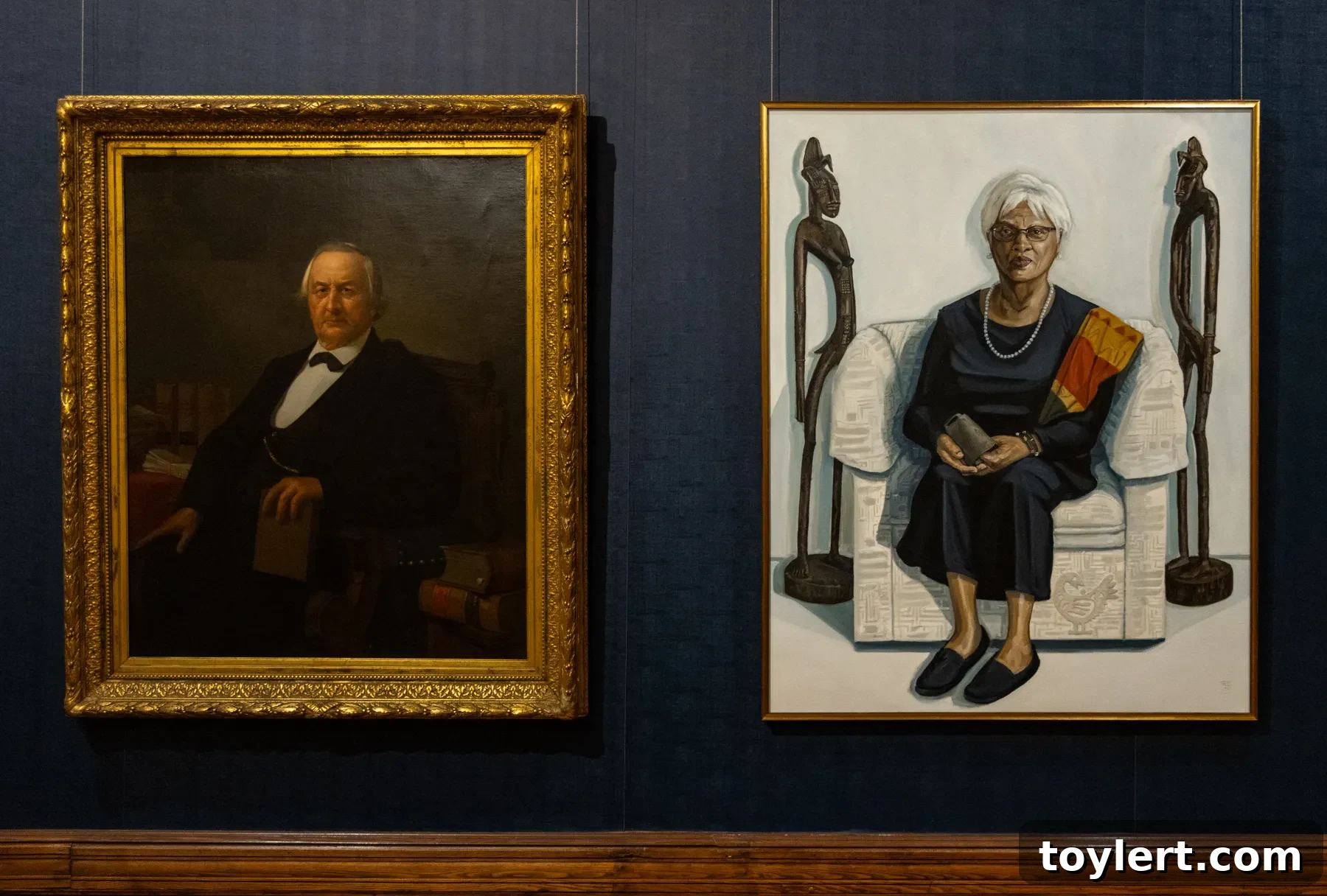
Upon entering the exhibition space, visitors are immediately greeted by two striking oil portraits, strategically placed to initiate a dialogue across centuries. One is a historical 19th-century portrayal of John A. Lott, a figure whose family history is inextricably linked to the practice of enslavement in Brooklyn. Standing in stark and poignant contrast is a contemporary portrait of Mildred Jones, a direct descendant – the great-great-granddaughter – of Samuel Anderson. Anderson was a man born into the brutal reality of slavery, specifically enslaved by a branch of the very Lott family depicted in the adjacent historical painting. This powerful visual juxtaposition instantly underscores the exhibition’s central theme: the profound, ongoing connection between historical injustice and contemporary identity.
The story of Samuel Anderson, so vividly represented through his descendant Mildred Jones, came to light not through traditional academic means alone, but primarily through diligent family research. This dedicated genealogical work uncovered a crucial piece of evidence: a captivating Brooklyn Daily Eagle interview from 1898. This rare historical document offered an invaluable first-person account of Samuel Anderson’s life in the borough, providing intimate details and perspectives that often remain hidden in official records. Such discoveries are a testament to the exhibition’s premise that personal family histories are not merely anecdotal but vital, primary sources that enrich and humanize our understanding of broader historical narratives, especially those as painful and complex as slavery.
The Power of Genealogical Research: Uncovering Hidden Narratives
One of the most compelling aspects of “Trace/s” is its emphatic demonstration of how family history research acts as a critical tool in unveiling the obscured narratives of enslaved individuals and their descendants. For too long, the stories of those subjected to slavery have been marginalized or entirely erased from mainstream historical accounts, often reduced to mere statistics or footnotes. This exhibition actively works to reverse that trend, showcasing how meticulous genealogical work can restore dignity and identity to those whose lives were deliberately stripped of it. By piecing together fragments of information—from census records and wills to newspaper clippings and oral histories—researchers like Mildred Jones are not just reconstructing family trees; they are resurrecting entire life stories, giving voice to the voiceless, and providing crucial context for the collective memory of a community.
The collaborative spirit of “Trace/s” between professional historians and community researchers creates a dynamic and holistic educational experience. Academic historians provide the overarching framework, detailing the economic, legal, and social structures of slavery in Brooklyn. Meanwhile, family historians infuse these structures with tangible, relatable human experiences, demonstrating the personal toll and resilient spirit of those who endured and eventually overcame unimaginable adversity. This approach moves beyond abstract historical facts, transforming them into lived realities that resonate deeply with contemporary audiences. It highlights the often-overlooked fact that the legacy of slavery is not confined to dusty archives but is woven into the fabric of families and communities today.
Slavery in Brooklyn: A Deeper Look into a Forgotten Past
Brooklyn, often celebrated for its vibrant diversity and progressive spirit, has a complex and often uncomfortable relationship with its past. The borough was once a significant center for slavery in New York, a fact that many residents today may find surprising or unsettling. Dutch and later English settlers brought enslaved Africans to the area as early as the 17th century, utilizing their forced labor to build farms, industries, and infrastructure that laid the foundation for modern Brooklyn. Landowners like the Lott family were prominent figures in this system, their prosperity often directly tied to the exploitation of enslaved people.
The exhibition delves into this often-ignored chapter, meticulously documenting the prevalence of slavery through various artifacts and records. It explores how enslaved individuals lived, worked, and resisted within this oppressive system. Visitors learn about the daily lives of enslaved people—their forced labor in agriculture, domestic service, and trades, as well as their persistent efforts to maintain cultural traditions, build communities, and seek freedom. The exhibition makes it clear that slavery in Brooklyn was not a peripheral phenomenon but a fundamental economic and social institution that shaped the borough’s development for centuries, leaving an indelible mark on its landscape and its people.
The Lott Family Legacy and Samuel Anderson’s Enduring Story
The Lott family, whose 19th-century patriarch John A. Lott is prominently featured in the exhibition, represents a powerful case study of slavery’s entanglement with Brooklyn’s foundational families. Descended from early Dutch settlers, the Lotts were significant landowners in Flatbush and Flatlands. Like many prominent families of their era, their estates and economic power were built, in part, upon the labor of enslaved Africans. The exhibition courageously confronts this aspect of their history, not to cast judgment through a modern lens, but to accurately represent the economic and social realities of the period.
The discovery of Samuel Anderson’s story, a man born into enslavement under a branch of the Lott family, is central to the exhibition’s narrative. His 1898 Brooklyn Daily Eagle interview is a rare and precious primary source, offering a direct window into the life of a former enslaved person in post-emancipation Brooklyn. Such documents are invaluable as they provide firsthand perspectives that challenge generalized historical accounts and offer intricate details about individual experiences of bondage and eventual freedom. Anderson’s narrative, painstakingly uncovered by his great-great-granddaughter Mildred Jones, transforms an abstract historical fact into a compelling personal journey of survival, resilience, and identity reclamation. It serves as a powerful reminder that behind every historical record are real lives with complex stories, deserving of recognition and remembrance.
Documents That Speak: Glimpses into an Unseen Past
A particularly poignant aspect of “Trace/s” is the inclusion of rare 18th and 19th-century documents. These aren’t merely historical relics; they are tangible links to a past often deliberately obscured. The exhibition showcases documents such as bills of sale for enslaved people, wills that bequeathed individuals as property, census records that enumerate them as chattel, and manumission papers that record their hard-won freedom. Each document, carefully preserved and displayed, tells a story—sometimes stark and brutal, sometimes hopeful and defiant. These primary sources offer irrefutable evidence of slavery’s legality and pervasiveness, grounding the exhibition’s themes in undeniable historical fact.
Viewing these documents firsthand allows visitors to connect directly with the historical record in a way that secondary accounts often cannot replicate. The fragility of the paper, the script of the hands that penned them, and the cold, legalistic language used to dehumanize individuals, evoke a visceral understanding of the era. They underscore the profound injustice inherent in a system that treated human beings as transferable property. By making these critical records accessible, the Center for Brooklyn History empowers visitors to engage in their own process of historical interpretation, challenging preconceived notions and fostering a deeper appreciation for the painstaking work involved in reconstructing such histories.
The Enduring Legacy: Generational Impact on Modern Brooklyn
Beyond simply documenting the historical facts of slavery, “Trace/s” profoundly grapples with its enduring legacy. The exhibition makes a compelling case that the impact of slavery did not cease with emancipation. Instead, its structural inequalities, economic disparities, and social biases reverberated through generations, continuing to shape the lives of African Americans in Brooklyn and beyond. These effects are evident in everything from housing patterns and wealth gaps to educational opportunities and systemic racism that persists in various forms today. By explicitly linking historical enslavement to present-day societal challenges, the exhibition fosters a more informed and empathetic understanding of contemporary issues.
The concept of “generational impact” is perhaps the exhibition’s most vital contribution. It illustrates how the denial of education, the destruction of family units, and the legal oppression experienced by enslaved people created disadvantages that accumulated over time, affecting subsequent generations. Conversely, it also celebrates the remarkable resilience, agency, and cultural preservation strategies employed by African Americans in the face of such adversity. The stories told in “Trace/s” are not just about suffering, but also about survival, resistance, and the continuous fight for justice and equality. The exhibition invites visitors to reflect on how this complex inheritance continues to manifest in Brooklyn’s diverse communities and encourages dialogue about reparative justice and collective healing.
A Call for Reflection and Continued Dialogue
“Trace/s: Family History Research and the Legacy of Slavery in Brooklyn” is more than just an exhibition; it is a powerful invitation to introspection, education, and collective remembrance. The Center for Brooklyn History, through this significant undertaking, reaffirms its commitment to presenting a complete and honest portrayal of the borough’s past, acknowledging both its triumphs and its profound injustices. By bringing academic rigor and personal narratives into conversation, the exhibition enriches our understanding of slavery’s pervasive influence and its undeniable imprint on the very foundations of Brooklyn.
Visitors leave “Trace/s” not only with a greater knowledge of specific historical events and figures but also with a deeper appreciation for the ongoing work required to understand and address the legacies of slavery. It serves as a potent reminder that history is not a static collection of facts but a living, evolving narrative that shapes our present and informs our future. The exhibition encourages residents and visitors alike to engage with this vital history, to recognize its echoes in contemporary society, and to contribute to a more just and equitable future for all of Brooklyn’s diverse communities. It is an essential visit for anyone seeking to understand the true depths of Brooklyn’s heritage.