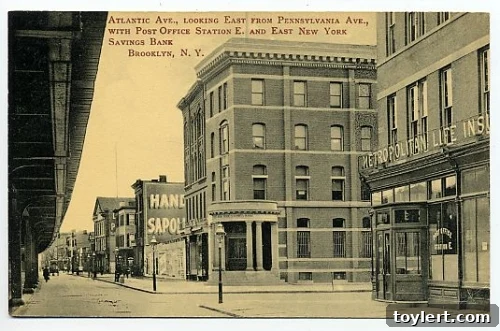
The Cornerstone of Progress: East New York’s Transformation and the Legacy of Its First Bank
On November 23, 1889, at precisely three in the afternoon, a distinguished gathering converged at a significant intersection in Brooklyn: Atlantic and Pennsylvania Avenues. This momentous occasion brought together East New York dignitaries, Brooklyn officials, and a throng of local well-wishers, all present to witness a pivotal event in the community’s burgeoning history. The ceremony marked the official cornerstone laying for East New York’s very first bank building, a symbol of stability and future prosperity. Richard Upjohn, Jr., a prominent architect of the era, had the distinct honor of presiding over the proceedings, initiating a venture that was enthusiastically celebrated with fervent speeches, solemn prayers, and earnest wishes for the community’s continued growth.
Keynote speaker Gustaf Dettloff eloquently captivated his audience, meticulously tracing East New York’s remarkable journey. He vividly recounted its origins as New Lots, a modest, pastoral settlement predominantly inhabited by industrious Dutch farmers. From these humble beginnings, Dettloff highlighted the dramatic transformation into the vibrant, bustling community it had evolved into by that late autumn day. He further detailed the bank’s foundational story, explaining how in 1868, a forward-thinking consortium of these very Dutch farmers and shrewd local businessmen—individuals whose names are so intrinsically linked to the city’s geography they now read like a map of its streets—collaborated to establish the East New York Savings Bank. Though many of these pioneering founders had passed from the earthly realm, their enduring vision and contributions were unequivocally honored and far from forgotten.
East New York: From Pastoral Hamlet to Urban Hub
The Roots of New Lots: Dutch Settlement and Agricultural Life
Before its transformation into the dynamic East New York, the area was known as New Lots, a name that vividly evokes its agricultural past. Settled by resilient Dutch farmers in the 17th century, this region was characterized by fertile lands, expansive farms, and a close-knit community deeply rooted in the soil. Families like the Schencks, Remsens, and Vanderveers were among the earliest European settlers, establishing the initial infrastructure of this nascent settlement, cultivating the land, and laying down the cultural bedrock that would persist for generations. Their economic activity revolved almost entirely around agriculture, with valuable produce regularly transported to burgeoning urban markets in Brooklyn and Manhattan. This initial period fostered a self-sufficient yet gradually expanding community, whose residents inherently understood the profound value of hard work, communal support, and steady, incremental investment.
The legacy of these early Dutch settlers was not merely confined to their farms but extended into the very fabric of local governance and social organization. Their traditional values emphasized thrift, the importance of communal savings, and a cautious, pragmatic approach to financial matters. As the 19th century progressed, the simple agrarian economy of New Lots began to feel the mounting pressures and exciting opportunities presented by a rapidly industrializing and urbanizing America. The need for more sophisticated financial institutions became increasingly apparent as local wealth grew and the population expanded well beyond its original farming base.
The Call for Development: Growth and Industrialization
The mid-19th century ushered in a period of profound and irreversible changes for New Lots. The strategic extension of vital transportation networks, most notably the Long Island Rail Road, played an absolutely crucial role in seamlessly connecting this previously outlying area to the bustling heart of Brooklyn and, by extension, to the wider metropolitan region. This dramatically improved accessibility served as a powerful catalyst, sparking a significant surge in population and concurrently spurring robust industrial development. Factories and a diverse array of businesses began to emerge across the landscape, attracting new waves of residents from across the globe, all seeking gainful employment and access to more affordable housing options. What was once a tranquil farming district quickly embarked on its remarkable metamorphosis into a thriving suburb, demanding urban amenities and essential services that its agricultural roots could no longer solely provide or sustain.
This period of rapid and transformative growth starkly highlighted a critical institutional gap: the pronounced absence of a dedicated local financial institution. While ambitious residents could certainly travel to downtown Brooklyn to conduct their banking affairs, the immense convenience and powerful symbolism of a truly local bank were paramount. A community-rooted bank would not only provide a secure and trusted haven for the hard-earned savings of local workers and families but would also serve as a vital engine for dynamic local investment, offering crucial mortgages for new homes and essential capital for emerging businesses. It was this pressing and undeniable need for localized financial services that galvanized the community’s visionary leaders and pioneering businessmen to decisive action, setting the intricate stage for the eventual creation of the East New York Savings Bank.
The Birth of a Local Institution: East New York Savings Bank (1868)
Visionary Founders: Farmers, Businessmen, and Community Spirit
The establishment of the East New York Savings Bank in 1868 was far more than a mere business venture; it was a profound and deeply strategic act of community building. It originated from the collective vision of prominent local figures, many of whom were direct descendants of the original Dutch farming families, now joined by astute new businessmen who had shrewdly recognized East New York’s immense potential. These individuals possessed an intrinsic understanding that for their beloved community to truly flourish and retain its economic independence, it absolutely needed its own financial heart. They proactively pooled their resources, meticulously navigated the complex legalities inherent in establishing a chartered bank, and committed themselves wholeheartedly to a future where local prosperity was robustly underpinned by local capital.
The foundational principles upon which the bank was built were deeply rooted in the core values of the community itself: fostering a culture of thrift, providing utterly secure savings opportunities for all residents, and diligently channeling vital funds directly back into local development initiatives. The inaugural board of trustees comprised illustrious names that echoed throughout the region’s rich history—Schenck, Remsen, Lott, Wyckoff, and other steadfast stalwarts of the original Dutch settlements, now judiciously joined by newer entrepreneurial spirits. This astute blend of respected tradition and dynamic progress ensured that the bank would serve both the long-established families and the rapidly growing population of newcomers, thereby fostering a shared sense of collective ownership and indispensable investment in East New York’s promising future.
The Significance of a Local Bank
For a burgeoning community like East New York, the presence of a local savings bank was far more than just a convenient place to deposit money; it was an irreplaceable anchor of progress. It powerfully signified maturity, stability, and an admirable degree of self-sufficiency. Prior to its establishment, residents were often compelled to undertake significant and time-consuming journeys to access rudimentary banking services, a considerable inconvenience that also implicitly meant local capital was not necessarily being reinvested within the very community that generated it. The creation of the East New York Savings Bank dramatically changed this fundamental dynamic entirely, decentralizing financial power and bringing it closer to the people it served.
This new institution effectively empowered individuals to save diligently for their future aspirations, greatly facilitated widespread homeownership through increasingly accessible mortgages, and provided crucial working capital for local businesses to confidently expand their operations and create vital jobs within the community. Its very physical presence instilled a profound sense of confidence, unequivocally signaling to potential residents and prospective businesses alike that East New York was truly a place of abundant opportunity, fully capable of meticulously managing its own economic destiny. The bank quickly became a tangible and powerful symbol of East New York’s highest aspirations, a physical manifestation of its remarkable journey from a once-rural outpost to a thriving and integral urban satellite of the greater Brooklyn area.
A New Era Dawns: The 1889 Cornerstone Laying Ceremony
A Community United: Speeches, Prayers, and Hopes
The cornerstone laying ceremony on November 23, 1889, was a vibrant and resounding affirmation of East New York’s remarkable progress and its collective, optimistic hope for the future. The atmosphere that day was palpably charged with optimism and anticipation as civic leaders, astute business owners, and ordinary citizens alike gathered en masse to commemorate this profound milestone. Speeches resonated deeply with themes of unwavering perseverance, robust community spirit, and the exciting promise of continued, sustained growth. Gustaf Dettloff’s eloquent address, in particular, served as a powerful and moving reflection on just how far the community had advanced, functioning as both a meticulous historical recounting and an inspirational call to further, collective action. The solemn prayers offered during the ceremony invoked divine blessing upon the new institution and its vital mission, underscoring the deep moral and ethical framework within which such crucial community ventures were undertaken in the late 19th century.
Such grand public ceremonies were always more than mere formalities; they were absolutely crucial for forging a strong and cohesive shared civic identity. They provided an invaluable opportunity for residents to come together in unity, reflect deeply on their collective achievements, and look forward with a shared sense of purpose and direction. The traditional laying of the cornerstone, an ancient and symbolically rich tradition, powerfully symbolized the strong and unyielding foundations upon which the bank, and by extension the entire community, intended to confidently build its future. It was a clear and unequivocal declaration of permanent presence, enduring commitment, and a vision for lasting prosperity.
Architectural Vision: Richard Upjohn, Jr. and the Symbolism of Design
The discerning choice of Richard Upjohn, Jr. as the principal architect for this landmark building was deeply significant. Upjohn, a distinguished scion of a highly renowned architectural family, was celebrated for his designs that masterfully blended practicality with an understated yet profound elegance. For the East New York Savings Bank, his design transcended mere bricks and mortar; it was meticulously crafted to create a landmark structure that inherently conveyed trust, unshakeable solidity, and an enduring sense of permanence. The architectural style, most likely reflecting the prevailing trends of the late 19th century such as Romanesque Revival or Classical influences, would have been robust and dignified, specifically projecting an image of unwavering financial security and institutional gravitas. A bank building of this prominent stature served as a crucial visual anchor within the burgeoning urban landscape, a tangible testament to the community’s growing prosperity and its bold, forward-looking ambition.
The physical structure itself, with its carefully chosen and ceremoniously laid cornerstone, intrinsically became a powerful metaphor for the core values the bank proudly represented. It was deliberately built to last for generations, meticulously designed to inspire profound confidence among its patrons, and intended to be a constant, reassuring presence in the daily lives of East New York residents. Upjohn’s visionary design contributed significantly to the civic pride intrinsically associated with the bank, ensuring that its majestic physical form perfectly mirrored its vital and indispensable function within the vibrant community it served.
Edward F. Linton: The Driving Force Behind East New York’s Transformation
The Atlantic Avenue Improvement Commission: Shaping the 26th Ward
At the forefront of the gathered crowd, keenly observing the solemn ceremony, stood Edward F. Linton. As the esteemed president of the Atlantic Avenue Improvement Commission, Linton was undeniably a pivotal and transformative figure in East New York’s dynamic development. This powerful and influential local business improvement organization played an instrumental role in tirelessly lobbying for crucial infrastructure projects and essential public services within the rapidly expanding 26th Ward. Their extensive efforts extended well beyond just the bank; they vehemently advocated for dramatically improved roads, more efficient public utilities, and a host of other vital amenities necessary for a modern, thriving urban district. Linton’s assertive leadership of this commission underscored his deep-seated commitment to fundamentally transforming East New York from its predominantly rural past into a vibrant, economically robust, and thoroughly modern community.
The Commission’s diligent work was absolutely vital in successfully attracting new residents and diverse businesses, thereby creating an environment intrinsically ripe for sustained growth and prosperity. Linton, through his influential and strategic position, was able to meticulously steer significant development, ensuring that East New York was not merely expanding organically but evolving strategically with a clear vision. His presence at the cornerstone laying ceremony was a profound testament to his direct and hands-on involvement in securing the bank, recognizing its monumental importance not just as a physical cornerstone, but as an indispensable catalyst for the overall economic health and social well-being of the entire ward. His efforts effectively laid much of the groundwork for the modern East New York that was taking shape.
A Landowner’s Legacy: Acquiring the Foundations of Future Growth
As Gustaf Dettloff paid heartfelt homage to the venerable founding families—Schenck, Remsen, Stoothoff, Rapelye, Vanderveer, Lott, Palmer, Wyckoff, and numerous others—Edward Linton’s internal chuckle was perhaps a moment of profound and knowing irony. While these names represented the historical bedrock and ancestral heritage of New Lots, for Linton, they represented something far more immediate and strategically significant: the very land upon which the future East New York was actively being rebuilt. He had meticulously and systematically acquired vast tracts of this precious land, often from the diligent heirs of these very same historic families. This strategic and far-sighted accumulation had firmly established him, by the pivotal year of 1889, as the single largest and most influential landowner in the entire 26th Ward, effectively giving him immense power over its trajectory.
Linton’s extensive land acquisitions were by no means accidental; they were an integral part of a deliberate, long-term, and expansive vision for comprehensive urban development. He possessed a keen understanding that controlling significant parcels of undeveloped land was the ultimate key to effectively guiding East New York’s future growth, enabling him to profoundly influence zoning regulations, the intricate layouts of new streets, and the strategic placement of future residential and commercial enterprises. His ambitious vision was to methodically transform the sprawling agrarian landscape into a structured grid of bustling streets, meticulously prepared for the homes and dynamic businesses of a rapidly arriving new generation. He was, in essence, diligently building the foundational canvas upon which the vibrant future of East New York would be painted, skillfully turning the enduring legacy of past generations into the robust foundation for future, unprecedented prosperity and growth.
Bridging Past and Future: The Interplay of Heritage and Progress
The Enduring Names: From Founders to Founders of New Fortunes
The names of the venerable Dutch farming families, lovingly remembered at the bank’s cornerstone ceremony, truly represent the genesis and foundational spirit of East New York. They were the original pioneers who painstakingly tilled the land and established the initial, close-knit community. Yet, the compelling story of East New York is also one of dynamic and continuous evolution, where the fundamental ownership and ultimate purpose of that precious land transitioned seamlessly through succeeding generations. Edward F. Linton perfectly embodies this intricate transition. He was not merely a passive observer of history unfolding but an active and determined shaper of its future, strategically leveraging the deep foundations laid by these early families to meticulously create entirely new opportunities and forge a new destiny for the area.
His significant acquisitions were not acts of erasure or disrespect but rather acts of purposeful transformation. The once-sprawling farms gradually became meticulously planned plots for vibrant residential blocks, bustling commercial avenues, and essential public spaces, all absolutely indispensable for a burgeoning urban district. The continuity between past and present was subtle yet profoundly impactful: the inherent foresight and industriousness of the original Dutch settlers found a modern and powerful echo in the ambitious development plans of Linton. Both, in their respective pivotal eras, were undeniably instrumental in envisioning and tirelessly building the dynamic East New York that proudly stood before them on that historic day.
A Community’s Evolution: A Testament to Vision and Investment
The compelling narrative of East New York’s remarkable development, powerfully encapsulated by the historic cornerstone laying of its first savings bank and the significant presence of a transformative figure like Edward F. Linton, stands as a profound testament to the intricate interplay of enduring heritage, visionary foresight, and strategic investment. It vividly highlights how vibrant communities evolve not merely through organic, undirected growth, but more significantly through the deliberate and concerted efforts of key individuals and pivotal institutions. The East New York Savings Bank rapidly became a powerful symbol of local empowerment and an effective mechanism for communal wealth building, while Linton emphatically represented the entrepreneurial spirit that skillfully transformed raw, undeveloped land into a structured, vibrant, and highly functional urban environment.
From its humble, agrarian origins as New Lots, through the careful and diligent cultivation of its early settlers, to its eventual emergence as a significant and integral part of the greater Brooklyn metropolis, East New York’s enduring story serves as a fascinating microcosm of America’s broader urban expansion. The 1889 cornerstone ceremony was not just about the opening of a new bank; it was about respectfully acknowledging a rich past, vibrantly celebrating a dynamic present, and confidently stepping into a promising and prosperous future, all meticulously built upon the enduring legacy of its pioneering founders and the bold, transformative vision of its most impactful developers.