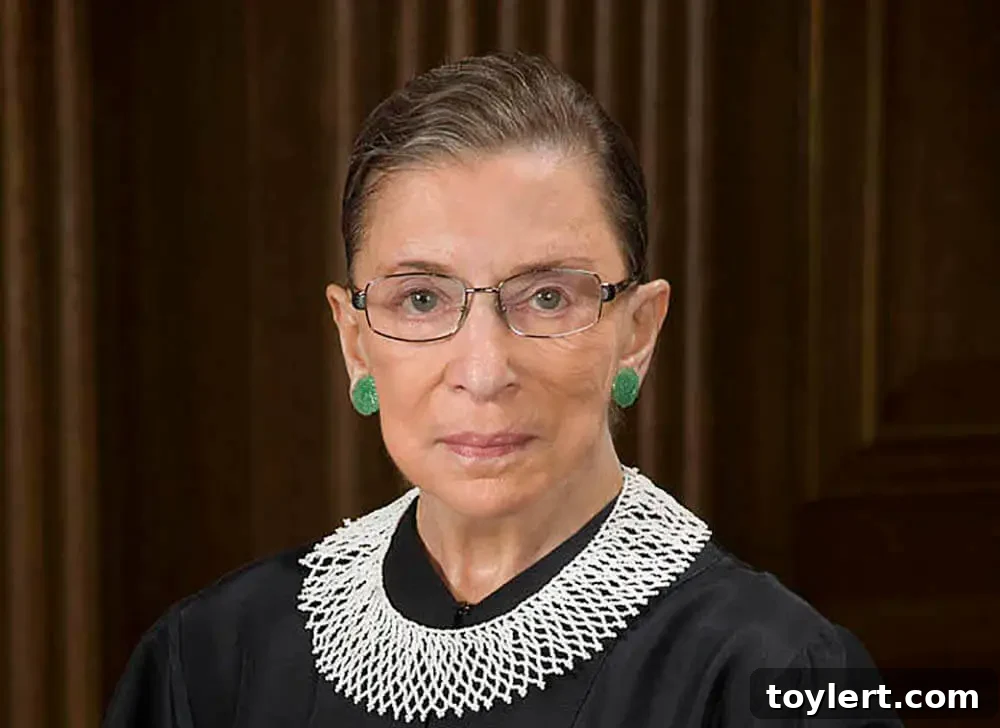
Ruth Bader Ginsburg: From Brooklyn Roots to Supreme Court Icon, The Enduring Legacy of “The Notorious RBG”
Within the annals of American legal history, few figures shine as brightly and command as much popular affection as Supreme Court Justice Ruth Bader Ginsburg. Affectionately known as “The Notorious RBG” to her legions of admirers, she carved an indelible path of justice and equality. What many might not immediately realize is that this formidable jurist shares a fascinating connection with another cultural titan bearing the “Notorious” moniker: the late, legendary rapper Biggie Smalls, also known as The Notorious B.I.G. Both giants, in their respective fields, hailed from the vibrant, diverse borough of Brooklyn, a common ground that subtly underscores the rich tapestry of American identity.
Early Life and Brooklyn Roots: The Formative Years of RBG
Born Joan Ruth Bader on March 15, 1933, in the Midwood neighborhood of Brooklyn, New York, Ruth Bader Ginsburg’s story is deeply intertwined with the immigrant experience and the American dream. Her parents, Nathan and Celia Bader, were Russian-Jewish immigrants who instilled in her a profound appreciation for education, hard work, and intellectual curiosity. Nathan Bader, a furrier, and Celia Bader, a garment factory worker, faced the challenges common to many immigrant families, yet they tirelessly supported their children’s aspirations.
Tragically, Celia Bader passed away from cancer the day before Ruth graduated from high school, a loss that profoundly shaped the young Ruth. Her mother, a brilliant student herself who was unable to pursue higher education, was a powerful advocate for Ruth’s academic pursuits, encouraging her to be independent and to strive for excellence. Celia taught Ruth two invaluable lessons: to be a lady and to be independent. “A lady,” her mother explained, “is someone who doesn’t succumb to useless emotions like anger. And independence is essential for every woman.” These principles would serve as guiding stars throughout Ginsburg’s illustrious career.
Ginsburg’s upbringing at 1584 East 9th Street in Midwood provided her with a grounding in a community that valued resilience and perseverance. Brooklyn, with its melting pot of cultures and fervent spirit, was more than just a place of residence; it was a crucible that forged her character. She attended James Madison High School, an institution renowned for fostering exceptional talent. Her graduating class included a pantheon of future leaders and public figures, such as presidential candidate Bernie Sanders, New York Senator Chuck Schumer, and television personality Judge Judy. This diverse alumni network speaks to the quality of education and the environment of intellectual vigor that shaped her early perspectives.
Academic Excellence and Overcoming Obstacles
After graduating high school, Ginsburg embarked on an extraordinary academic journey. She enrolled at Cornell University, where she excelled, earning a Bachelor of Arts degree in government in 1954, graduating top of her class. It was at Cornell that she met the love of her life, Martin D. Ginsburg, an astute and supportive law student who would become her steadfast partner in all of life’s endeavors. Their marriage, celebrated shortly after her graduation, would last for 56 years until his passing in 2010, marked by mutual respect, shared ambition, and an unwavering commitment to each other.
Following her husband to Harvard Law School, Ruth faced immense challenges. She was one of only nine women in a class of over 500 men. The dean of the law school famously asked the female students why they were occupying seats that could have been filled by men. Despite the overt sexism and the added responsibility of raising their young daughter, Jane, while Martin battled testicular cancer, Ginsburg persevered. She cared for her husband, attended his classes, and typed his notes while maintaining her own demanding academic schedule, proving her extraordinary intellect and resilience.
When Martin accepted a position in New York, Ruth transferred to Columbia Law School, where she once again distinguished herself, graduating tied for first in her class in 1959. Despite her stellar academic record from two Ivy League institutions, Ginsburg encountered significant discrimination when seeking employment. Law firms were reluctant to hire a woman, especially one with a child and a Jewish background. Yet, these early experiences with systemic bias only strengthened her resolve to fight for equality.
A Champion for Gender Equality: Paving the Way for Women’s Rights
Ginsburg’s early career focused on academia and research. She served as a law clerk for Judge Edmund L. Palmieri of the U.S. District Court for the Southern District of New York. Later, she became a professor at Rutgers School of Law, and then at Columbia Law School, where she was the first tenured female professor. During this period, she co-founded the Women’s Rights Law Reporter, the first law journal in the United States to focus exclusively on women’s rights.
Her most impactful work during this phase came as the director of the Women’s Rights Project of the American Civil Liberties Union (ACLU) in the 1970s. Here, Ginsburg meticulously crafted a legal strategy to dismantle gender discrimination piece by piece, challenging discriminatory statutes and practices across various domains. Her approach was strategic and incremental, carefully selecting cases that demonstrated how gender stereotypes harmed not just women, but men and society as a whole. This often involved arguing cases where men were discriminated against based on gender, such as a widower denied benefits because he was not recognized as a primary caregiver in the same way a widow would be.
Ginsburg argued six landmark cases before the Supreme Court, winning five of them. Her brilliant legal arguments in cases like Frontiero v. Richardson (1973) and Weinberger v. Wiesenfeld (1975) systematically chipped away at laws that treated men and women differently, paving the way for greater gender equality under the Fourteenth Amendment’s Equal Protection Clause. Her unwavering dedication during this era profoundly reshaped American jurisprudence and laid the groundwork for modern women’s rights.
A Seat on the Supreme Court: A Legacy of Landmark Decisions and Dissents
In 1980, President Jimmy Carter appointed Ruth Bader Ginsburg to the U.S. Court of Appeals for the District of Columbia Circuit, where she served with distinction for 13 years. Her reputation as a meticulous jurist, a sharp legal mind, and a consensus-builder grew during this period, positioning her for a higher calling.
On August 10, 1993, President Bill Clinton nominated her to the Supreme Court of the United States, fulfilling a campaign promise to appoint a woman to the high court. She was confirmed by the Senate with a vote of 96-3, becoming the second woman to serve on the nation’s highest court, following Justice Sandra Day O’Connor. Her appointment was celebrated as a monumental step forward for women in the legal profession and for the cause of civil rights.
During her 27 years on the Supreme Court, Justice Ginsburg became known for her clear, often forceful writing, her commitment to the rule of law, and her steadfast defense of constitutional rights, particularly for women and minorities. She authored numerous majority opinions that reshaped American law, including United States v. Virginia (1996), which struck down the male-only admissions policy of the Virginia Military Institute, affirming that the Constitution’s Equal Protection Clause prohibits gender-based discrimination.
Beyond her majority opinions, Justice Ginsburg’s powerful dissents became legendary. When she disagreed with the majority, her dissents were not merely expressions of disagreement but passionate calls for justice, meticulously outlining her legal reasoning and often serving as blueprints for future legal battles or legislative action. Her dissent in Ledbetter v. Goodyear Tire & Rubber Co. (2007), a case concerning pay discrimination, famously declared, “The Court does not comprehend, or is unwilling to cope with, the insidious character of the discrimination to which Ledbetter was subjected.” Her dissent directly inspired the Lilly Ledbetter Fair Pay Act of 2009, signed into law by President Barack Obama, a testament to the influence of her judicial writings.
Similarly, her dissent in Shelby County v. Holder (2013), which invalidated a key provision of the Voting Rights Act of 1965, warned against dismantling protections for minority voters. She famously stated, “The Court’s opinion can scarcely be described as an embrace of the ideal of equal political opportunity.” These dissents solidified her status as a fierce advocate for equality and justice, making her an enduring symbol of resistance against what she perceived as judicial overreach or a rollback of fundamental rights.
The Notorious RBG: A Cultural Phenomenon and Enduring Inspiration
In her later years, Justice Ginsburg transcended the judicial sphere to become an unlikely pop culture icon. “The Notorious RBG” phenomenon, initially sparked by a Tumblr blog in 2013, captured the imagination of millions. Adorned in collars, often with fierce expressions, her image appeared on merchandise, in memes, and became a symbol of resilience, intellect, and the fight for justice. Documentaries like “RBG” and biopics like “On the Basis of Sex” further cemented her status as a beloved public figure, making her story accessible to new generations.
Her rigorous workout routine, her lifelong friendship with conservative Justice Antonin Scalia (despite their vastly different judicial philosophies), and her unwavering commitment to her work even as she battled multiple cancers, all contributed to her mystique and admiration. She was a woman who faced adversity with grace and grit, inspiring countless individuals to pursue their passions and to stand up for what is right.
Justice Ruth Bader Ginsburg passed away on September 18, 2020, at the age of 87, leaving an irreplaceable void in the legal community and in the hearts of many. Her death sparked a national outpouring of grief and a renewed appreciation for her profound contributions to American law and society.
An Indelible Legacy of Justice and Equality
From her humble beginnings in Brooklyn, shaped by immigrant parents and a vibrant community, Ruth Bader Ginsburg rose to become one of the most influential legal minds in American history. Her journey from James Madison High School to the highest court in the land is a powerful testament to her intellect, tenacity, and unyielding belief in justice for all.
Her legacy extends far beyond her judicial opinions; it lies in the doors she opened for women, the legal frameworks she established for gender equality, and the inspiration she provided to generations of activists, lawyers, and citizens. “The Notorious RBG” will forever be remembered not just as a brilliant Supreme Court Justice, but as a cultural icon, a beacon of hope, and a relentless champion for a more just and equitable world. Her Brooklyn roots provided the foundation, but her vision and dedication built a legacy that continues to resonate across the nation and the globe.