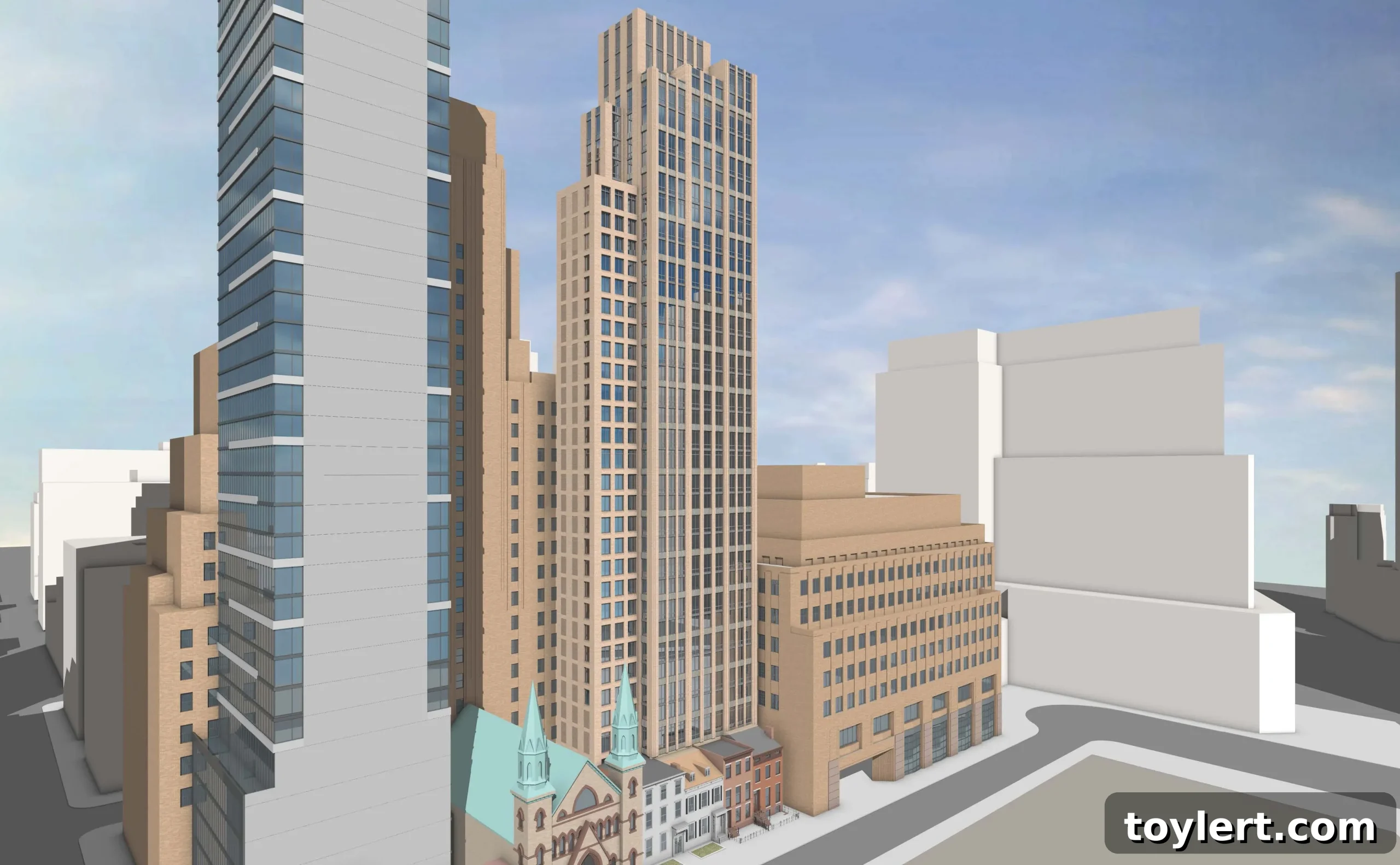
In a significant decision underscoring the ongoing tension between urban development and historic preservation, New York City’s Landmarks Preservation Commission (LPC) has rejected ambitious plans to construct a 33-story residential tower behind a row of four landmarked 19th-century houses on Downtown Brooklyn’s Duffield Street. The unanimous ruling sends developer Watermark Capital and its design team, led by Drew Hartley of Acheson Doyle Partners Architects and David West of Hill West, back to the drawing board, marking a temporary reprieve for these historically significant structures.
The developer’s proposal had sought to intricately weave a modern skyscraper into the fabric of the historic block. This involved more than just building behind; it entailed a substantial alteration of the landmarked homes themselves. Plans included combining the interiors of the historic properties, modifying their existing entrance points, and undertaking partial reconstruction of roofs, interior walls, floors, and the rear facades. The proponents argued that this adaptive reuse strategy would breathe new life into the buildings, which have suffered years of vacancy and deterioration, while simultaneously preserving their essential character. However, the LPC commissioners and a vocal public disagreed, finding the proposed alterations too extensive and the integration of the tower fundamentally flawed.
The Heart of the Debate: Preservation vs. Progress in Downtown Brooklyn
Downtown Brooklyn has transformed dramatically over the past few decades, evolving from a primarily commercial and civic center into a vibrant mixed-use district. This rapid urbanization, characterized by a boom in high-rise residential and commercial developments, often brings with it complex questions about how to expand upwards while respecting the historical integrity of its existing streetscapes. The Duffield Street houses, with their distinct 19th-century architecture, represent a tangible link to Brooklyn’s past, and their landmark designation by the LPC signifies their recognized cultural and architectural importance.
Landmark status, conferred by the LPC, is a powerful tool designed to protect buildings and districts that contribute significantly to the city’s heritage. It means that any proposed changes to the exterior of these structures, and in some cases their interiors, must undergo rigorous review and approval by the commission. This process ensures that development proposals are sensitive to the historical context and architectural character of designated sites, often leading to protracted negotiations between developers, preservationists, and community stakeholders.
A Closer Look at the Proposed Development and Its Challenges
Watermark Capital’s vision for 182-188 Duffield Street was ambitious: to erect a towering residential structure that would significantly increase housing density in the area, a common goal in New York City’s ever-growing housing market. The architects presented their plan to the LPC, emphasizing the “adaptive reuse” aspect as a solution to the houses’ dilapidated state. Adaptive reuse, a preservation strategy, aims to convert old buildings for new purposes while retaining their historic features. In theory, it allows for the economic viability of historic structures that might otherwise face demolition due to lack of suitable modern use or prohibitively expensive maintenance.
However, the specifics of Watermark Capital’s proposal raised immediate red flags for preservation advocates and ultimately for the LPC. The planned “gutting” of interiors, even with an intent to restore or combine, was seen by many as going against the spirit of landmark protection. The argument was that while the facades might remain, the soul and original layout of the 19th-century homes would be irrevocably lost. Furthermore, the partial reconstruction of roofs, interior walls, and floors, alongside significant modifications to the rear facades, suggested a level of intervention that went far beyond sensitive restoration or subtle integration.
The scale of the 33-story tower, even if positioned behind the historic row, also presented integration challenges. Commissioners expressed concerns about how such a massive contemporary structure would visually relate to the much smaller, older houses at its base. Historic districts rely on a sense of scale and architectural harmony, and the juxtaposition of a towering modern building with a row of modest 19th-century homes requires an exceptionally thoughtful and delicate design approach to avoid overwhelming the historic context.
The LPC’s Verdict: A Unanimous Rejection and a Clear Message
The Landmarks Preservation Commission hearing on the Duffield Street proposal was a pivotal moment. The unanimous decision to reject the plans, supported by overwhelming public testimony, sent a clear message: while development is necessary, it cannot come at the expense of New York City’s irreplaceable architectural heritage. Commissioners were not inherently opposed to the idea of a new tower on the site, acknowledging the need for urban growth and the potential to activate a long-vacant parcel. However, their primary objection centered on the *method* of integration and the *degree* of alteration proposed for the landmarked structures.
The commission’s directive for the design team to return to the drawing board underscores a fundamental principle of landmark preservation: new development must respect and enhance, rather than diminish, the character of historic buildings. The LPC’s role is not to halt progress, but to ensure that it proceeds in a manner that honors the city’s past. The proposed “gutting” of interiors and the extensive facade alterations were deemed incompatible with the goals of landmark protection, which seeks to preserve not just the outward appearance, but also the historical fabric and spatial qualities that define a building’s unique character.
This decision is a testament to the LPC’s commitment to its mandate, especially in a city where land is at a premium and development pressures are intense. It highlights the agency’s willingness to push back against designs that, in their view, fail to adequately balance modern needs with historical sensitivity. For the Duffield Street houses, it offers a renewed opportunity for a design that truly embraces adaptive reuse without sacrificing the intrinsic qualities that earned them landmark status in the first place.
Implications for Future Development and Preservation in Brooklyn
The rejection of Watermark Capital’s plans for Duffield Street carries significant implications for future development projects involving landmarked properties in Downtown Brooklyn and beyond. It reinforces the idea that developers proposing projects in historic districts must prioritize designs that are not only innovative and economically viable but also deeply respectful of existing architectural heritage. The “back to the drawing board” mandate encourages a more collaborative and creative approach, urging architects and developers to explore solutions that genuinely integrate new and old, rather than merely appending one to the other.
This case serves as a powerful reminder of the delicate balance required in urban planning. On one hand, there is an undeniable demand for new housing and economic growth in a thriving metropolis like New York City. On the other, there is a profound responsibility to protect and celebrate the structures that tell the story of the city’s past and contribute to its unique character. The Duffield Street houses, standing as silent sentinels of the 19th century amidst a rapidly modernizing skyline, represent this intersection of history and progress.
What comes next for these houses and the proposed development remains to be seen. Watermark Capital now faces the challenge of re-imagining their project in a way that satisfies the LPC’s stringent requirements. This might involve a scaled-down tower, a different approach to the adaptive reuse of the historic homes that minimizes interior alterations, or a completely redesigned integration strategy. Whatever the outcome, the LPC’s firm stance ensures that the architectural heritage of Duffield Street will continue to be a central consideration, reinforcing the value of preservation in shaping the future of Downtown Brooklyn.
The community, preservationists, and developers will undoubtedly watch closely as new plans emerge, hopeful that a solution can be found that allows for thoughtful development while ensuring the enduring presence and integrity of these vital landmarks. This ongoing dialogue is crucial for safeguarding the distinct identity of New York City’s diverse neighborhoods, ensuring that the stories etched in their buildings continue to inspire future generations.