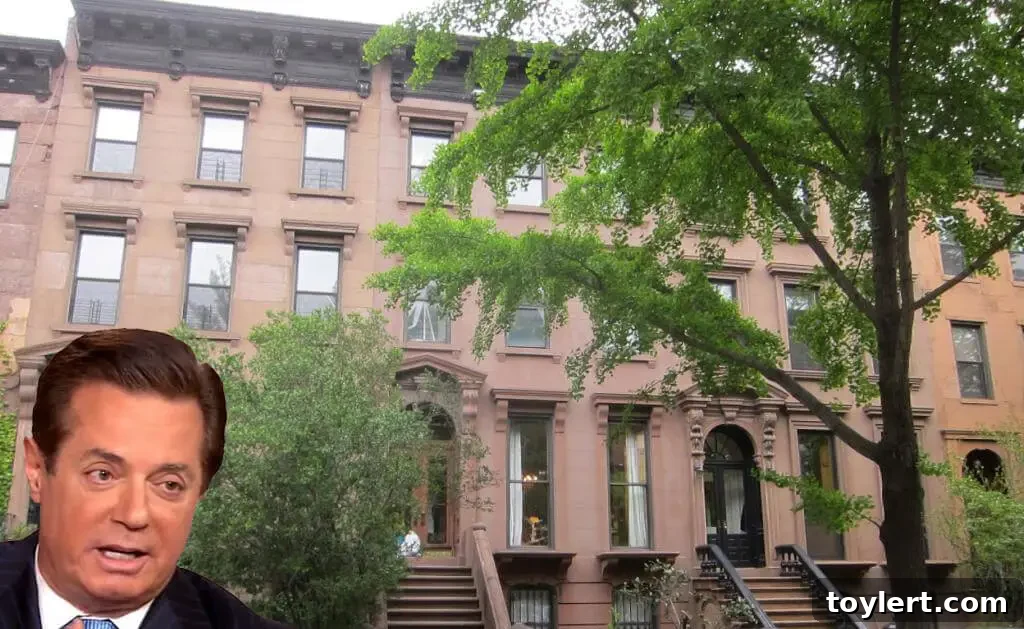
Unraveling the Mystery: Paul Manafort’s Carroll Gardens Brownstone and the Web of Scrutiny
In the quiet, tree-lined streets of Carroll Gardens, Brooklyn, a historic brownstone at 377 Union Street has become a focal point of national interest and intense scrutiny. This seemingly ordinary piece of New York real estate is tied to none other than Paul Manafort, the former campaign chairman for President Donald Trump, a figure whose financial dealings and political associations have been under an extensive federal investigation by the FBI. What began as a local real estate curiosity has rapidly evolved into a complex saga, intertwining high-stakes politics, alleged financial irregularities, and the diligent work of local investigative journalism.
The Man Behind the Headlines: Paul Manafort’s Political Journey
Paul Manafort has long been a prominent figure in American political consulting, with a career spanning decades. He advised Republican presidential campaigns from Gerald Ford to Ronald Reagan and George H.W. Bush, cultivating a reputation as a shrewd strategist and international lobbyist. His work extended far beyond U.S. borders, involving controversial engagements with foreign leaders and political parties, particularly in Eastern Europe. His role as the campaign chairman for Donald Trump during a critical phase of the 2016 presidential election brought him into the national spotlight with unprecedented intensity. It was during this period, and in its aftermath, that his past dealings and financial arrangements, including his real estate holdings, came under an aggressive federal microscope, primarily concerning alleged contacts and financial ties with Russian entities.
Carroll Gardens: A Prized Brooklyn Enclave and 377 Union Street
The Allure of a Brooklyn Brownstone
Carroll Gardens is one of Brooklyn’s most coveted neighborhoods, celebrated for its historic charm, vibrant community, and stunning architectural heritage. Its namesake brownstones, characterized by their distinctive brown or reddish-brown sandstone facades, grand stoops, and intricate details, are highly sought-after properties. These homes represent a significant investment, often commanding multi-million-dollar price tags, and embody a quintessential New York lifestyle. The neighborhood boasts a rich history, leafy streets, and an array of independent shops and acclaimed restaurants, making it an attractive locale for affluent residents and savvy real estate investors alike. The intrinsic value and desirability of a Carroll Gardens brownstone naturally draw attention, especially when it becomes linked to a figure embroiled in a national controversy.
The Specifics of 377 Union Street
The brownstone at 377 Union Street stands out not just for its prestigious location but for its peculiar status. For a property in such a high-demand area, it has been notably unoccupied. More intriguingly, the brownstone has been undergoing extensive renovations, a common sight in rapidly gentrifying Brooklyn neighborhoods. However, this construction has been stalled due to an official “stop-work order.” This halt in activity raises immediate questions: Why is a valuable property left vacant? What were the planned renovations? And why was construction abruptly halted? These questions only deepen the layers of mystery surrounding Manafort’s Brooklyn asset, suggesting potential issues beyond mere property development.
Under the Magnifying Glass: FBI Investigations and Alleged Russian Connections
At the heart of the scrutiny surrounding Paul Manafort and his assets is a far-reaching FBI investigation. The bureau’s inquiry focuses on whether Manafort had any illicit dealings with Russian officials or entities, particularly in the context of alleged Russian interference in the 2016 U.S. presidential election. These investigations are part of a broader federal effort to understand the scope and nature of foreign influence on American political processes. For Manafort, this meant a deep dive into his past work as a political consultant for pro-Russian factions in Ukraine, his financial connections, and any potential coordination or communication with Russian actors during his time with the Trump campaign. Properties like the Carroll Gardens brownstone, along with other real estate holdings and financial transactions, inevitably become part of such an investigation, as authorities seek to trace the origins and movements of funds and identify any assets that could be linked to illicit activities.
A Closer Look at the Finances: Mysteriously Large Mortgage Loans
Perhaps the most perplexing aspect of the 377 Union Street brownstone saga involves its financial history. Reports indicate that mysteriously large mortgage loans have been taken out against the property. These loans are reportedly so substantial that they likely exceed the property’s actual market value, a highly unusual and often suspicious circumstance in the real estate world. In a typical real estate transaction, lenders are cautious to ensure the loan amount is well within the property’s appraised value, mitigating risk. When loans appear to inflate beyond a reasonable market valuation, it can signal a number of red flags: potential for inflated appraisals, unusual financing arrangements, attempts to extract equity far beyond its worth, or even serve as a mechanism for money laundering. For a figure under federal investigation for financial impropriety and foreign dealings, such financial anomalies on a valuable asset like a Brooklyn brownstone amplify suspicions and necessitate deeper inquiry into the source and purpose of these unusually large sums.
The Watchdogs of the Web: Pardon Me For Asking and Local Journalism
The intricate details and initial revelations about Paul Manafort’s Carroll Gardens brownstone did not first emerge from national news desks but from the dedicated efforts of local investigative journalism. The intrepid neighborhood blog, Pardon Me For Asking, deserves significant credit for unearthing this story. This independent blog, known for its keen observation and commitment to local issues, has a track record of breaking important news; it previously brought to light a suspicious massage parlor on Smith Street, demonstrating its ability to spot and investigate local oddities that have broader implications. Their meticulous digging into public records, permits, and local chatter provided the initial clues and a wealth of information that subsequently garnered national attention. This highlights the indispensable role of grassroots reporting and citizen journalism in holding powerful figures accountable and shedding light on issues that might otherwise remain hidden, proving that even a local blog can be a vital component of a robust journalistic ecosystem.
Implications and Unanswered Questions in the Heart of Brooklyn
The unfolding narrative surrounding Paul Manafort’s Carroll Gardens brownstone is a microcosm of larger national and international questions. It forces a critical look at the intersection of high-stakes politics, complex financial networks, and the often-hidden world of real estate transactions. For the residents of Carroll Gardens, the presence of such a property tied to a federal investigation can be unsettling, transforming a symbol of neighborhood charm into a subject of notoriety. For the public at large, it underscores the importance of transparency in the financial dealings of political figures and the relentless pursuit of truth by investigative bodies. Many questions persist: What was the ultimate purpose of acquiring and renovating this brownstone? Were the substantial loans legitimate, or do they mask more nefarious financial activities? How will the resolution of the FBI’s investigation impact the fate of 377 Union Street? The answers to these questions are crucial, not only for understanding Manafort’s legal entanglements but also for broader implications concerning financial regulations, political ethics, and national security.
Conclusion: Awaiting Clarity on Union Street
The story of Paul Manafort’s brownstone at 377 Union Street in Carroll Gardens is far from over. It serves as a potent reminder that even seemingly innocuous real estate holdings can become central to major political and financial controversies. From the initial uncovering by a diligent local blog to the ongoing federal scrutiny, the layers of this narrative reflect the complex challenges of untangling political intrigue, financial irregularities, and the pursuit of justice. As the FBI investigation continues and public interest remains high, the fate of this Brooklyn brownstone—unoccupied, under a stop-work order, and burdened by mysterious mortgages—will undoubtedly continue to draw attention, awaiting the clarity that only a thorough and transparent resolution can provide. What happens next on Union Street will be more than just a real estate update; it will be a chapter in a larger story of accountability and transparency.