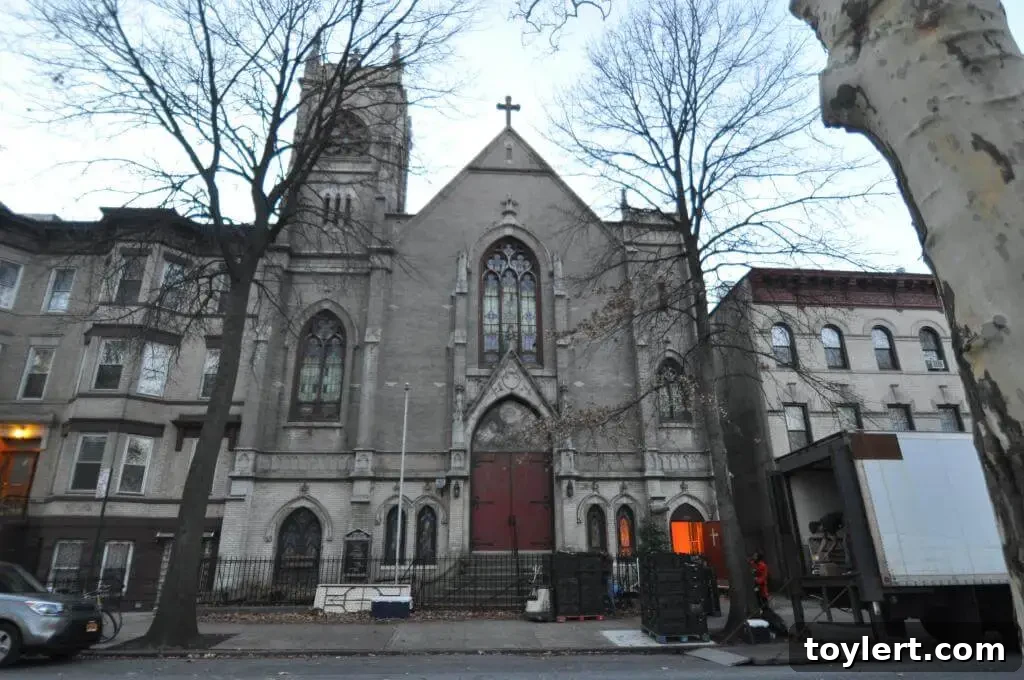
Greenpoint’s Park Church Co-op Faces Imminent Closure as Lutheran Synod Withdraws Crucial Funding
A significant and cherished pillar of the Greenpoint community, the Park Church Co-op, is now bracing for an unexpected and disheartening closure, currently scheduled for next June. This looming shutdown follows a decisive and abrupt move by the Metropolitan New York Synod, the regional governing body representing the national Evangelical Lutheran Church of America (ELCA), to cease all financial support for the beloved congregation. The news has sent ripples of concern and disappointment throughout the local neighborhood, underscoring the precarious balance that often exists between vital faith-based initiatives, essential community service, and the ever-evolving priorities of larger institutional funding bodies. The potential loss of such a deeply embedded institution raises profound questions about the future of community spaces in a rapidly changing urban environment like Brooklyn.
The trajectory leading up to this definitive closure has been marked by a series of escalating financial cuts, which have left the Park Church Co-op and its dedicated leadership grappling with increasing uncertainty and mounting pressure. According to Pastor Jacob Simpson, the initial indication of impending financial trouble emerged in April when the Synod first communicated its intention to significantly reduce its financial contributions. This preliminary warning quickly escalated into a more severe prognosis by August, when the church was formally notified that all financial contributions would be entirely terminated by July 2022. However, the most recent and arguably most impactful update arrived in October, when the Synod accelerated this termination date even further, pushing it forward to January 2022. This rapid succession of decisions, each one tightening the financial noose, has created immense operational challenges and severely limited the options available to the congregation, making the prospect of maintaining self-sufficient operations increasingly insurmountable.
Pastor Simpson has openly articulated his profound frustration concerning what he perceives as the Synod’s shifting and inconsistent rationale for these drastic funding cuts. He candidly remarked, “Their rationale has been several things, and I think their rationale is kind of where the frustration lies, both for Park and myself.” He highlighted a perceived “moving target” of reasons presented by the Synod, which has included concerns about the church’s long-term sustainability, insufficient congregational numbers, and lingering questions about the extent to which the significant and varied use of the church building directly benefited the core congregation. Furthermore, the overall condition of the historic building itself was explicitly cited as a significant concern, adding yet another complex layer to the multifaceted issues at play. This apparent lack of a consistent, clear, and unwavering justification has undoubtedly exacerbated the sense of bewilderment and deep disappointment felt by both the church leadership and its dedicated community members, who now face the imminent loss of their spiritual and communal home.
The concept of “sustainability,” particularly in the demanding context of urban churches like the Park Church Co-op, is inherently multifaceted and frequently fraught with considerable challenges. For a multitude of religious institutions situated in dynamic, often rapidly gentrifying or economically diverse urban areas, maintaining a robust and stable financial footing relies not solely on the traditional pillars of tithes and offerings but also on broader institutional support and sustained community engagement. The Synod’s pronounced emphasis on sustainability very likely reflects a growing and widespread concern within the Evangelical Lutheran Church in America (ELCA) regarding the long-term viability of congregations that may struggle significantly to independently meet their increasing operational costs, especially when confronted with the dual challenges of declining attendance and an aging membership base. Such circumstances often necessitate exceptionally difficult decisions about resource allocation across the entire synod, a process that can, unfortunately, impact smaller or already struggling congregations disproportionately.
Another critical concern raised by the Synod unequivocally revolved around the number of people actively participating and engaging with the church. In an contemporary era where religious affiliation is experiencing profound societal shifts and traditional church attendance patterns face unprecedented challenges, many congregations struggle intensely to maintain or, indeed, grow their membership rolls. For the Park Church Co-op, a vibrant and active community presence might not always directly translate into a corresponding increase in Sunday service attendance, particularly if its unique co-op model naturally fosters more diverse and inclusive forms of engagement beyond conventional worship. This pervasive demographic challenge is far from unique to Greenpoint; rather, it represents a widespread and systemic issue confronting numerous mainline denominations as they earnestly attempt to adapt and remain relevant within rapidly evolving modern societal landscapes.
The Park Church Co-op: A Vital Greenpoint Community Cornerstone Under Threat
Beyond its primary identity as a Lutheran congregation, the Park Church Co-op has, for decades, meticulously cultivated a well-deserved reputation as an indispensable and vibrant community hub within Greenpoint. The very inclusion of the term “co-op” in its name inherently suggests a collaborative, inclusive, and deeply community-oriented operational model, strongly implying that the physical space serves a much broader and more encompassing purpose than merely housing traditional worship services. Indeed, historic church buildings, with their often grand architecture and central locations, frequently evolve into crucial anchors for their surrounding neighborhoods, tirelessly hosting a myriad of activities and programs that skillfully cater to an exceptionally diverse range of needs, interests, and demographics within the local populace. While the Synod astutely raised valid questions about whether the extensive and varied use of the building adequately “benefits the church” in terms of direct congregational growth or immediate financial contributions, it is absolutely imperative to recognize and fully appreciate the invaluable, albeit often indirect, benefits such a multi-purpose space invariably provides to the wider community.
For many years, the Park Church Co-op has undeniably functioned as a versatile venue for an astonishing array of local activities, ranging from vibrant arts and cultural events that showcase local talent to crucial community meetings addressing neighborhood concerns, essential support groups offering solace and guidance, and valuable educational workshops fostering learning and skill development. Imagine a truly dynamic space that not only offers spiritual solace and profound inspiration on Sunday mornings but then seamlessly transforms into an engaging art gallery during weekdays, provides a vital meeting point for numerous neighborhood associations in the evenings, and perhaps even spearheads impactful food drives or critical outreach programs aimed at supporting the most vulnerable members of the community. This multi-faceted utility and unwavering commitment to public service has demonstrably made the church building an indispensable asset, tirelessly fostering social cohesion, providing much-needed affordable spaces for local grassroots initiatives, and profoundly enriching the overall cultural fabric of Greenpoint. The pastor’s poignant phrase, “we do a lot with the building,” eloquently hints at this dynamic and expansive role, strongly suggesting that while the immediate congregational footprint might appear numerically modest, its broader and deeper community impact is, in fact, immeasurable and undeniably substantial.
The physical condition of the building itself, a significant point of contention explicitly brought up by the Synod, represents another pervasive and recurrent challenge for numerous historic religious structures across the nation. Many older churches, while possessing immense architectural significance and being deeply intertwined with the historical narratives of their respective communities, invariably demand substantial and continuous maintenance. Critical repairs to aging roofs, costly upgrades to inefficient heating systems, necessary accessibility modifications to meet modern standards, and the inevitable wear and tear accumulated over decades can quickly amount to truly prohibitive costs, often far exceeding the financial capacity of a single congregation or even a regional synod. Striking a delicate balance between the urgent preservation of these invaluable historical assets and the harsh financial realities of their ongoing upkeep is a constant and arduous struggle. Furthermore, deferred maintenance, a common pitfall, can rapidly lead to critical and exponentially expensive structural issues. Such a daunting scenario can, indeed, legitimately contribute to a well-reasoned rationale for withdrawing institutional support, particularly if the projected investment required is deemed financially unsustainable or disproportionately high relative to the size and financial health of the congregation.
Broader Implications: Enduring Challenges Facing Urban Religious Institutions
The impending closure of Greenpoint’s Park Church Co-op serves as a particularly poignant and insightful microcosm of the broader and systemic challenges currently confronting traditional religious institutions across diverse urban landscapes throughout the country. In an increasingly diverse, pluralistic, and often secular society, churches are grappling with a complex confluence of issues, including steadily declining membership rates, an aging demographic profile among their congregants, and a persistent struggle to maintain relevance and attract the engagement of younger generations. Many vibrant urban areas, including the rapidly evolving borough of Brooklyn, have experienced significant and transformative demographic shifts, with an influx of new residents often bringing with them different spiritual orientations, secular perspectives, or simply a disinterest in traditional religious practices. This dynamic environment makes the arduous task of attracting new congregants and ensuring long-term financial stability an incredibly challenging uphill battle for many long-standing and historically significant churches.
Furthermore, the immense financial burden associated with maintaining large, often historic, church buildings in high-cost-of-living areas such as Greenpoint is nothing short of colossal. The cumulative costs of property taxes, comprehensive insurance premiums, escalating utility bills, and the inevitable and unpredictable need for major structural repairs can very quickly deplete even the most robust financial resources, sometimes even for congregations supported by endowments or external funding. The fundamental question of whether these undeniably valuable community assets can be sustained solely by a numerically dwindling congregation, or if they critically require broader civic, governmental, or extensive institutional support, is a profoundly important and increasingly urgent one. The Park Church Co-op’s dire situation starkly underscores the inherent tension between the noble imperative of preserving architectural heritage and ensuring the ongoing viability of the essential religious and diverse community services housed within these cherished structures.
The difficult decision rendered by the Metropolitan New York Synod also reflects a much wider and increasingly prevalent trend within national church bodies to meticulously re-evaluate and strategically manage their extensive portfolios of properties and congregations. Synods and dioceses are frequently tasked with the unenviable responsibility of making exceptionally difficult and often painful decisions about where to optimally allocate their finite and increasingly constrained resources. This often involves prioritizing areas identified for potential growth, or consolidating existing operations to ensure the overall long-term health, sustainability, and strategic resilience of the larger institutional framework. While such strategic decisions are typically made with the utmost intent to foster institutional well-being, they inevitably generate profound and often devastating local impacts, frequently culminating in the irreversible closure of deeply cherished community spaces, thereby leaving behind a void that is extraordinarily difficult, if not impossible, to adequately fill.
The Deep Void Left Behind: A Profound Impact on Greenpoint’s Fabric
The imminent closure of the Park Church Co-op will, without a shadow of a doubt, leave a profound and irreplaceable void in the very heart of Greenpoint. For its devoted congregants, this tragic event signifies the agonizing loss of a spiritual home, a sacred place of worship, and a tightly-knit community of faith that has likely served as an unwavering constant in their lives for many years, if not several decades. For the broader Greenpoint neighborhood, the far-reaching impact extends significantly to the loss of an invaluable and accessible public space. Numerous community groups, talented local artists, essential support organizations, and countless individuals who have regularly utilized the church for a diverse range of events and activities will now be compelled to embark on the challenging search for alternative venues, which are increasingly scarce, often less suitable, and invariably more expensive in a rapidly developing and gentrifying area like Greenpoint.
This challenging situation also raises critical and fundamental questions regarding the preservation of intrinsic community identity and historical continuity. Places like the Park Church Co-op are far more than just mere buildings; they are, in essence, living repositories of local history, potent symbols of collective resilience, and vibrant centers of shared memory that encapsulate generations of experiences and stories. Their regrettable disappearance can gradually erode the unique and irreplaceable character of a neighborhood, often replacing established, community-focused anchors with potentially less accessible, commercially driven, or purely profit-oriented alternatives. The emotional toll inflicted upon the community, particularly those individuals and families who possess deep, long-standing connections to the church, should not, under any circumstances, be underestimated. The sense of loss can be palpable, affecting not just spiritual life but the very social fabric of the neighborhood.
Looking Ahead: The Uncertain Future of a Historic Greenpoint Space
As the Greenpoint community collectively grapples with the disheartening news of the Park Church Co-op’s impending closure, the ultimate fate of the historic building located at 129 Russell Street becomes an increasingly pressing and critical concern. Will this valuable property inevitably be sold? If so, to whom will it be transferred, and for what specific purpose will it be utilized? In a fiercely competitive and insatiably hungry real estate market like that of Brooklyn, the financial temptation for developers to acquire such a sizable and strategically located property for high-value residential or commercial development is undeniably immense. However, passionate community advocates and dedicated local organizations often actively campaign for the staunch preservation of such culturally significant structures for public benefit, diligently seeking to repurpose them in innovative ways that continue to profoundly serve the diverse needs and long-term interests of the neighborhood.
Potential future scenarios for the Park Church Co-op building could realistically include its sensitive conversion into much-needed affordable housing units, its transformation into an expanded and truly comprehensive community center, its reimagining as a dynamic new arts and cultural venue, or even its adaptive reuse for various commercial enterprises. Each of these prospective options inherently comes with its own distinct set of challenges, opportunities, and complex considerations. The proactive involvement of local government officials, influential community organizations, and passionate, engaged residents will be absolutely crucial in advocating tirelessly for an outcome that most effectively serves the long-term, collective interests of the Greenpoint community. The imminent closure of the church offers a stark and compelling reminder of the paramount importance of proactive engagement and sustained vigilance in preserving, adapting, and innovating with existing community assets to ensure they continue to thrive and contribute, even when the original institutional framework or funding dynamics undergo significant and irreversible changes.
The Park Church Co-op’s journey from a vital and dynamic community hub to a struggling institution tragically facing imminent closure is a profoundly sobering and emotionally resonant narrative. It encapsulates the complex and often precarious interplay of financial realities, evolving congregational dynamics, broader societal shifts in religious engagement, and the critical, often understated role that historic church buildings play as indispensable anchors in vibrant urban neighborhoods. While the immediate future undeniably holds significant uncertainty and palpable sadness for its devoted members and the wider Greenpoint community, this challenging situation also presents a crucial opportunity for deep reflection and meaningful dialogue on how communities can more effectively support, sustain, and imaginatively adapt their invaluable local institutions in an ever-changing and unpredictable world. The impending loss of a place like the Park Church Co-op is unequivocally more than just the end of a series of religious services; it represents the heartbreaking dimming of a significant and cherished light in the very heart and soul of Greenpoint.