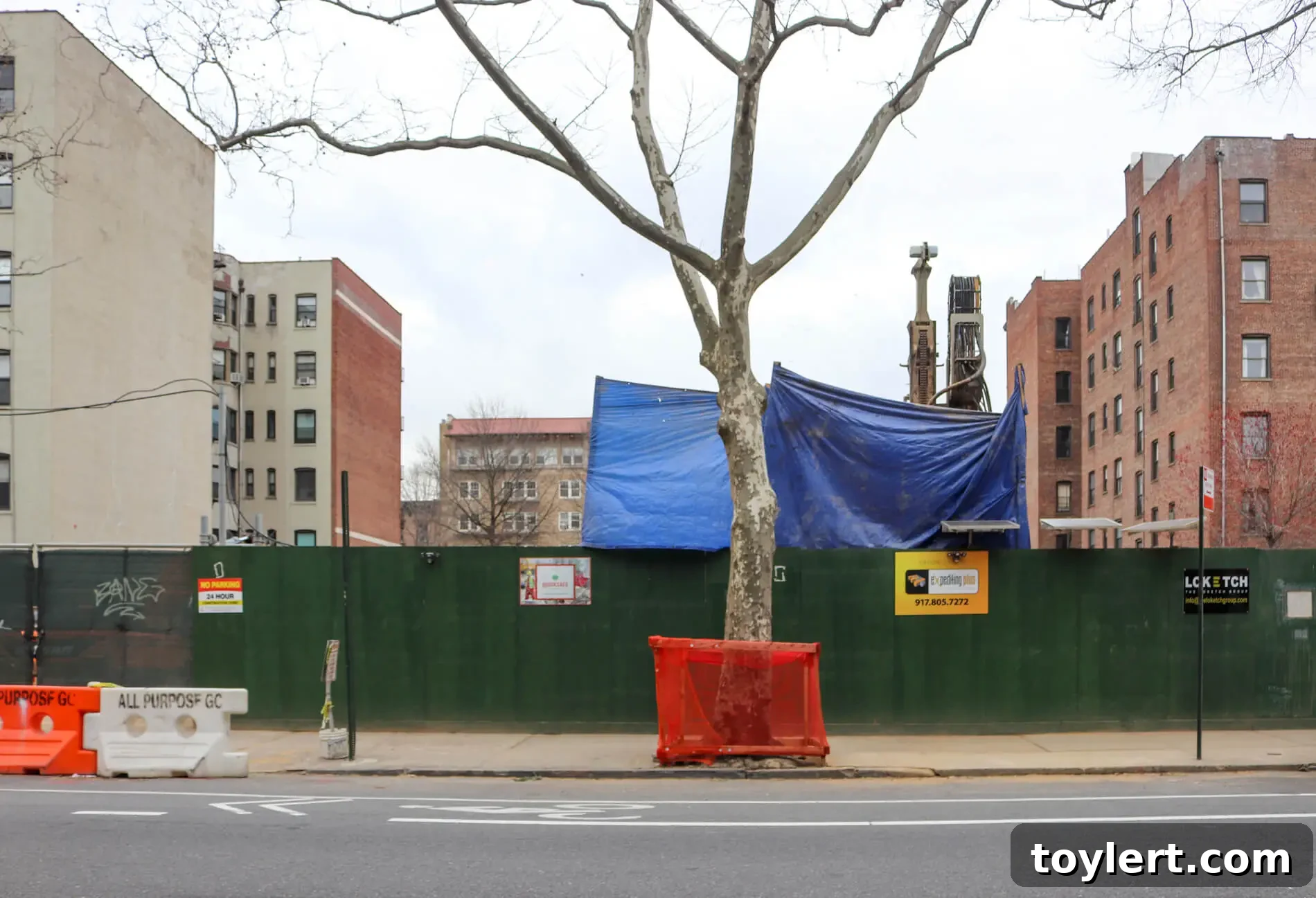
In a significant development that underscores the ongoing tension between urban expansion and historical preservation, the final two structures on a expansive, block-through property in Brooklyn’s distinguished Clinton Hill neighborhood have been demolished. This concludes the razing of a site formerly owned by a Christian organization, making way for what is anticipated to be a new chapter in one of New York City’s most architecturally rich areas.
The demolition marks the complete clearance of a property that once housed a prominent brick mansion, a carriage house, and a mid-20th-century building, fundamentally altering a notable corner of Clinton Hill. The loss of these structures, particularly the historic carriage house, reignites critical discussions about safeguarding Brooklyn’s dwindling architectural heritage against the relentless pressures of redevelopment.
Clinton Hill’s Architectural Legacy: A Vanishing Act?
Clinton Hill, a picturesque enclave in Brooklyn, is celebrated for its tree-lined streets, elegant brownstones, and an eclectic mix of Victorian, Neo-Grec, Romanesque Revival, and Queen Anne style mansions. It’s a neighborhood where every block tells a story, and its historic fabric is cherished by residents and architectural enthusiasts alike. The area is largely composed of historic districts, both on the National Register and locally designated by the New York City Landmarks Preservation Commission (LPC), which aim to protect its unique character.
The recently demolished property, formerly under the stewardship of Teen Challenge, a Christian organization, occupied a strategic location, bridging Vanderbilt Avenue. Its transformation began earlier with the demolition of the main brick mansion that once graced the site. This initial removal set the stage for the subsequent razing of the remaining buildings, culminating in the current cleared state of the entire parcel.
The Demolished Structures: A Closer Look
The Neo-Federal Carriage House at 434AB Vanderbilt Avenue
Among the structures lost, the carriage house at 434AB Vanderbilt Avenue stood out for its historical and architectural significance. Likely contemporary with the grand brick mansion that previously occupied the site, this neo-Federal style building contributed significantly to the streetscape. Its design, characterized by classical symmetry, delicate detailing, and a dignified presence, reflected the architectural tastes of its era, typically late 19th or early 20th century, when Clinton Hill was burgeoning with affluent residences.
Crucially, this carriage house was situated within a National Register historic district. National Register listing acknowledges a property’s historical or architectural significance at a national, state, or local level. While a prestigious recognition, it often provides limited direct protection against demolition by private owners, especially if no federal funding or permits are involved in the development. This distinction proved to be the carriage house’s undoing; despite its historic merit and contextual importance to the district, it lacked the stronger, enforceable protections afforded by a local landmark designation from the NYC Landmarks Preservation Commission.
The demolition of such a structure within a recognized historic district serves as a stark reminder of the vulnerabilities faced by historically significant buildings in rapidly developing urban centers. It highlights a critical loophole in preservation efforts, where properties deemed historically valuable by national standards can still be lost due to the absence of robust local oversight.
The Mid-20th Century Building at 443 Vanderbilt Avenue
The second building to be razed was located at 443 Vanderbilt Avenue. Described as a blue and white structure resembling a school, it dated from the mid-20th century. While perhaps not possessing the same degree of architectural grandeur as the carriage house or the former mansion, this building likely played a functional role in the property’s recent history, possibly serving as an administrative office, dormitory, or educational facility during Teen Challenge’s ownership. Its design reflected the pragmatic aesthetics of its era, contrasting with the ornate styles of earlier buildings in the neighborhood.
The removal of this structure, alongside its more venerable counterparts, signifies a complete overhaul of the property, erasing all prior physical manifestations of its history under the Christian organization’s purview. The clearance of this diverse collection of buildings, from the historic carriage house to the more functional mid-century structure, underscores a comprehensive approach to preparing the site for entirely new development.
The Mechanics and Motives Behind Demolition
The decision to demolish historic structures in a prime Brooklyn neighborhood is rarely made lightly, though often driven by powerful economic forces. In New York City, particularly in highly desirable areas like Clinton Hill, land values have soared dramatically over recent decades. Developers are keenly interested in acquiring large, unobstructed parcels that can accommodate significant new construction, typically high-end residential units or mixed-use developments.
For organizations like Teen Challenge, which may own valuable real estate, selling a property can represent a significant capital infusion to support their mission or relocate to more suitable facilities. The transaction between the former owner and the developer often hinges on the potential for maximum buildable area, making the removal of existing structures a precursor to maximizing profit from the site.
The process of demolition itself involves obtaining specific permits from the NYC Department of Buildings (DOB), ensuring safety protocols are followed, and managing environmental considerations. While the immediate act of demolition is swift, the planning, legal processes, and site preparation can span months or even years. The fact that the initial mansion and now these final two buildings have been systematically removed indicates a clear, long-term plan for the site’s future.
The Future of the Cleared Site: What’s Next for Clinton Hill?
With the entire block-through property now cleared, attention shifts to what will rise in place of these lost structures. Given Clinton Hill’s desirability and the current real estate market, it is highly probable that the site will be redeveloped into a luxury residential complex. This could manifest as a single large condominium building, multiple townhouses, or a combination thereof, designed to cater to Brooklyn’s affluent buyer demographic.
New developments in historic districts often face heightened scrutiny from community boards, preservation groups, and local residents. While developers are typically required to adhere to zoning regulations concerning height, bulk, and setbacks, the architectural style and materials of new construction can significantly impact the visual harmony of a historic streetscape. The challenge for developers will be to design a new building that, while modern, respects the existing scale and aesthetic of Clinton Hill’s unique architectural heritage.
The influx of new residents that a large development could bring will also have broader implications for the neighborhood. This includes increased demand for local services, potential changes in traffic patterns, and evolving commercial landscapes. While new residents and businesses can inject vitality, they also contribute to the ongoing transformation and, sometimes, gentrification of the area, a process that is often met with mixed feelings within established communities.
The Broader Debate: Preservation vs. Development
The demolition of the Clinton Hill buildings serves as a potent case study in the perennial conflict between urban development and historic preservation in New York City. On one side are the arguments for progress, economic growth, and the creation of much-needed housing in a densely populated city. Developers and property owners often highlight the economic benefits of new construction, including job creation, increased tax revenue, and the modernization of urban infrastructure.
On the other side are the impassioned pleas from preservationists, historians, and local residents who advocate for the protection of architectural treasures and the irreplaceable character of historic neighborhoods. They argue that once a historic building is gone, it is lost forever, taking with it a piece of the city’s narrative and cultural identity. The unique charm and allure of neighborhoods like Clinton Hill are intrinsically linked to their historic architecture, and unchecked development risks eroding the very qualities that make these areas so desirable.
The specific circumstances of the carriage house – being within a National Register Historic District but lacking local landmark protection – underscore a critical gap in the city’s preservation framework. It highlights the need for stronger and more comprehensive protective measures, as well as greater public awareness and advocacy, to ensure that significant historical assets are not inadvertently sacrificed for new construction. This case will undoubtedly fuel further calls for the NYC Landmarks Preservation Commission to proactively identify and designate more properties in vulnerable historic areas, thereby closing the loopholes that permit such losses.
Conclusion: A New Landscape for Clinton Hill
The complete demolition of the former Teen Challenge property marks an irreversible change for this corner of Clinton Hill. While the future development promises to bring new life and possibly new amenities to the area, it comes at the cost of losing significant architectural elements that contributed to the neighborhood’s celebrated charm and historical depth. The cleared site now stands as a blank canvas, awaiting a new structure that will inevitably reshape the character of Vanderbilt Avenue and its surroundings.
This event serves as a powerful reminder of the delicate balance required in urban planning and development. It challenges communities, policymakers, and developers to find innovative solutions that allow for growth and modernization without sacrificing the invaluable historical fabric that defines so much of New York City’s enduring appeal. As Clinton Hill continues to evolve, the memory of these lost buildings will undoubtedly remain a point of reflection in the ongoing narrative of Brooklyn’s development.