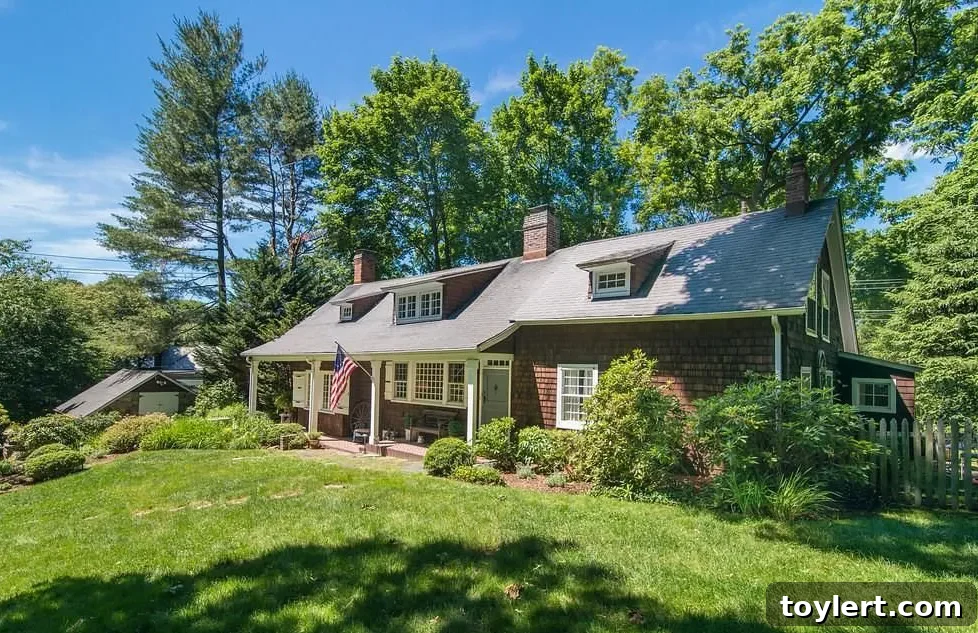
For those who dream of owning a tangible piece of history, a property that whispers tales from centuries past, a unique opportunity has emerged in Scarsdale, New York. Tucked away on Post Road stands a charming Dutch-style farmhouse, known as the Underhill House, which historians widely believe to be the oldest surviving residence in this affluent Westchester community. This architectural gem, with its foundations reaching back to the late 17th century, is now on the market, seeking a discerning buyer ready to embrace its rich legacy and add their own chapter to its storied existence. It represents more than just a house; it’s a living artifact, a bridge to Scarsdale’s earliest days.
While Scarsdale today is often celebrated for its magnificent early 20th-century estates, a testament to the suburban building boom that shaped much of the region, its origins are far more ancient and humble. The town’s recorded history began in 1701 with Caleb Heathcote’s establishment of the sprawling Manor of Scarsdale. This vast tract of land, encompassing what we now know as Scarsdale and surrounding areas, laid the groundwork for future development. Following Heathcote’s death and the subsequent breaking up of the manor, Scarsdale officially became a town in 1788. Through centuries of change, development, and expansion, only a precious handful of Scarsdale’s truly early homes have endured, and among these rare survivors, the Underhill House stands as a prominent and deeply significant example.
The Enduring Charm of the Underhill House: A Glimpse into the 17th Century
The Underhill House is a remarkable testament to the architectural styles and building techniques of its era. Believed to have been constructed in the late 1600s, it predates Scarsdale’s official founding as a manor. This suggests it was built by early Dutch settlers or their immediate descendants, pushing its historical significance even further back into the colonial tapestry of New Netherland. Its design hallmarks are characteristic of Dutch Colonial architecture, an enduring style brought to the region by the initial European colonists. Key features likely include a robust stone or fieldstone foundation, thick timber framing, and potentially a distinctive gambrel roof, designed to accommodate more living space on the upper floor while retaining a rustic, sturdy profile. These homes were built for resilience, designed to withstand the harsh colonial winters and serve generations of families.
Imagine the hands that shaped its timbers, the stories whispered within its walls over hundreds of years. The farmhouse would have originally been part of a working agricultural property, a self-sustaining homestead vital to the survival of its early inhabitants. Its strategic location along Post Road, a historic thoroughfare, further underscores its importance in the fledgling community. While specific records detailing every original owner might be scarce, the Underhill name itself hints at a prominent early family who contributed to the development of the region. Owning this house means becoming a steward of these untold narratives, connecting directly to the very first people who settled and cultivated this land.
Architectural Legacy and Modern Adaptations
Over the centuries, historic homes like the Underhill House often undergo careful transformations to blend modern comfort with historical integrity. A true appreciation for such a property requires an understanding of its evolution. While original elements like hand-hewn beams, wide-plank floorboards, and perhaps original fireplace surrounds would ideally be preserved, later additions and sympathetic renovations contribute to the home’s layered history. Modern heating, plumbing, and electrical systems are seamlessly integrated, allowing for contemporary living without sacrificing the unique character. This delicate balance of preservation and modernization is what makes a historic home not just a museum piece, but a vibrant and livable space that continues to serve its purpose centuries after its initial construction.
The beauty of Dutch Colonial architecture, especially as seen in houses of this vintage, lies in its understated elegance and practical design. Unlike the grander, more ornate styles that would emerge later, these early farmhouses prioritized function, durability, and a deep connection to the land. They often feature a welcoming central entryway, a comfortable living area, and bedrooms that offered respite from demanding daily lives. Natural light, though sometimes limited by smaller, period-appropriate windows, would have been highly valued. Any prospective owner would undoubtedly be captivated by the opportunity to explore these architectural details, uncover hidden historical features, and live within a design aesthetic that has stood the test of time.
Scarsdale’s Historical Tapestry: Beyond the Gilded Age
Scarsdale’s identity today is largely defined by its beautiful residential neighborhoods, excellent schools, and sophisticated suburban lifestyle. However, the true depth of its history extends far beyond the Gilded Age mansions of the early 20th century. The establishment of the Manor of Scarsdale by Caleb Heathcote in 1701 was a pivotal moment. Heathcote, an influential English merchant and politician, acquired vast tracts of land, envisioning a thriving agricultural and mercantile community. His vision laid the administrative and economic foundations for what would become Scarsdale. This era, characterized by large landholdings and tenant farming, set a distinct social and economic structure that persisted for decades.
The American Revolution brought significant changes to colonial land ownership, leading to the dissolution of many manors, including Scarsdale. The year 1788, when Scarsdale officially transitioned from a manor to a town, marked a new chapter, reflecting the emerging democratic ideals of the young United States. This period saw land ownership become more widespread, fostering the growth of independent farms and smaller communities. Homes like the Underhill House would have witnessed these profound transformations firsthand, standing resiliently through conflicts, economic shifts, and social evolution. They are silent observers of history, tangible links to the very fabric of American nation-building.
The Rarity of Scarsdale’s Early Homes
Given Scarsdale’s later reputation for grander homes, the survival of the Underhill House is particularly remarkable. Many early colonial structures, built primarily of wood, succumbed to fire, neglect, or were simply replaced as tastes and needs evolved. The post-Civil War period, and especially the early 20th century, saw Scarsdale transform into a desirable commuter town for wealthy New Yorkers. This led to a boom in construction, often resulting in the demolition of older, smaller homes to make way for more expansive estates. The fact that the Underhill House stands today speaks volumes about its sturdy construction, the care it has received from generations of owners, and its inherent historical value.
It is precisely this rarity that elevates the Underhill House from a mere dwelling to a historical treasure. It offers a unique window into Scarsdale’s past, providing a counter-narrative to the prevailing image of early 20th-century opulence. For historians, architects, and preservationists, it is an invaluable resource, offering insights into colonial life, architecture, and the continuous human endeavor to build and sustain communities. Its presence enriches Scarsdale’s heritage, reminding residents and visitors alike of the town’s deep and complex origins.
The Allure of Historic Home Ownership
Owning a historic home like the Underhill House transcends typical property ownership; it’s a profound commitment to stewardship. It means becoming a custodian of a legacy, safeguarding a piece of the past for future generations. For many, the appeal lies in the unique character and charm that modern homes simply cannot replicate. The craftsmanship, the quality of materials, and the inherent sense of history imbue these properties with an unparalleled soul. Every creak of the floorboards, every worn threshold, tells a story, offering a daily connection to those who walked its halls centuries before.
Beyond the emotional and historical gratification, owning a historic property can also be a sound investment. While they may require specialized maintenance and a commitment to period-appropriate renovations, these homes often appreciate in value due to their irreplaceable nature and distinctiveness. Many regions offer tax incentives or grants for the preservation of historic homes, recognizing their cultural importance. For the right buyer, someone with a deep appreciation for history, architecture, and the art of preservation, the Underhill House represents an extraordinary opportunity to live within a dynamic and ever-unfolding narrative.
A New Chapter for a Venerable Home
The availability of the Underhill House on the market is a rare event, a chance for someone to step into a role as its next guardian. It calls to an individual or family who values authenticity, who seeks more than just a place to live, but a place to belong to history. Imagine hosting gatherings in rooms that once sheltered colonial settlers, or enjoying quiet moments in a garden that has flourished through centuries. This is not merely a transaction; it’s an invitation to participate in a continuing legacy.
The future of the Underhill House lies in the hands of its next owner. It is an opportunity to revitalize its spaces, to restore any elements that may have faded over time, and to ensure its longevity for centuries to come. It represents a chance to bridge the past and the present, living within a dwelling that has witnessed the birth of a nation and the evolution of a vibrant community. For anyone who has ever dreamed of possessing Scarsdale’s oldest house, this is the moment to claim a truly irreplaceable piece of American history.