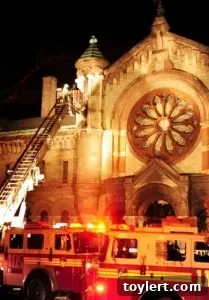
Arson Attack Strikes Historic Clinton Hill Church: A Community Beacon Damaged
In the quiet, tree-lined streets of Clinton Hill, Brooklyn, a community cornerstone was tragically impacted by a suspicious fire just before 4 AM on a recent Sunday. The Church of St. Luke and St. Matthew, a venerable institution built in 1891 and located at 520 Clinton Avenue, sustained significant charring to its entrance and exterior. More than just a place of worship, this historic church served as a vital homeless shelter and a bustling hub for the Occupy Sandy relief efforts, making the incident a profound blow to the neighborhood’s collective spirit and its most vulnerable residents. Authorities quickly launched an investigation into the blaze, treating it as a suspected arson, with initial reports indicating that cans of gas, originally intended for emergency generators, were used to deliberately ignite the fire. This act of destruction has left the community reeling, prompting both sorrow and a resolute determination to overcome adversity.
The Enduring Legacy of St. Luke and St. Matthew: A Pillar of Clinton Hill
For over a century, the Church of St. Luke and St. Matthew has stood as a testament to faith, community, and architectural splendor in Clinton Hill. Erected in 1891, its Gothic Revival elements and commanding presence have long defined a significant part of the neighborhood’s character. Beyond its stunning stained-glass windows and soaring spires, the church has always embraced a mission far exceeding its Sunday services. It has historically been a focal point for social outreach, offering solace and practical assistance to countless individuals and families. From its earliest days, it adapted to the evolving needs of the Brooklyn community, becoming not just a house of worship but a true sanctuary and a center for civic engagement.
Its role as a homeless shelter, in particular, underscores its deep commitment to humanitarian service. Providing a safe haven, warm meals, and essential support to those experiencing homelessness, the church became a lifeline for many who had nowhere else to turn. In a bustling urban environment like Brooklyn, such shelters are indispensable, offering dignity and hope in challenging circumstances. The sheer humanity embedded in this aspect of the church’s operations made the fire especially heartbreaking, as it directly threatened a critical resource for vulnerable populations. The congregation and leadership have consistently demonstrated an unwavering dedication to embodying Christian principles through action, making the church a true beacon of hope for all.
A Sanctuary in Crisis: The Church’s Vital Role in Occupy Sandy Relief
The year of the fire also saw the Church of St. Luke and St. Matthew step up in an extraordinary way to address a massive humanitarian crisis: the aftermath of Hurricane Sandy. When the superstorm devastated parts of New York City and beyond, leaving countless without power, heat, or shelter, the church quickly transformed into a crucial hub for Occupy Sandy relief efforts. This grassroots movement provided an organized response to the disaster, mobilizing volunteers and distributing aid where it was most needed. The church became a central command post, coordinating food distribution, warm clothing drives, and vital information dissemination. It served as a place for volunteers to gather, strategize, and find respite, while also directly providing shelter and warmth to those displaced by the storm.
Its generous opening of its doors during this period highlighted its profound civic responsibility and its capacity to act as a resilient anchor in times of extreme adversity. The church’s willingness to become a nexus for such intensive and widespread relief efforts solidified its reputation as a tireless servant of the community, transcending traditional religious roles to become an indispensable secular aid provider. This extensive engagement in the Occupy Sandy response meant that the fire not only damaged a historic building but also threatened the infrastructure of goodwill and practical support that had become so essential to the region’s recovery.
The Night of Malice: A Suspicious Blaze Ignites Questions and Concern
The circumstances surrounding the fire sent shockwaves through Clinton Hill. The early morning hours of Sunday, typically a time of quiet reflection before Sunday services, were shattered by the sound of sirens and the sight of flames licking at the venerable facade of the Church of St. Luke and St. Matthew. The prompt arrival of the Fire Department of New York (FDNY) prevented the complete destruction of the structure, but the damage to the entrance and exterior was evident and severe. What truly elevated the incident from an unfortunate accident to a malicious act was the discovery that the fire was intentionally set. Investigators found clear evidence that cans of gas, which had been stored on the premises for use in emergency generators – a crucial resource, particularly in the context of ongoing hurricane recovery efforts – were deliberately used as accelerants to start the blaze.
This detail transformed the narrative, shifting focus from mere damage to an act of deliberate arson, an assault on a sacred space and a vital community institution. The precise motives behind such a heinous act remain a subject of intense investigation and speculation, leaving the community grappling with unanswered questions and a sense of vulnerability. The targeted nature of the attack, particularly against a church so actively engaged in humanitarian work, fueled widespread anger and sorrow. The implications of an attack on such a community-centric organization extend far beyond the physical damage, touching upon the very fabric of trust and safety within the neighborhood.
Community Rallies: Faith, Forgiveness, and a United Front
In the wake of the fire, the resilience and compassion of the community shone brightly. Reverend Chris Ballard, the church’s curate, eloquently captured the prevailing sentiment, as quoted by the New York Daily News: “Why do people do bad things? We don’t know and our job is to try to work past that, try to find forgiveness. This is the season of it.” His words offered a profound message of grace and a call to transcend anger, focusing instead on the spiritual tenets of the season and the church’s enduring mission of compassion. This message resonated deeply, emphasizing healing and continuity over retribution, even as the search for accountability began.
Despite the damage and the disruption, the spirit of the church remained unbroken. On that very Sunday morning, rather than succumb to despair, the choir gathered outside the charred entrance, their voices rising in unison, a powerful symbol of unwavering faith. Regular services were promptly relocated a few blocks away to the welcoming embrace of Brown Memorial Baptist Church, demonstrating the interconnectedness and mutual support within the broader Brooklyn religious community. This swift adaptation ensured that the congregation could continue to gather, worship, and find comfort in shared faith, showcasing the enduring strength of collective spirit in the face of adversity. The community’s immediate rallying around the Church of St. Luke and St. Matthew underscored its profound importance to the lives of many.
Justice Sought: Council Member James Offers Reward for Information
The severity of the incident and its implications for public safety spurred a rapid response from local authorities and elected officials. Council Member Tish James, representing the district, immediately issued a press release condemning the act and announcing a significant step towards bringing the perpetrator to justice. A reward of $1,000 was offered for any information that would lead to the arrest and conviction of whoever was responsible for setting the fire. Such rewards are critical tools in criminal investigations, often incentivizing individuals with knowledge to come forward, thereby assisting law enforcement in solving complex cases. This public appeal underscored the seriousness with which the arson was being treated and the collective desire to protect community institutions from such malicious acts.
The offer of a reward served multiple purposes: it conveyed a strong message that such crimes would not be tolerated, it provided a tangible incentive for cooperation, and it reassured the community that authorities were actively pursuing every avenue to ensure justice. It also highlighted the fact that this was not merely damage to property, but an attack on the values and services that the church represented. The community was encouraged to remain vigilant and to report any suspicious activity or information that might shed light on the incident, reinforcing the idea that public safety is a shared responsibility.
Looking Forward: Rebuilding, Resilience, and Renewed Hope
Even as the investigation continues, the focus for the Church of St. Luke and St. Matthew and the Clinton Hill community quickly shifted towards rebuilding and recovery. The immediate physical damage, particularly to the entryway, necessitates extensive repairs and restoration work. This process, while costly and time-consuming, is also an opportunity for the community to come together, demonstrating its collective resolve to see the church restored to its former glory and functionality. The ongoing presence of the church, its history, and its vital services mean that its future is intertwined with the well-being of the neighborhood itself. The spirit of the season, a time traditionally associated with hope and renewal, provided a poignant backdrop for these efforts.
In a powerful testament to its unwavering commitment, the church confirmed that its cherished Christmas Eve midnight mass would proceed as planned, though perhaps with some adjustments to location or access, as announced on its website tonight at 10 pm. This decision to continue with such an important spiritual event, despite the recent trauma, embodies the very essence of resilience and faith. It sends a clear message that while the physical structure may have been targeted, the heart and mission of the Church of St. Luke and St. Matthew remain vibrant and undiminished. The community looks forward to supporting these rebuilding efforts, ensuring that this historic beacon of hope continues to serve for generations to come.
The Broader Implications: Protecting Our Community Sanctuaries
The arson attack on the Church of St. Luke and St. Matthew serves as a stark reminder of the vulnerability of community institutions, especially those that tirelessly serve the most marginalized. Churches, community centers, and shelters are often the unsung heroes of urban landscapes, providing essential services, fostering social cohesion, and offering spiritual guidance. When such places are attacked, it reverberates throughout the entire community, shaking foundations of trust and safety. This incident highlights the critical need for increased vigilance and support for these vital organizations, ensuring they can continue their work without fear of malicious disruption. Protecting these sanctuaries is not just about safeguarding buildings; it is about preserving the vital social safety nets and moral compasses they represent.
The outpouring of support and the collective determination to see the church rebuilt reflect a deep understanding of its invaluable role. It underscores the profound truth that a community is only as strong as its weakest link, and that acts of malice against institutions of service ultimately harm everyone. As the investigation progresses and the church embarks on its journey of restoration, the incident will undoubtedly leave an indelible mark. Yet, it also reinforces the powerful message that compassion, resilience, and community solidarity can ultimately triumph over acts of hatred and destruction.
For more details on this developing story, please refer to:
- Fire Damages Brooklyn Church [The New York Times]
- Historic Brooklyn Church Damaged in Early Morning Blaze [New York Daily News]