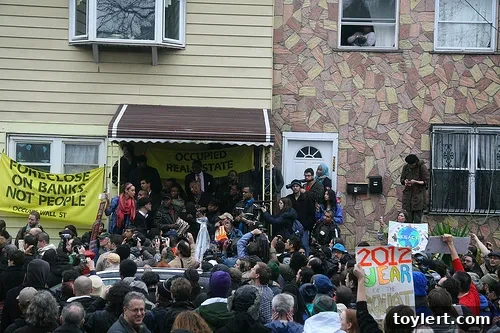
Occupy Wall Street’s East New York Foreclosure Intervention: A Complex Struggle for Housing Justice
In a bold move that captured national attention and ignited fierce debate, members of the Occupy Wall Street (OWS) movement initiated a direct action campaign in late 2011, taking over a foreclosed property in the East New York neighborhood of Brooklyn. The activists’ stated objective was clear: to renovate the vacant home, left derelict after a foreclosure, and transform it into a habitable dwelling for a homeless family struggling with the harsh realities of New York City’s persistent housing crisis. This act, part of OWS’s broader “Occupy Homes” initiative, aimed to draw public scrutiny to the devastating impact of widespread foreclosures and the urgent need for accessible, affordable housing solutions. However, the narrative surrounding this particular intervention quickly grew complicated, evolving from a simple act of humanitarian aid into a complex legal and ethical quandary that brought into question the efficacy and profound consequences of direct social action.
The Genesis of Occupy Wall Street and the Housing Crisis Connection
To fully understand the context of the East New York takeover, it’s essential to recall the broader landscape of the Occupy Wall Street movement. Emerging in September 2011 from Zuccotti Park in Lower Manhattan, OWS was a grassroots protest against deep-seated economic inequality, corporate greed, and the perceived failures of the financial system that led to the 2008 global financial crisis. Its rallying cry, “We are the 99%,” resonated with millions who felt marginalized and exploited by a system that seemed to favor the wealthy few at the expense of the vast majority.
The housing market collapse was a direct and devastating consequence of this financial instability, leaving countless homeowners in distress and contributing to an unprecedented surge in foreclosures across the nation. Millions lost their homes, their savings, and their sense of security. For OWS, these vacant, foreclosed properties symbolized the systemic injustices they sought to challenge. The movement argued passionately that homes should be for people, not merely for profit or speculative investment, and that a society with unoccupied houses coexisting with a pervasive homelessness crisis represented a profound moral and governmental failing.
The “Occupy Homes” offshoot of OWS specifically targeted this issue, organizing interventions designed to prevent evictions, reclaim foreclosed properties, and provide desperately needed shelter for those in need. These actions were rooted in the belief that direct intervention could not only offer immediate relief to individuals and families but also pressure authorities and financial institutions to address the root causes of the housing crisis. The East New York operation, situated at 702 Vermont Street, was one such high-profile endeavor, intended to serve as a powerful symbol of resistance against corporate power and a tangible, albeit temporary, solution to homelessness.
The East New York Intervention: A Beacon of Hope or a PR Gambit?
Upon taking control of the property in East New York, OWS members publicly announced their intentions to meticulously renovate the house, aiming to make it safe, clean, and welcoming for a family without a home. The vision presented to the public was compelling: transforming a symbol of neglect and economic devastation into a sanctuary of hope and stability. The initiative garnered significant and widespread media attention, initially portraying the activists as compassionate champions for the underprivileged, actively working to mend the cracks in society’s safety net. They emphasized the moral imperative of repurposing abandoned assets for the greater social good, particularly in a city like New York, where homelessness continued to be a pressing and visible issue. The very act of “fixing up” a house was meant to demonstrate a constructive, community-oriented approach to activism, moving beyond mere protest to tangible, impactful change that benefited those most in need.
However, the initial reports surrounding the East New York project quickly became clouded with ambiguity and conflicting accounts. While OWS declared a homeless family was slated to move in, the actual occupancy remained uncertain for some time. Reports from outlets like the New York Post indicated that the family in question had “yet to fully do so.” The precise reasons behind this delay were opaque: was the renovation incomplete, rendering the home uninhabitable or unsafe? Or was there an issue of insufficient space, making the property unsuitable for the family’s specific needs and size? This lack of clarity immediately raised critical questions about the ultimate effectiveness and primary motivation behind the occupation. Critics and observers began to speculate whether the East New York intervention was genuinely about providing sustainable housing or if it served primarily as a powerful public relations stunt, strategically designed to amplify OWS’s broader message rather than deliver concrete, long-term results on the ground for an individual family.
The Homeowner’s Plight: Wise Ahadzi’s Struggle to Reclaim His Property
Adding a profound and deeply personal layer of complexity to the unfolding drama was the story of Wise Ahadzi, the original homeowner of the property at 702 Vermont Street. Ahadzi’s narrative, tragically common during the tumultuous post-2008 economic downturn, painted a poignant picture of personal loss and systemic hardship. He had purchased the house in 2007 for a significant sum of $424,500, investing his life savings, his hopes, and his dreams into what he believed would be a stable future for his children and himself. Just a couple of years later, in 2009, his life took a devastating turn. After losing his job, he found himself in the dire position of being unable to make the escalating mortgage payments. Compounding his financial woes, the value of his home plummeted in the aftermath of the market crash, leaving him “underwater” on his loan—meaning he owed more than the property was worth. This eventually forced him into the agonizing process of foreclosure.
Despite the foreclosure, Ahadzi had not abandoned his home willingly or permanently. He asserted his rightful ownership and, crucially, his fervent desire to reclaim the property from the activists who had taken it over. His plea was straightforward, deeply personal, and emotionally charged: “I’m trying to get my house back, and they’re trying to take it from me.” This statement starkly highlighted the fundamental clash of rights and intentions at the heart of the East New York saga. While OWS viewed the property as an “abandoned” or “vacant” asset ripe for social reclamation, Ahadzi saw it as his cherished home, a tangible symbol of his past efforts, and a potential anchor for his family’s future, despite his temporary displacement. He claimed that the Occupy Wall Street organizers were unwilling to even entertain the notion of reinstating him and his children in the house, suggesting either a lack of empathy for his individual plight or a rigid adherence to their activist agenda. His situation powerfully underscored the painful reality that behind almost every foreclosed home, there is a personal story of hardship, not necessarily an intentional or willing abandonment.
Navigating the Ethical and Legal Labyrinth
The East New York incident forced a critical examination of the ethical and legal boundaries of housing activism and direct action. On one hand, OWS activists invoked a potent moral argument: that providing essential shelter for the homeless outweighs technical property rights when a house stands vacant and decaying amidst a dire housing crisis. Their actions were deeply rooted in a desire for social justice, aiming to rectify what they perceived as profound systemic failures. On the other hand, Wise Ahadzi’s claim to his property, even post-foreclosure, raised valid and pressing legal questions about trespass, rightful ownership, and the sanctity of individual property rights. While a bank might hold the mortgage and have initiated foreclosure proceedings, the property’s precise legal status and the former owner’s emotional and potential legal ties to it remained complex and subject to interpretation.
The debate extended far beyond the immediate parties involved, prompting broader public discussions about the rights of homeowners facing foreclosure, the responsibilities and ethical conduct of banks and financial institutions, and the appropriate role of activist movements in addressing vast societal problems. Is it truly justifiable for activists to unilaterally decide the fate of a private property, even if their intentions are benevolent and their cause is noble? What are the long-term implications for property law, civil order, and community relations if such direct actions become widespread? These questions had no easy or universally accepted answers, reflecting the nuanced and often conflicting perspectives inherent in situations where severe economic hardship meets fervent activist zeal. The lack of a clear, public resolution regarding Ahadzi’s efforts to reclaim his home further muddied the waters, leaving many to wonder about the true legacy and enduring impact of the East New York intervention.
Beyond East New York: The Broader Impact of Housing Activism
The Occupy Wall Street East New York incident, regardless of its immediate, definitive outcome for the specific property and individuals involved, served as a powerful microcosm of the larger, ongoing struggles surrounding housing insecurity and social justice in America. It vividly illuminated the desperate conditions faced by countless families without shelter and underscored the profound, often devastating, impact of the foreclosure crisis on ordinary citizens. It also highlighted the inherent tension between direct action advocacy — which seeks immediate, tangible change — and existing legal and governmental frameworks, which often move slowly or are perceived as inadequate.
While such interventions may not always lead to simple, definitive, or universally celebrated solutions, they undeniably play a crucial role in raising public awareness, sparking vital public debate, and often forcing a critical re-evaluation of current policies and societal priorities. The OWS movement, through its various “Occupy Homes” initiatives, brought the pressing issue of vacant properties existing paradoxically amidst widespread homelessness into sharp focus, challenging the status quo and urging a more compassionate, equitable, and effective approach to housing. The story of 702 Vermont Street, therefore, transcends a single property dispute; it embodies the complex, often heartbreaking, interplay of powerful economic forces, individual plights, and the persistent human drive for justice and shelter in a rapidly changing and often unequal world.
The lasting impression left by the East New York saga is not just about a single house, but about the continuing, crucial conversation surrounding who has a right to shelter, who truly owns the spaces we inhabit, and how a society balances fundamental property law with urgent humanitarian needs. It reminds us that solving the multifaceted housing crisis requires comprehensive, multi-faceted approaches, combining necessary legal reforms, innovative community initiatives, robust governmental support, and, at times, the uncomfortable but necessary disruptions brought by courageous direct action.