Brooklyn’s Forgotten Catastrophes: Unearthing the Borough’s Most Harrowing Historical Disasters
Brooklyn, a borough celebrated for its vibrant culture, iconic landmarks, and dynamic communities, also possesses a somber history punctuated by a surprising number of devastating, yet often overlooked, tragedies. From the clamor of its early industrial era to the mid-20th century, Brooklyn has endured a variety of transit disasters, catastrophic fires, and structural collapses. While many of these incidents resulted in significant loss of life and property, the passage of time has sadly dimmed their memory, pushing them into the forgotten annals of local lore.
These man-made catastrophes, whether stemming from rapidly expanding infrastructure, the inherent risks of burgeoning transportation systems, or unforeseen structural failures, profoundly impacted the borough’s residents and development. They stand as stark reminders of the challenges faced by a rapidly growing urban center. This article aims to shed light on some of Brooklyn’s most extreme yet least remembered tragedies, exploring their causes, consequences, and enduring, albeit faint, echoes in the present day. By revisiting these harrowing chapters, we not only honor the lives lost but also gain a deeper appreciation for the borough’s resilience and the relentless pursuit of urban safety that followed in their wake.
The Echoes of Steel and Smoke: Major Transit Disasters in Brooklyn
As a vital nexus of commerce and population, Brooklyn’s transportation networks were, and remain, arteries of daily life. However, their rapid expansion in the late 19th and early 20th centuries often came with unforeseen risks, leading to some of the borough’s most horrific incidents. These transit disasters, involving trains, subways, and even early aviation, highlight the inherent dangers of progress when safety measures lagged behind technological advancements, leaving a legacy of cautionary tales.
The Malbone Street Wreck (1918): Brooklyn’s Deadliest Subway Disaster
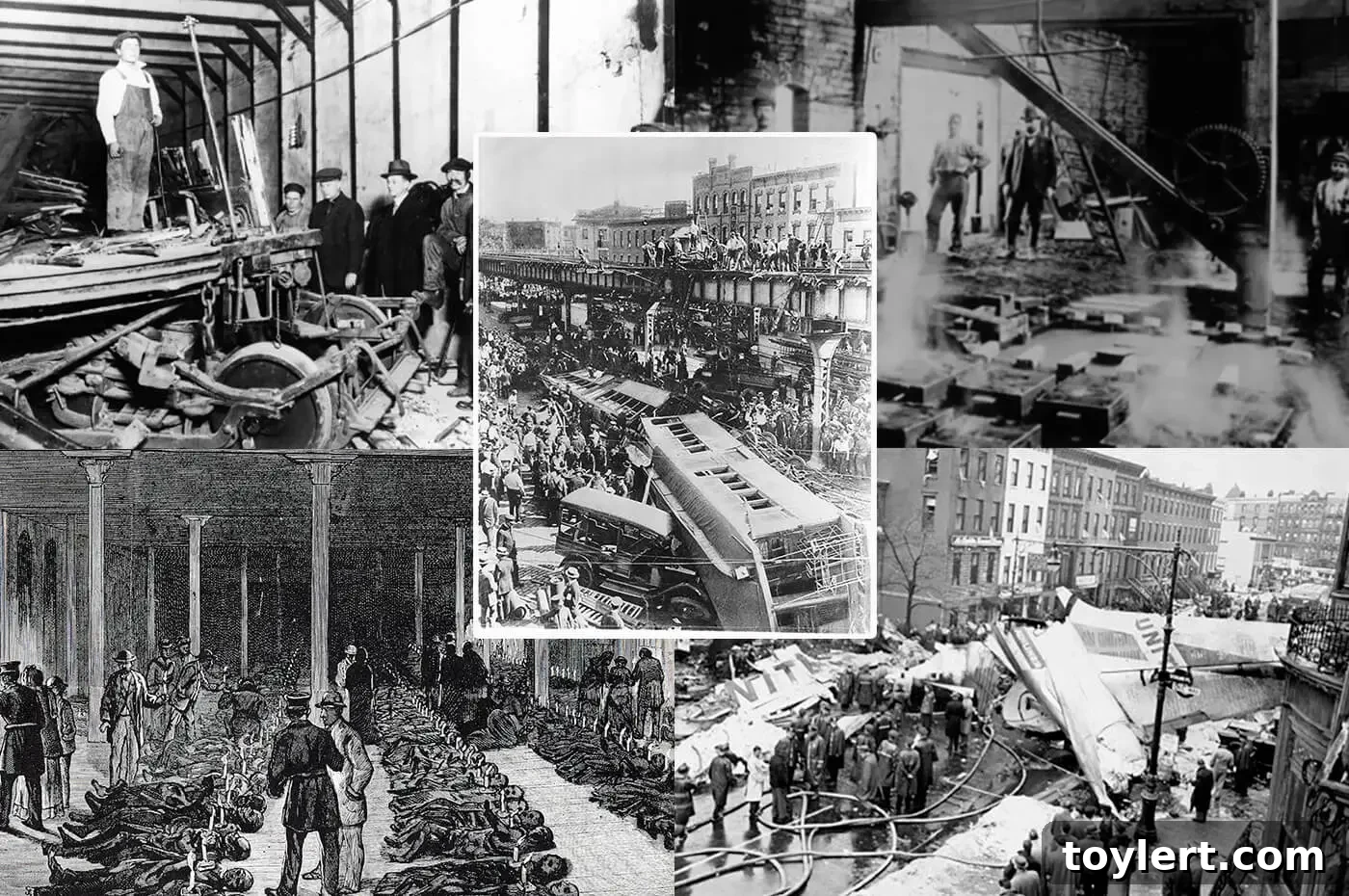
Among the most tragic events in Brooklyn’s history, and certainly its deadliest subway accident, is the Malbone Street Wreck, which occurred on November 1, 1918. In the heart of the First World War’s final days and amidst the global influenza pandemic, Brooklyn faced another horror. A five-car wooden elevated train, operated by the Brooklyn Rapid Transit Company (BRT), derailed in a tight curve on the Brighton Beach line near Malbone Street (now Empire Boulevard) in what is now Prospect Lefferts Gardens. The motorman, an inexperienced dispatcher pressed into service due to a strike, was speeding through the curve at an estimated 30-40 miles per hour, well above the mandated 6 mph limit.
The consequences were catastrophic. The wooden cars crumpled and shattered, trapping and crushing hundreds of passengers. The initial death toll was reported at 93, but revised figures indicate that at least 102 people perished, with many more severely injured. The scene was one of utter devastation, requiring hours for emergency responders to extricate the dead and wounded from the wreckage. The Malbone Street Wreck exposed severe operational deficiencies and inadequate safety protocols within the BRT, leading to widespread public outcry, governmental investigations, and ultimately, significant reforms in subway safety, infrastructure, and employee training across New York City’s transit system. It remains a grim benchmark in urban transportation history, a tragedy that reshaped public expectations for safety and accountability in mass transit, yet its specific details are often overlooked by those outside of local historical circles.
Other Forgotten Rail and Road Incidents
While the Malbone Street Wreck stands out for its sheer casualty count, countless smaller yet still impactful transit incidents have faded from collective memory. Early elevated train lines, bustling streetcars, and burgeoning automobile traffic all contributed to a streetscape prone to accidents. Collisions between streetcars and horse-drawn carriages, and later automobiles, were commonplace, often resulting in fatalities and serious injuries. Bridge failures, though less frequent, also posed significant threats, particularly to pedestrians and smaller vessels navigating Brooklyn’s waterways. These less-publicized events, while not reaching the scale of Malbone Street, painted a continuous backdrop of danger in Brooklyn’s bustling streetscape, each leaving its own individual scar on families and communities. They underscore the relentless hazards faced by a city grappling with rapid modernization and the challenges of integrating diverse modes of transport.
Infernos and Ashes: Catastrophic Fires That Engulfed Brooklyn
Fire has always been an ever-present danger in densely populated urban environments, particularly in eras when building materials were predominantly wood and fire safety codes were nascent or non-existent. Brooklyn’s history is scorched by several devastating infernos that not only consumed property but also claimed numerous lives, fundamentally altering the borough’s physical and social fabric and driving crucial advancements in fire prevention and response.
The Brooklyn Theatre Fire (1876): A Night of Unthinkable Horror
One of the most horrific forgotten fires in American history occurred in Brooklyn on the night of December 5, 1876, at the Brooklyn Theatre on Washington Street (now Cadman Plaza West). During a performance of “The Two Orphans,” a gaslight ignited a piece of scenery on stage. Despite initial attempts by actors to extinguish it, the fire quickly spread to the canvas backdrop and then rapidly consumed the theater’s wooden interior, trapping hundreds of spectators in a terrifying inferno.
Panic ensued as patrons rushed for the exits, many of which were either locked, unfamiliar, or quickly became impassable due to dense smoke and roaring flames. The fire claimed the lives of at least 278 people, though some estimates place the number closer to 300, making it one of the deadliest theater fires globally. Most victims were found piled at the foot of staircases or near obstructed exits, a grim testament to the chaos and inadequate escape routes. The tragedy led to a massive overhaul of fire safety regulations for public venues across the nation, mandating emergency exits, outward-opening doors, fireproof materials, and clear evacuation routes. Yet, despite its profound impact on safety legislation and the stark lessons it provided, the memory of the Brooklyn Theatre Fire often pales in comparison to other historical disasters, leaving its full historical significance underappreciated.
Industrial Fires and Residential Blazes
Beyond grand public venues, countless industrial fires and residential blazes have shaped Brooklyn’s history, often with devastating consequences that rarely make it into mainstream historical accounts. Factories, warehouses, and densely packed tenement buildings were particularly vulnerable. Fires in garment factories, bakeries, or workshops, such as those that occurred throughout New York City in the late 19th and early 20th centuries, highlight the dangerous working conditions prevalent during these eras. These blazes, often starting from faulty machinery, highly flammable materials, or negligent safety practices, led to significant loss of life among workers, many of whom were immigrant women and children striving to make a living. The sheer scale of industrial activity in Brooklyn meant that these incidents were tragically common.
Residential fires, fueled by heating accidents, overcrowded living conditions, or inadequate construction, also frequently plagued Brooklyn’s poorer neighborhoods, particularly in areas with wooden structures and limited access for early fire departments. Such fires left behind widespread destruction, displacement, and personal tragedies, their individual stories often lost in the sheer volume of daily misfortunes. While lacking the single, dramatic death toll of a major theater fire, the cumulative effect of these smaller, localized infernos profoundly impacted countless Brooklyn families, contributing to the borough’s ongoing struggle for safer housing and working environments.
When the Sky Fell: Aviation Disasters Over Brooklyn
While less common than ground-based incidents, the advent of air travel in the 20th century brought a new dimension of potential catastrophe to urban areas. Brooklyn, with its proximity to major metropolitan airports, has tragically been the site of at least one major aviation disaster that sent shockwaves through the community, even if its intricate details are not universally recalled today.
The Park Slope Plane Crash (1960): A Collision Above the City
On December 16, 1960, the skies above New York City became the scene of a catastrophic mid-air collision between two commercial airliners: United Airlines Flight 826 and TWA Flight 266. While much of the wreckage from TWA Flight 266, a Lockheed Super Constellation originating from Ohio, fell into Staten Island, the larger United Airlines Flight 826, a Douglas DC-8 en route from Chicago to Idlewild Airport (now JFK), crashed directly into the vibrant Park Slope neighborhood of Brooklyn.
The impact in Park Slope was devastating. The DC-8 plunged into a busy intersection at Seventh Avenue and Sterling Place, destroying several brownstones, a church, and a funeral parlor. All 128 people aboard both aircraft were killed, along with six people on the ground in Brooklyn who were caught in the fiery aftermath. The site was transformed into an inferno, with debris scattered across multiple blocks, creating a scene of unparalleled destruction and chaos. The crash highlighted the urgent need for more sophisticated and integrated air traffic control systems, particularly over densely populated metropolitan areas, becoming a critical case study in aviation safety. Though it was a major news event in its time, the Park Slope plane crash is sometimes overshadowed by other national tragedies, making its profound local impact and the heroism of first responders less universally known outside the borough, even as it continues to resonate deeply within the Park Slope community.
Collapsing Foundations: Structural Failures and Building Disasters
The rapid construction boom that characterized much of Brooklyn’s growth inevitably led to instances of structural failure. Though less frequent than fires or transit incidents, these collapses often had equally devastating consequences, underscoring the critical importance of robust engineering, stringent building codes, and vigilant construction standards.
Forgotten Building Collapses and Construction Accidents
Beyond major fires or crashes, Brooklyn’s history includes a multitude of less-remembered structural failures that, while perhaps not reaching the scale of a theater fire, profoundly impacted the lives of workers and residents. These range from the collapse of factory walls, often due to age, poor maintenance, or excessive loads, to poorly constructed tenement buildings giving way, tragically burying their inhabitants. Scaffolding accidents during the construction of ambitious new projects were also not uncommon, claiming the lives of laborers and sometimes innocent bystanders caught in the path of falling debris.
For instance, in the late 19th and early 20th centuries, as Brooklyn rapidly urbanized and underwent massive infrastructure development, construction sites were often incredibly hazardous, with minimal safety regulations. The tragic collapse of incomplete structures, or parts thereof, was a grim reality, claiming lives and highlighting the rudimentary state of engineering knowledge and safety enforcement at the time. These incidents, while localized, contributed to the ongoing evolution of building codes and safety regulations, gradually transforming construction into a safer, more regulated industry. Each collapse, however small its reported scale, represents a failure of design or execution and a profound loss for those affected, now largely forgotten within the grand narrative of Brooklyn’s development, but instrumental in shaping its modern safety landscape.
The Enduring Legacy of Forgotten Tragedies
The collective memory of a city is often shaped by its grand achievements and its most celebrated figures. However, it is also intrinsically woven with the fabric of its hardships and its forgotten disasters. Brooklyn’s history of extreme tragedies, from the terrifying speed of a runaway train to the sudden inferno of a theater or the explosive impact of a falling plane, serves as a powerful testament to the borough’s resilience and its relentless journey toward safer urban living.
These forgotten incidents were not mere footnotes; they were catalysts for profound change. The Malbone Street Wreck prompted significant reforms in subway operation and safety, leading to the overhaul of transit systems. The Brooklyn Theatre Fire led to nationwide improvements in public venue safety, mandating clearer exits and fireproof materials. The Park Slope plane crash spurred advancements in air traffic control technology and safety protocols, making air travel safer for millions. Each disaster, in its own grim way, contributed to the development of better regulations, more robust infrastructure, and a heightened public awareness of safety, often at an immeasurable human cost.
Remembering these events is crucial not only for honoring the lives lost and acknowledging the suffering endured but also for understanding the foundational efforts that underpin our modern safety standards. By unearthing these harrowing chapters, we gain a deeper appreciation for the complex, often challenging, history of Brooklyn and the constant human endeavor to build a safer, more resilient urban environment. These forgotten catastrophes are silent teachers, whispering lessons of vigilance, accountability, and the profound cost of oversight, ensuring that their echoes, however faint, continue to guide us in building a future free from their grim repetitions.