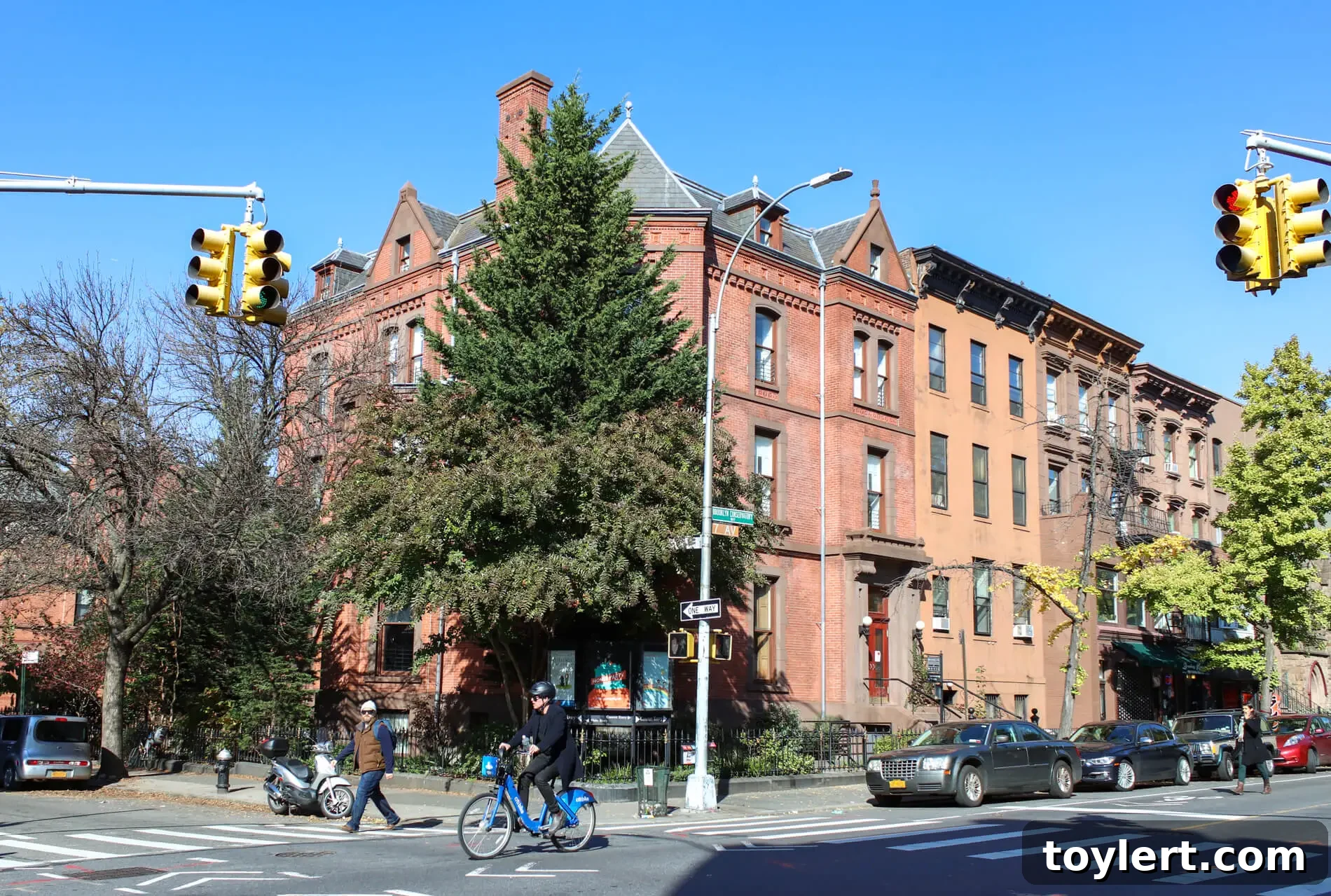
The Enduring Legacy of 58 7th Avenue: From Oilcloth Empire to Musical Landmark in Park Slope
This article expands on a previous exploration of this iconic Brooklyn edifice, delving deeper into its rich history and architectural significance.
Nestled on the vibrant corner of 7th Avenue and Lincoln Place in Brooklyn’s historic Park Slope, the grand structure at 58 7th Avenue stands as a magnificent testament to a bygone era of industrial success and architectural splendor. Today, this imposing mansion serves as the cherished home of the Brooklyn Conservatory of Music, a beacon of cultural enrichment for the borough. Yet, its origins tell a fascinating story of a self-made industrialist, William M. Brasher, whose lucrative oilcloth manufacturing business in the mid to late-19th century provided the means to construct this lavish private residence. Brasher’s story is intertwined with the burgeoning prosperity of Brooklyn and the evolving architectural tastes that shaped its grandest neighborhoods.
William M. Brasher: A Titan of the Oilcloth Industry
William M. Brasher was not merely a businessman; he was a visionary who capitalized on a practical necessity of the 19th century: durable floor coverings. His name became synonymous with high-quality oilcloths, which were revolutionary alternatives to traditional rugs and carpets. In an era before widespread linoleum and vinyl, oilcloths offered a hygienic, affordable, and easily cleanable solution for homes, offices, and public spaces.
Brasher’s manufacturing operations were extensive, anchored by a prominent factory situated on 7th Avenue at 20th Street. For many years, this facility hummed with activity, churning out vast quantities of oilcloth that found their way into countless American households. Oilcloths were typically made by applying multiple coats of linseed oil-based paint to heavy canvas or duck cloth, then often finished with decorative patterns and protective varnishes. This meticulous process resulted in a product celebrated for its longevity and water resistance, attributes highly valued in a time when cleanliness was a constant challenge and expensive woven carpets were susceptible to dirt and wear.
The success of Brasher’s enterprise was immense. His innovative approach and dedication to quality garnered him significant wealth, a testament to the industrial boom of the period. This prosperity allowed him to realize a dream shared by many successful entrepreneurs of his time: to build a substantial, architecturally distinguished home that reflected his accomplishments and social standing. The mansion at 58 7th Avenue was precisely that — an embodiment of Brasher’s personal triumph and a physical manifestation of his flourishing oilcloth empire.
A Symphony of Styles: Victorian High Gothic Meets Queen Anne Grandeur
The architectural design of 58 7th Avenue is a captivating study in late 19th-century eclecticism, masterfully blending two dominant and highly expressive styles: Victorian High Gothic and Queen Anne. At first glance, the building’s imposing presence and intricate details immediately draw the eye, signaling a deliberate departure from simpler, more uniform designs.
The influence of the **Victorian High Gothic** style is particularly evident in the building’s robust massing, the use of varied and often rough-hewn materials, and its dramatic verticality. This style, popularized by figures like John Ruskin and inspired by medieval cathedrals, emphasized natural forms, structural honesty, and a picturesque asymmetry. In Brasher’s mansion, one can discern High Gothic elements through its heavy, stone-trimmed windows, potentially steeply pitched gables, and an overall sense of solidity and grandeur. The preference for rich, contrasting materials, such as different types of stone or brick alongside terra cotta or wood, is a hallmark of this style, contributing to a facade that tells a story through its varied textures and colors.
Concurrently, the house exhibits strong **Queen Anne styling**, a distinctively American interpretation of late Victorian architecture known for its playful complexity and domestic charm. Queen Anne elements are vividly apparent in the “massing of the different parts of the house,” which refers to the way various sections of the building project, recede, and interlock, creating an irregular and visually engaging silhouette. This often includes towers, turrets, bays, and varying rooflines that break up the traditional box-like form. The “mixture of materials used” and “how they were assembled on the façade and interior” are quintessential Queen Anne characteristics. This style revels in combining textures like shingles, brick, stone, terra cotta panels, and elaborate woodworking (such as spindlework or fish-scale shingles) to create dynamic and highly decorative surfaces. Intricate patterns, stained glass, and decorative chimneys further enrich the Queen Anne aesthetic.
Together, these styles create a harmonious yet complex architectural statement. The solidity and structural integrity of High Gothic elements provide a powerful foundation, while the decorative flair and irregular forms of Queen Anne lend the house an inviting, almost narrative quality. This fusion resulted in a residence that was both formidable and aesthetically rich, perfectly suiting the aspirations of its prosperous owner and reflecting the sophisticated tastes prevalent in Brooklyn’s elite neighborhoods during the latter half of the 19th century.
A New Chapter: From Private Residence to Community Cornerstone
Like many grand mansions of its era, 58 7th Avenue eventually transitioned from a single-family dwelling to serve broader community purposes. While the exact timeline of its transformation after Brasher’s tenure would require specific historical records, it is known that the building later became home to the Park Slope Masonic Club. This period reflects a common trend where large, opulent homes became increasingly impractical for single families and were often acquired by fraternal organizations, clubs, or institutions seeking prestigious and spacious headquarters.
The Masonic Club would have utilized the mansion’s expansive rooms for meetings, social gatherings, and ceremonial events, preserving its historical integrity while adapting it to new needs. The transition from private home to a fraternal club marked an important step in its journey towards public accessibility and communal utility.
The most significant chapter in the building’s modern history began when it became the permanent home of the Brooklyn Conservatory of Music. Established in 1897, the Conservatory is one of the oldest and most respected community music schools in New York City. Its move into the former Brasher mansion provided it with an iconic, architecturally significant home that perfectly complemented its mission of fostering musical education and appreciation. The grand ballrooms and spacious parlors, once witness to Brasher’s family life and Masonic gatherings, were revitalized as practice rooms, performance spaces, and classrooms, filled with the vibrant sounds of aspiring musicians and seasoned instructors.
Today, the Brooklyn Conservatory of Music continues to thrive at 58 7th Avenue, offering a wide array of programs for all ages and skill levels, from early childhood music classes to adult ensemble performances. The institution is a vital cultural anchor in Park Slope, contributing significantly to the borough’s artistic landscape and ensuring that this historic building remains a place of vibrant activity and community engagement.
Park Slope and 7th Avenue: A Historic Context
The location of 58 7th Avenue in Park Slope is no accident; it speaks volumes about the neighborhood’s prestige and development during the late 19th century. Park Slope rapidly transformed from rural farmland into one of Brooklyn’s most desirable residential areas following the construction of Prospect Park and the extension of transportation lines. Wealthy merchants, industrialists like Brasher, and professionals flocked to the area, commissioning architects to design magnificent brownstones and mansions that lined its tree-shaded streets.
7th Avenue, in particular, emerged as a prominent commercial and residential thoroughfare, blending elegant homes with bustling shops and services. The intersection of 7th Avenue and Lincoln Place offered a prime spot, providing both visibility and proximity to the amenities and social life of the burgeoning city. The grand architecture of homes like Brasher’s mansion defined the character of Park Slope, creating a streetscape that was both opulent and cohesive, reflecting the affluence and cultural aspirations of its residents.
The preservation and adaptive reuse of buildings like 58 7th Avenue are crucial for maintaining the architectural heritage and historical narrative of Brooklyn. These structures are not merely old buildings; they are living testaments to the ingenuity of their builders, the lives of their inhabitants, and the evolving spirit of their communities. The fact that this particular mansion now serves as a vibrant center for music education further enhances its legacy, connecting past prosperity with present-day cultural enrichment.
An Enduring Architectural and Cultural Icon
From the ambitious vision of an oilcloth magnate to its current incarnation as a hub for musical excellence, the building at 58 7th Avenue remains an architectural and cultural jewel in the heart of Park Slope. Its intricate blend of Victorian High Gothic and Queen Anne styles offers a visual feast, reflecting the dynamic architectural trends of its time. Beyond its aesthetic appeal, the mansion embodies a journey through Brooklyn’s history – from industrial growth and private luxury to community service and artistic expression.
The Brooklyn Conservatory of Music ensures that William M. Brasher’s grand residence continues to resonate with life and purpose, filling its historic rooms with melodies and harmonies that enrich countless lives. This enduring landmark stands not just as a monument to its original owner’s success, but as a vibrant, living testament to Brooklyn’s rich past and its continually evolving cultural future, proving that true architectural beauty, when cared for, can inspire for generations.