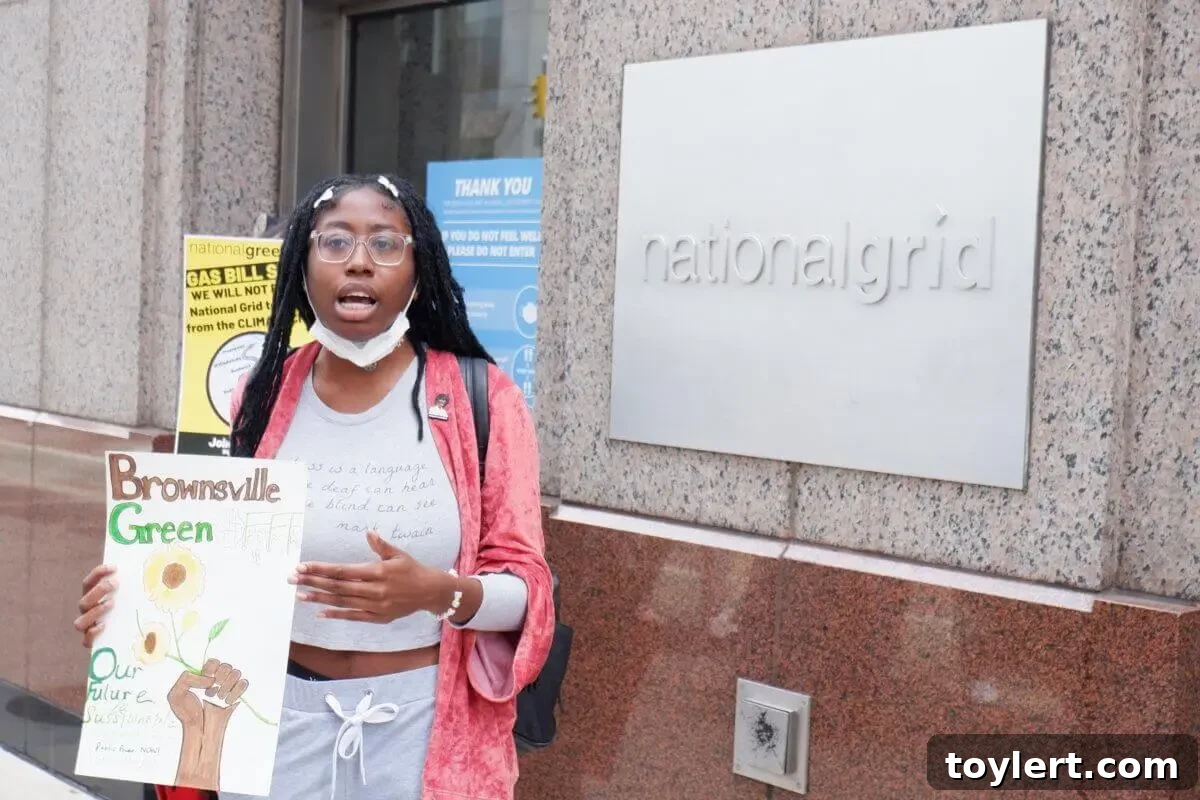
Greenpoint Fights Back: Environmental Lawsuit Challenges National Grid’s Natural Gas Facility Expansion
A pivotal legal battle is currently unfolding in the vibrant Brooklyn neighborhood of Greenpoint, where tenacious environmental activists have initiated a significant lawsuit aimed at halting the ongoing construction of National Grid’s natural gas facility. The plaintiffs assert that this ambitious project is in direct violation of state environmental law, raising profound questions about accountability, regulatory oversight, and New York’s commitment to its ambitious climate goals. This legal action highlights a growing tension between traditional energy infrastructure development and the urgent global mandate for a swift transition to renewable energy sources.
The lawsuit, officially filed on July 23 in Kings County Supreme Court by the Sane Energy Project and the Cooper Park Resident Council, makes compelling claims that both the city and the state have demonstrably “failed to enforce their own climate laws.” This alleged dereliction of duty, according to the activists, manifests in the glaring omission of a proper and comprehensive environmental review for the construction project. Such a review is a critical safeguard designed to assess and mitigate potential adverse impacts on the environment and the health of local communities.
Specifically, the activists accuse the City of New York of violating the foundational State Environmental Quality Review Act (SEQRA). The legal complaint explicitly names the City, the Fire Department of New York (FDNY), and National Grid as key defendants, underscoring the broad scope of responsibility that the plaintiffs believe extends beyond the energy utility to governmental bodies tasked with protecting public welfare and environmental integrity.
The Heart of the Matter: Allegations of Environmental Law Violations
At the core of the activists’ legal challenge are serious allegations regarding the environmental review process – or lack thereof – for National Grid’s expansion project in Greenpoint. The State Environmental Quality Review Act (SEQRA) is New York’s primary mechanism for ensuring that environmental factors are considered during governmental decision-making. It mandates that all agencies, both state and local, must evaluate the environmental impacts of their actions, including permitting, funding, and undertaking projects. The absence of a thorough SEQRA review, as claimed by the plaintiffs, represents a fundamental procedural flaw that could have significant, long-lasting consequences for the Greenpoint community.
The official petition and complaint document details the specific legal arguments and evidence supporting the activists’ claims. It meticulously outlines how, in their view, the defendants have failed to adhere to statutory requirements, thereby endangering the health and safety of Greenpoint residents and contributing to broader climate change concerns. This legal challenge is not merely about procedural errors; it reflects a deep-seated belief that critical public infrastructure projects, particularly those involving fossil fuels, must be subjected to the highest level of environmental scrutiny and public accountability.
Understanding SEQRA: New York’s Environmental Safeguard
The State Environmental Quality Review Act (SEQRA) serves as a vital environmental protection statute in New York. Enacted to ensure that environmental consequences are given proper consideration in the earliest stages of planning and decision-making for projects, SEQRA aims to prevent or mitigate adverse environmental impacts. For any proposed project that may have a significant impact on the environment, SEQRA typically requires the preparation of an Environmental Impact Statement (EIS), a detailed public document that analyzes potential impacts, considers alternatives, and outlines mitigation measures.
Activists argue that the National Grid facility expansion in Greenpoint, due to its scale, its potential for increased emissions, and its location within an already vulnerable community, unequivocally warrants a comprehensive EIS. They contend that any approval of the project without such a robust review process not only violates the spirit but also the letter of SEQRA. A proper SEQRA review would involve extensive public input, allowing community members to voice their concerns, contribute local knowledge, and challenge assumptions made by project proponents and regulatory agencies. The lawsuit seeks to compel the defendants to undertake this necessary, legally mandated process.
National Grid’s Greenpoint Project: A Symbol of Energy Debate
The facility at the center of this controversy is an integral part of National Grid’s larger natural gas infrastructure network, crucial for delivering gas to millions of customers across New York City and Long Island. The expansion in Greenpoint, often controversially referred to by activists as the “North Brooklyn Pipeline” or the “Metropolitan Reliability Project,” involves significant upgrades, including the installation of new high-pressure gas pipelines and a powerful compressor station. National Grid maintains that these enhancements are indispensable for ensuring system reliability, meeting growing energy demands, and providing essential service, especially during periods of peak consumption.
However, environmental groups and local residents view this ongoing investment in fossil fuel infrastructure with deep alarm. They argue that expanding natural gas capabilities directly contradicts New York State’s groundbreaking climate legislation, particularly the Climate Leadership and Community Protection Act (CLCPA), which sets aggressive targets for greenhouse gas emission reductions and mandates a statewide transition to renewable energy. Critics contend that rather than doubling down on natural gas, resources and investment should be redirected towards developing truly clean, renewable energy sources like offshore wind and solar, coupled with advanced energy efficiency programs and building electrification initiatives. The Greenpoint project has thus become a focal point in the broader debate about New York’s energy future and its commitment to combating climate change.
Greenpoint: A Community’s History with Environmental Injustice
The Greenpoint neighborhood carries a heavy legacy of environmental contamination and industrial pollution, making the current lawsuit particularly resonant. The area is infamously known for hosting multiple Superfund sites, including the historic Greenpoint oil spill, one of the largest undetected petroleum spills in U.S. history. Generations of residents have lived in close proximity to hazardous industrial operations, resulting in disproportionate health impacts and a heightened sensitivity to new environmental threats. This community has been a tireless advocate for environmental justice, striving to rectify past wrongs and prevent future burdens.
The prospect of additional fossil fuel infrastructure, such as a natural gas compressor station, triggers profound concerns among residents regarding exacerbated air pollution, the potential for dangerous methane leaks, and the inherent risks associated with transporting and storing highly flammable materials in a densely populated urban environment. Residents articulate fears that increased emissions from the facility could intensify respiratory illnesses and other chronic health issues, further eroding their quality of life. The lawsuit, therefore, is not merely a legal maneuver but a powerful expression of a community’s deep-seated frustration and its unwavering demand for protection from environmental injustice.
The Activists’ Vision: A Path to a Renewable New York
Organizations like the Sane Energy Project, alongside the Cooper Park Resident Council, are at the forefront of a movement advocating for a paradigm shift in New York’s energy policy. Their vision extends far beyond merely stopping one project; it encompasses a complete overhaul of the state’s energy infrastructure, prioritizing renewable energy, robust energy efficiency measures, and the equitable distribution of resources. They view the National Grid expansion as a retrograde step, one that would prematurely lock New York into decades of continued fossil fuel dependency at a critical juncture when the climate crisis demands urgent and decisive decarbonization.
These groups adamantly assert that technologically sound and economically viable alternatives to natural gas expansion already exist. These include aggressive demand-side management programs, comprehensive electrification of buildings across the state, and substantial investments in utility-scale solar and wind power generation. They contend that regulatory bodies and utility companies bear a profound responsibility to rigorously explore and implement these sustainable alternatives before resorting to projects that perpetuate environmental harm and contribute to global climate change. The Greenpoint lawsuit, in this context, transcends a localized dispute; it is a fundamental challenge to the prevailing energy paradigm and a clarion call for a future powered by truly clean, sustainable solutions.
National Grid’s Defense: Reliability and Regulatory Compliance
National Grid, in its defense, consistently asserts that the Greenpoint facility is absolutely critical for maintaining reliable energy delivery to its vast customer base and that the project adheres to all applicable local, state, and federal regulations. The utility company frequently emphasizes its long-standing commitment to operational safety and its essential role in providing vital energy services to millions of homes and businesses. They argue that natural gas remains an indispensable component of New York’s energy mix, particularly during periods of peak demand and extreme weather conditions, and that the ongoing upgrades are necessary to ensure system integrity and prevent widespread service disruptions, especially during the harsh winter months.
While acknowledging New York State’s ambitious long-term climate objectives, National Grid often positions natural gas as a crucial “bridge fuel”—a necessary intermediary step in the transition from dirtier fossil fuels like coal and oil to a fully renewable energy grid. They highlight that their operations are subject to stringent oversight by various regulatory agencies, including the Department of Environmental Conservation (DEC) and the Public Service Commission (PSC), and that environmental considerations are routinely integrated into their planning and operational processes. However, this “bridge fuel” narrative often clashes directly with environmental activists who argue that the bridge is being unnecessarily prolonged, thereby delaying essential climate action and locking in fossil fuel dependence for decades to come.
Government Accountability: City and State Under Scrutiny
The decision by activists to include both the City of New York and the FDNY as defendants in the lawsuit critically underscores their belief that governmental entities share ultimate responsibility for safeguarding public health, protecting the environment, and upholding existing environmental laws. The plaintiffs contend that by either providing insufficient environmental review and approving the project or by failing to intervene decisively to ensure proper regulatory compliance, these governmental bodies have effectively enabled National Grid’s alleged violations. This strategic inclusion places a direct spotlight on the effectiveness and impartiality of New York’s regulatory framework and the political will of its agencies to rigorously enforce their own climate mandates.
New York State has notably positioned itself as a national and international leader in climate action, enacting groundbreaking legislation such as the Climate Leadership and Community Protection Act (CLCPA). This seminal act establishes legally binding targets for significant greenhouse gas emission reductions and mandates a just transition to a clean energy economy. The current lawsuit vividly highlights a critical tension: how can the state credibly achieve these ambitious climate goals if new fossil fuel infrastructure projects are permitted to proceed without comprehensive, transparent, and legally compliant environmental scrutiny? The ultimate outcome of this case could profoundly influence how all future energy projects are reviewed, approved, and regulated across the entire state, potentially setting a crucial precedent for environmental accountability and climate governance.
Broader Implications for New York’s Energy Future
The Greenpoint lawsuit transcends the confines of a local dispute; it serves as a powerful microcosm of a much broader, statewide, and indeed national debate concerning critical energy infrastructure, the escalating climate crisis, and the imperative of environmental justice. As New York actively strives to meet its aggressive renewable energy targets, every decision concerning new fossil fuel projects becomes critically important. The resolution of this specific legal challenge has the potential for far-reaching implications, significantly influencing whether other proposed gas pipelines, compressor stations, and related fossil fuel facilities will be permitted to move forward across the state.
A favorable ruling for the environmental activists could serve as a powerful catalyst, empowering other communities engaged in similar battles against fossil fuel expansion, and reinforcing the fundamental principle that robust environmental reviews and genuine community consent are non-negotiable prerequisites for such projects. Conversely, should the lawsuit ultimately fail, it risks emboldening energy companies to continue investing heavily in gas infrastructure, thereby making the state’s ambitious transition to 100% clean energy even more challenging and protracted. This case represents a crucial test of New York’s unwavering resolve to prioritize bold climate action and diligently protect its most vulnerable communities from the disproportionate impacts of pollution and environmental degradation.
Conclusion: A Pivotal Moment for Greenpoint and Climate Action
The landmark lawsuit initiated by Greenpoint environmental activists against National Grid’s natural gas facility stands as a powerful testament to the assertion of community rights and the unwavering commitment to environmental stewardship. It bravely challenges not only a specific, highly controversial infrastructure project but also scrutinizes the broader regulatory processes that ostensibly govern energy development throughout New York State. By vociferously demanding strict adherence to the State Environmental Quality Review Act and by emphatically underscoring the urgent, existential need for a rapid transition away from fossil fuels, the plaintiffs are seeking to fundamentally redefine how critical energy decisions are made in this era of unprecedented climate crisis.
As the complex legal proceedings continue to unfold, all eyes will undoubtedly remain on Kings County Supreme Court. The ultimate verdict will carry profound and enduring consequences, extending far beyond the immediate future of Greenpoint’s air quality and public health. It will crucially impact the credibility and enforcement efficacy of New York’s progressive climate laws and its demonstrated commitment to the principles of environmental justice. This ongoing legal battle represents an undeniably pivotal moment in the collective, unwavering efforts to construct a healthier, more sustainable, and equitable future for all New Yorkers, unequivocally signaling that communities are ready and willing to stand firm against any projects that threaten their collective well-being and the fragile health of our planet.