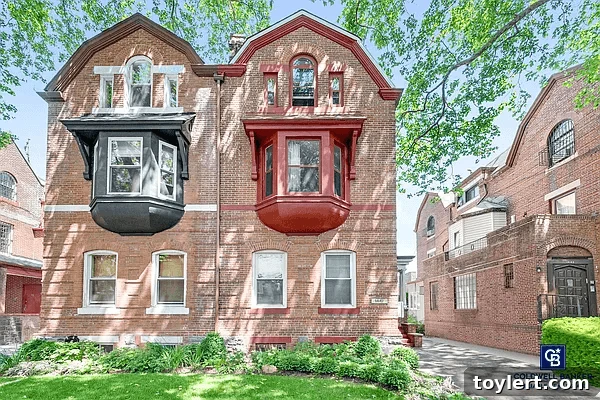
A Historic Gem in Crown Heights: Unveiling 1441 Union Street and Its Unique Architectural Legacy
Nestled within the vibrant and historically rich neighborhood of Crown Heights, Brooklyn, lies a property that offers more than just ample living space; it presents a rare opportunity to own a piece of architectural history. The semi-detached townhouse at 1441 Union Street stands as a testament to early 20th-century innovation and design, situated on a block renowned for its distinctive character and thoughtful planning. Having been cherished by the same family for decades, this residence, complete with the highly coveted amenity of a private garage, invites discerning buyers to explore its generous proportions and a story woven into the very fabric of Brooklyn.
While only a handful of interior photographs currently offer a glimpse into its original details, the potential for restoration and personalization within this expansive home is immense. The true allure of 1441 Union Street extends beyond its walls to the fascinating narrative of its immediate surroundings – a block uniquely conceived and executed by visionary developers more than a century ago.
The Visionary Development of Union Street: A Masterplan for Modern Living
The remarkable block, stretching between the tree-lined avenues of Brooklyn and Kingston, was the ambitious brainchild of builder Henry B. Moore and the Eastern Parkway Company. Their grand scheme, initiated in 1902, was to construct an impressive collection of 42 semi-detached houses. This development was not merely about building homes; it was about defining a new standard of modern living for the burgeoning middle and upper-middle classes of Brooklyn. The homes were meticulously designed to appeal to buyers seeking cutting-edge amenities and, notably, the then-revolutionary convenience of reliable central heat.
Construction commenced with great fanfare, as the Brooklyn Daily Eagle reported the houses were of “the style of house now in demand.” This phrase underscored a keen understanding of contemporary tastes, emphasizing architectural aesthetics combined with functional excellence. A key design principle was a deliberate setback from the street, carefully calculated “to produce the right architectural proportion.” This detail created a sense of grandeur and openness, distinguishing these homes from the more common row houses built directly on the street line.
The development’s architectural philosophy was truly innovative: to create a cohesive yet varied streetscape. The block was designed to be homogeneous in its overall appeal and quality, yet ingeniously not identical. According to advertisements from the period, an astonishing twenty-nine different designs were employed across the 42 houses. This approach ensured visual interest and individuality for each property while maintaining an overarching harmony, preventing the monotonous repetition often found in large-scale developments. It allowed the Eastern Parkway Company to cater to diverse aesthetic preferences within a unified vision, showcasing a remarkable foresight in urban planning and design principles.
Revolutionizing Home Comfort: The Pioneering Central Heating Plant
Perhaps the most groundbreaking innovation of this Union Street development was its pioneering approach to home comfort. Articles and advertisements of the era enthusiastically lauded the novel plans for providing consistent heat, a feature that was nothing short of revolutionary for early 20th-century urban dwellings. The solution was a sophisticated central heating plant, a communal facility designed to supply year-round hot water and reliable heat to each individual house on the block.
In an era when most homes relied on individual coal furnaces or fireplaces, requiring constant tending and often resulting in uneven heating, this centralized system offered unparalleled convenience and efficiency. Homeowners could enjoy a consistent, comfortable temperature throughout their residence without the daily chore of stoking a fire or managing fuel supplies. Furthermore, the provision of year-round hot water was a luxury that significantly elevated the standard of daily living, transforming mundane tasks into effortless routines. This commitment to modern amenities positioned the Union Street homes at the forefront of residential comfort, making them highly desirable properties that promised a lifestyle of ease and sophistication.
The implementation of such a system was a bold engineering feat, showcasing the Eastern Parkway Company’s dedication to quality and forward-thinking design. It represented a significant investment in infrastructure, underscoring their belief that advanced, shared utilities would be a major draw for prospective buyers. This innovative approach not only provided immediate comfort but also set a precedent for future residential developments, influencing the evolution of urban housing standards.
The Art of Design: Commodious Layouts and Exquisite Interiors
Beyond their innovative heating system, the homes on Union Street were celebrated for their commodious layouts and attention to interior detailing. The term “commodious” in this context refers to spacious, well-proportioned rooms that flowed logically, providing ample space for living, entertaining, and daily activities. These designs were a significant draw, contrasting sharply with the often cramped or less thoughtfully arranged interiors of older urban homes.
An ad from 1903, for instance, included a detailed plan of a sample first floor, meticulously outlining the quality wood finishes and intricate decorative details that characterized these residences. Prospective buyers could envision themselves in homes featuring elegant hardwood flooring, perhaps parquet patterns in formal rooms, and rich wainscoting adorning dining areas and entryways. Elaborate crown moldings, decorative plasterwork on ceilings, and built-in cabinetry were likely standard features, reflecting the era’s appreciation for craftsmanship and ornate embellishment.
These interior elements not only added aesthetic beauty but also contributed to the homes’ functionality and sense of grandeur. Fireplaces, often with decorative mantels, served as focal points in living spaces, while large windows allowed natural light to flood the generous rooms. The thoughtful planning of these layouts ensured that each space served its purpose efficiently while maintaining an atmosphere of warmth and elegance, appealing to families seeking both comfort and style in their urban dwelling.
Architectural Tapestry: The Distinctive Exterior Styles of Union Street
The exteriors of the Union Street houses present a captivating visual narrative, reflecting the eclectic blend of revival styles that enjoyed immense popularity in the early 20th century. This period was characterized by a nostalgic nod to historical architectural forms, reinterpreted for modern sensibilities. The result on this block is a harmonious yet diverse streetscape, where elements from various classical and European traditions converge.
Among the styles proudly displayed are Flemish-Revival stepped gables, which lend a distinct, almost fairytale-like quality with their stair-stepped silhouettes rising against the sky. These intricate gables are often accompanied by Gothic tracery, delicate ornamental stonework, or carved wood details typically seen around windows and doorways, evoking a sense of medieval grandeur and sophisticated artistry. Colonial Revival door surrounds, characterized by their classical proportions, pilasters, pediments, and sidelights, provide a sense of dignified Americana, offering stately welcomes to each residence.
The Unique Charm of 1441 Union Street
No. 1441 Union Street stands out with its particularly charming and well-preserved features. The house boasts a distinctive Dutch Colonial Revival inspired gambrel roof. This unique roofline, with its characteristic double slope on two sides, not only adds considerable curb appeal but also allows for more usable space on the upper floors, often creating a full second story with ample headroom. Below this iconic roof, a prominent oriel window graces the second story. Projecting outward from the main wall of the building, this architectural feature provides expansive views, allows extra light into the interior, and adds a dynamic, sculptural element to the facade.
Further enhancing its exterior appeal is the intricate brick banding below the oriel window, a decorative detail that highlights the craftsmanship and attention to texture inherent in its design. These specific elements — the gambrel roof, the oriel window, and the detailed brickwork — combine to give 1441 Union Street a unique architectural identity within an already distinguished block. They exemplify the period’s commitment to aesthetic richness and structural integrity, contributing to a streetscape that continues to captivate residents and admirers alike.
At the time of their initial marketing, these meticulously crafted homes were advertised with a price tag ranging between $12,000 and $15,000. While these figures may seem modest by today’s standards, they represented a significant investment in a modern, amenity-rich home at the turn of the 20th century, cementing the block’s status as a premium residential address in Brooklyn.
Crown Heights: A Neighborhood of Enduring Appeal and Rich History
Today, Crown Heights remains one of Brooklyn’s most sought-after neighborhoods, celebrated for its diverse community, tree-lined streets, and a wealth of historic architecture. Living on Union Street means being part of a vibrant cultural tapestry, with easy access to Prospect Park, the Brooklyn Botanic Garden, the Brooklyn Museum, and a burgeoning scene of independent shops, cafes, and restaurants.
The enduring appeal of Crown Heights lies in its perfect blend of historical charm and contemporary convenience. Excellent public transportation options connect residents to Manhattan and other parts of Brooklyn, making it an ideal location for commuters and urban dwellers alike. The neighborhood’s strong community spirit, combined with its architectural grandeur, ensures that properties like 1441 Union Street retain their value and desirability.
Owning a home on this architecturally significant block is more than just an investment in real estate; it’s an investment in a lifestyle steeped in history, surrounded by beauty, and connected to a dynamic urban environment. The opportunity to restore and personalize a semi-detached townhouse with such a unique backstory and rare features, including a garage, is truly exceptional in today’s Brooklyn market.
Embrace the Legacy: Your Opportunity at 1441 Union Street
1441 Union Street represents a rare convergence of history, architectural distinction, and significant potential. From its generous interior spaces, awaiting a new chapter of personalization, to its unique place within a block celebrated for pioneering amenities like central heating and its varied yet cohesive architectural styles, this Crown Heights townhouse is a standout offering.
It’s an invitation to become part of a storied legacy, to reside in a home that not only provides comfort and convenience but also tells a compelling tale of early 20th-century Brooklyn innovation. For those seeking a property that combines historical character with the practical benefits of a semi-detached structure and the invaluable addition of a garage, 1441 Union Street offers an unparalleled opportunity to craft a truly unique urban sanctuary.