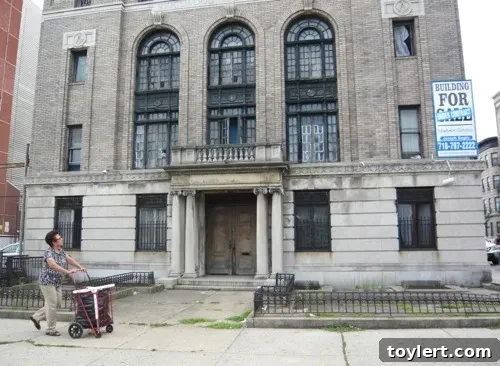
The Historic Masonic Temple at 1054 Bushwick Avenue: A New Chapter for a Brooklyn Landmark
A significant piece of Bushwick’s architectural and cultural heritage, the former Masonic Temple at 1054 Bushwick Avenue, has officially entered into contract. This pivotal development marks a new chapter for the grand 18,000-square-foot edifice, which has stood as a silent sentinel to the neighborhood’s evolution. After a period of at least two years on the market, the news of its potential sale signals considerable interest in properties that combine historical significance with prime Brooklyn location. The building, currently classified as a hotel rather than residential, presents a unique set of opportunities and challenges for its prospective new owner, particularly given the large Verizon electrical substation that neighbors it.
A Glimpse into History: The Masonic Temple’s Legacy at 1054 Bushwick Avenue
Masonic Temples, historically, were more than just meeting places; they were often architectural marvels and community cornerstones, symbolizing the ideals of fraternity, charity, and truth. The Bushwick Masonic Temple at 1054 Bushwick Avenue is no exception. While specific construction dates and detailed historical records for this particular temple might require deeper archival research, most Masonic lodges of its era were built with a sense of permanence and grandeur, reflecting the prominence of their members within the community. These structures frequently featured neoclassical, Gothic, or Art Deco elements, designed to inspire awe and convey the solemnity of their purpose.
The presence of such a substantial building in Bushwick speaks volumes about the neighborhood’s historical importance. Before its transformation into a renowned artistic and cultural hub, Bushwick was a thriving working-class community, home to breweries, factories, and a dense population that valued local institutions. The Masonic Temple would have served as a social and ceremonial center for its members, contributing to the fabric of the community through various philanthropic endeavors and fraternal gatherings. Its distinctive architecture would have undoubtedly made it a local landmark, familiar to generations of Bushwick residents.
Architectural Significance and Community Role
The building at 1054 Bushwick Avenue likely showcases the distinctive architectural style prevalent during its construction, often characterized by robust masonry, intricate detailing, and imposing facades designed to convey strength and dignity. These temples were typically designed with specific interior layouts to accommodate Masonic rituals, including large assembly halls, smaller meeting rooms, and administrative offices. Such unique layouts present both creative opportunities and design considerations for any developer contemplating its future use. Understanding its original purpose and architectural integrity will be crucial for any adaptive reuse project, ensuring that its historical essence is respected while reimagining it for contemporary needs.
The Property in Detail: Unpacking the 18,000 Square Feet
With a sprawling 18,000 square feet of interior space, the former Masonic Temple offers immense potential. Its substantial footprint is a rarity in today’s dense Brooklyn real estate market, providing a canvas for ambitious development projects. The sheer scale of the building allows for a multitude of possibilities, from a boutique hotel or event venue to innovative commercial spaces or even a unique institutional facility. However, its current classification as a “hotel” presents a critical distinction that will heavily influence the path forward for its new owners.
Classification Challenges: Hotel vs. Residential
The classification of the property as a hotel, rather than residential, is a pivotal detail. This designation implies specific zoning regulations, building codes, and operational requirements that differ significantly from those governing residential condominiums or apartments. While its potential for residential condos might seem enormous at first glance, especially given the demand for housing in Bushwick, converting a commercial “hotel” classification to residential would likely involve a complex and potentially lengthy process of rezoning and permit acquisition. This could entail navigating various city agencies, community board approvals, and substantial investment in structural and system modifications to meet residential standards, including light, air, and egress requirements.
For a developer, pursuing a residential conversion would mean a longer timeline and higher upfront costs. Conversely, maintaining its commercial classification could lead to a different set of opportunities. The building could be reimagined as a unique boutique hotel, capitalizing on Bushwick’s appeal to tourists and artists, or transformed into an expansive event space, a creative co-working hub, or even an arts and culture center. Each of these options comes with its own financial models, market demands, and regulatory hurdles, all of which would have been carefully considered by the party now holding the contract.
Bushwick’s Evolving Real Estate Landscape
Bushwick has undergone a dramatic transformation over the past two decades, evolving from an industrial and working-class neighborhood into one of Brooklyn’s most sought-after enclaves. Its vibrant arts scene, diverse culinary offerings, and dynamic community have attracted a new wave of residents, businesses, and investors. This rapid gentrification has fueled a competitive real estate market, driving up property values and inspiring creative redevelopment projects. Historic buildings like the Masonic Temple are increasingly viewed as opportunities for adaptive reuse, blending old-world charm with modern functionality.
A Neighborhood on the Rise
The appeal of Bushwick lies in its unique blend of industrial grit and artistic flair. Mural-lined streets, independent galleries, and innovative eateries contribute to its distinctive character. Excellent public transportation links, including the L and J/M/Z subway lines, connect residents to Manhattan and other parts of Brooklyn, further enhancing its desirability. Against this backdrop, a historically significant building like 1054 Bushwick Avenue represents a rare chance to own a piece of the neighborhood’s past while contributing to its future.
The Two-Year Journey on the Market
The fact that the property was on the market for at least two years suggests that its sale was not straightforward. This extended period could be attributed to several factors. The unique nature of a former Masonic Temple, with its specialized layout and historical significance, might have narrowed the pool of suitable buyers. Furthermore, the complexities associated with its “hotel” classification and, crucially, the presence of the adjacent Verizon electrical substation, likely posed significant challenges that required specific expertise and vision to overcome. Savvy developers often take time to conduct thorough due diligence on such multifaceted properties, assessing not only the structural integrity and zoning but also the environmental and community impacts.
Development Potential and the Adjacent Substation Dilemma
The true potential of 1054 Bushwick Avenue lies in its capacity for adaptive reuse. Preserving historic buildings through thoughtful redevelopment is a sustainable practice that enriches urban landscapes and tells the ongoing story of a neighborhood. However, any grand vision for this site must meticulously address one significant, immediate challenge: the large electrical substation owned by Verizon, located directly next door.
The Allure of Adaptive Reuse
Adaptive reuse projects, particularly those involving historic structures, are highly valued in urban planning circles. They prevent demolition, reduce waste, and allow existing buildings to find new relevance in a changing world. For the Masonic Temple, possibilities are abundant. Imagine a luxury boutique hotel retaining some of the temple’s original grandeur, offering unique event spaces and themed guest rooms. Envision a vibrant arts complex, with galleries, performance spaces, and artist studios, or perhaps a unique co-working campus designed to foster collaboration among Bushwick’s creative professionals. Each of these scenarios leverages the building’s generous proportions and distinctive character. The high ceilings, robust construction, and unique architectural details inherent in a former temple could be stunning assets for a creative repurposing.
Navigating the Verizon Substation: A Key Consideration
The electrical substation is more than just a visible neighbor; it introduces practical considerations that significantly impact development choices, especially regarding residential use. Substations are vital infrastructure components, but they are also sources of noise, visual impact, and, for some, concerns about electromagnetic fields (EMF).
Impact on Residential Development
For residential development, the substation poses considerable obstacles. Noise pollution from transformers and cooling systems can be a constant concern for future residents, impacting quality of life and potentially property values. Visually, a substation is rarely an attractive neighbor for residential units, limiting views and curb appeal. Furthermore, public perception regarding EMF exposure, while often debated in scientific communities, can be a deterrent for potential homeowners or renters, making it challenging to market residential units in close proximity. Developers would need to invest heavily in soundproofing, visual barriers, and potentially even address concerns about environmental safety, adding significant costs and complexities to any residential conversion project. This is likely a primary reason why the building’s “residential potential” was identified as huge at first glance but quickly tempered by the substation’s presence.
Commercial and Event Space Viability
The impact of the substation might be less prohibitive for commercial uses or an event space. Businesses, offices, or event venues might be less sensitive to noise or visual aesthetics compared to residential units. Soundproofing could still be necessary for certain commercial applications, but the “quality of life” metrics are different. For a unique event space, the substation could even be cleverly integrated into an urban industrial aesthetic, or simply managed with thoughtful design and landscaping. The focus shifts from residential tranquility to functional utility and unique visitor experience. Therefore, the “hotel” classification, whether maintained or adapted for other commercial purposes, might be a more natural fit given the immediate surroundings.
What Lies Ahead for This Iconic Bushwick Structure?
The sale of the former Masonic Temple at 1054 Bushwick Avenue is a defining moment for this unique property and a potential bellwether for future development trends in Bushwick. The party now in contract has undoubtedly weighed the building’s historical charm and prime location against the substantial challenges posed by its existing classification and the adjacent substation.
The Vision of Future Developers
The successful redevelopment of this building will hinge on a creative vision that embraces its heritage while skillfully navigating modern urban planning complexities. Whether it emerges as a cutting-edge cultural institution, a distinctive hospitality venue, or an innovative commercial hub, its transformation will add another layer to Bushwick’s dynamic narrative. The new owners will not only acquire a significant piece of real estate but also become custodians of a local landmark, with the opportunity to shape a new legacy for this once-secretive fraternal hall. Their choices will reflect the evolving character of Bushwick itself – a neighborhood that continually reinvents itself while honoring its rich past.
Further Reading: Building of the Day: 1054 Bushwick Avenue [Brownstoner]
Explore the Location: View on Google Maps