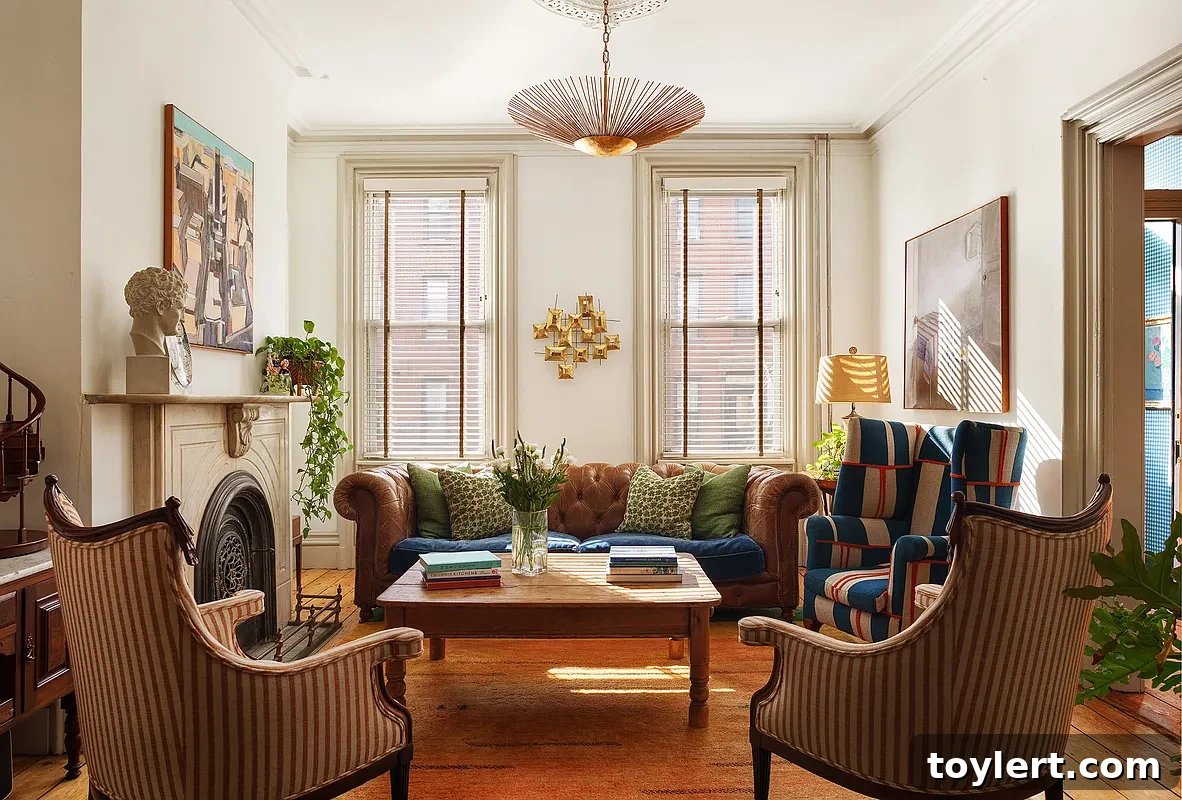
A Timeless Transformation: Restoring Historic Charm at 141 Calyer Street, Greenpoint
Nestled within the revered Greenpoint Historic District, the residence at 141 Calyer Street has undergone a magnificent renovation, emerging with a truly stylish presence that captivates onlookers. This thoughtful revitalization tackled every aspect of the wood-frame home, inside and out, striking a harmonious balance between its venerable past and the demands of contemporary living. The project is a testament to sophisticated design, merging original architectural integrity with essential modern upgrades, making it a benchmark for historic preservation in Brooklyn.
The interior transformation is a masterclass in blending eras. While the renovation introduced state-of-the-art kitchens and luxurious bathrooms, great care was taken to retain and celebrate the home’s historic soul. Original features, such as the grand main staircase and the distinctive wide plank floorboards, were meticulously preserved and restored, allowing the property’s rich history to resonate through its meticulously updated spaces. This sensitive approach ensures that while the home offers every modern comfort, it never loses sight of its unique heritage.
Greenpoint’s Architectural Gem: A Legacy on Calyer Street
The story of 141 Calyer Street is deeply intertwined with the development of Greenpoint itself. According to the comprehensive designation report for the Greenpoint Historic District, this distinguished house, along with its adjacent twin at No. 143, was constructed around 1868 by the notable builder John W. Ford. This period marked a significant expansion phase for Brooklyn, particularly in neighborhoods like Greenpoint, which was rapidly developing from a quiet waterside community into a thriving urban center.
Calyer Street, a foundational artery of the neighborhood, officially opened in the 1850s, setting the stage for the residential boom that followed. Historical records, including a detailed map published in 1868, confirm the early existence of these two striking wood-frame dwellings. These maps illustrate them as impressive three-story structures, each complemented by two-story rear extensions, a common architectural configuration for residences of this stature during that era. Such details underscore the historical significance of 141 Calyer Street, not just as a residence, but as a living piece of Greenpoint’s rich architectural tapestry.
The Evolving Facade: A Chronicle of Change and Renewal
The exterior of 141 Calyer Street tells a fascinating story of evolution, reflecting changing tastes and the passage of time before its recent sympathetic renovation. By the time the circa 1940 tax photo was taken, alterations to the facade were already apparent, though some original elements bravely persisted. These included a charming wooden stoop, an elegant door hood, and remnants of what was once a more elaborate cornice, hinting at the home’s initial Victorian grandeur.
However, by 1982, when the Greenpoint Historic District received its designation, these delicate wooden details had unfortunately vanished. The designation report notes that the facade had by then been covered with asphalt siding, a material choice common in the mid-20th century for its perceived durability and low maintenance, but one that obscured the home’s original aesthetic. A modern brick stoop had also replaced the earlier wooden version, further altering its historic character. A glimpse into the more recent past, through a 2022 street view, even reveals the presence of faux keystone lintels, another layer of aesthetic modification.
The current, recently renovated facade presents a fresh and historically sensitive appearance. It now boasts tasteful blue siding complemented by crisp white trim, a palette that not only enhances its visual appeal but also respects the traditional aesthetic often found in historic wood-frame homes. This careful selection of materials and colors contributes significantly to the home’s curb appeal, ensuring it stands as a proud example within its historic setting.
The Art of Preservation: Blending Old-World Charm with Modern Luxury
The philosophy behind the renovation of 141 Calyer Street was clearly one of thoughtful integration rather than wholesale replacement. This approach is critical in historic districts, where the goal is to enhance livability without erasing the tangible links to the past. By choosing to retain the original stair and wide plank floorboards, the designers paid homage to the craftsmanship of yesteryear. These elements are not just decorative; they are structural storytellers, offering a tactile connection to the home’s 19th-century origins. The warmth of the aged wood, the subtle creak of the stairs – these are features that cannot be replicated in a new build and contribute immeasurably to the home’s unique character and charm.
Conversely, the introduction of a new kitchen and bathrooms addresses the needs of modern living. Today’s homeowners expect state-of-the-art appliances, efficient layouts, and luxurious finishes in these key areas. The challenge, expertly met at Calyer Street, was to introduce these contemporary elements in a way that feels cohesive with the historic fabric. This often involves selecting materials that nod to tradition while offering modern performance, such as classic subway tiles with modern fixtures, or custom cabinetry that echoes historic styles but incorporates smart storage solutions. The result is a home that functions flawlessly for the 21st century while maintaining an undeniable sense of timeless elegance.
Such comprehensive renovations require a delicate balance. It’s about respecting the past by preserving its best features, while simultaneously ensuring the home meets stringent modern building codes and offers the lifestyle amenities expected by today’s discerning buyers. This careful dance between preservation and innovation is what elevates 141 Calyer Street into more than just a house; it’s a beautifully curated home that bridges centuries.
Why Greenpoint Historic District Matters
The Greenpoint Historic District plays a crucial role in safeguarding the architectural legacy of one of Brooklyn’s most vibrant neighborhoods. Designation as a historic district by the Landmarks Preservation Commission means that exterior alterations to buildings within its boundaries are subject to review, ensuring that renovations like the one at 141 Calyer Street are carried out sensitively and in keeping with the area’s established character. This oversight helps prevent inappropriate changes that could erode the unique charm and visual cohesion of the streetscape.
The district encompasses a diverse array of architectural styles, primarily from the mid-19th to early 20th centuries, including significant numbers of wood-frame houses, brick row houses, and commercial buildings. These structures collectively tell the story of Greenpoint’s industrial past, its working-class roots, and its evolution into a residential haven. For homeowners and developers, operating within these guidelines means a commitment to stewardship—a recognition that their property is part of a larger, irreplaceable historical narrative.
The benefits of living in a historic district extend beyond mere aesthetics. Properties often retain their value better due to the stability and desirability of well-preserved neighborhoods. Furthermore, residents enjoy a strong sense of community and connection to history, fostering an environment where the past is not just remembered but actively lived within. The successful renovation of 141 Calyer Street serves as a prime example of how modern needs can be met within the framework of historic preservation, contributing positively to the district’s ongoing legacy.
Beyond the Renovation: Living in Greenpoint Today
The allure of 141 Calyer Street is magnified by its location in Greenpoint, a neighborhood that effortlessly blends historic charm with a dynamic, contemporary culture. Known for its tree-lined streets, independent boutiques, acclaimed restaurants, and vibrant arts scene, Greenpoint offers an unparalleled quality of life. Residents enjoy easy access to beautiful waterfront parks, with stunning views of the Manhattan skyline, and a strong sense of community that is increasingly rare in New York City.
The neighborhood’s convenient access to public transportation makes commuting a breeze, connecting residents to the rest of Brooklyn and Manhattan. Yet, Greenpoint retains a distinct, village-like atmosphere, a peaceful retreat from the city’s relentless pace. The painstaking renovation of homes like 141 Calyer Street only enhances the neighborhood’s appeal, attracting individuals and families who appreciate both historical authenticity and modern comfort. Owning a piece of Greenpoint’s history, especially one so beautifully restored, offers a unique opportunity to immerse oneself in a thriving community that values its past while eagerly embracing its future.