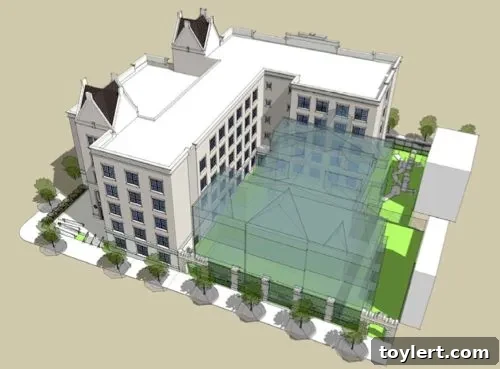
P.S. 133: A Landmark in Bilingual Education and Community Inclusion for Brooklyn
The landscape of education in Brooklyn has always been dynamic, striving to meet the evolving needs of its diverse communities. Among the most anticipated educational developments was the construction and opening of P.S. 133, a state-of-the-art school designed to serve the vibrant neighborhoods of Park Slope and beyond. When news broke, notably reported by the Park Slope Stoop blog, about an upcoming open house and information session concerning this then under-construction institution, it generated considerable excitement. Located strategically on 4th Avenue, nestled between Baltic and Butler streets, P.S. 133 was poised to become a cornerstone of innovative learning.
Its opening, planned for a September in the near future at the time of the original announcement, marked a significant milestone not just for the immediate community but for the entire borough. P.S. 133 was set to make history as the first school in Brooklyn to introduce comprehensive dual-language immersion programs in both Spanish and French. This bold initiative promised to offer students a unique educational advantage, fostering bilingualism and biculturalism from an early age. Beyond its groundbreaking linguistic programs, the school also garnered attention for a progressive affirmative action policy, endorsed by the Department of Education, aimed at ensuring equitable access for all students. This policy reserved a significant portion – 30 percent – of P.S. 133’s seats for English Language Learners (ELLs) and students who qualified for free and reduced-price lunches, reflecting a commitment to diversity and inclusion that stirred both discussion and anticipation.
The Genesis of P.S. 133: A New Era for Park Slope Education
The vision for P.S. 133 emerged from a critical need for expanded educational infrastructure in the burgeoning areas of Park Slope and Gowanus. As Brooklyn continued to grow, so did the demand for high-quality, accessible schooling options. The choice of location on 4th Avenue, a bustling artery connecting several neighborhoods, underscored its role as a central hub for learning. The construction project itself was a testament to urban planning and community investment, transforming a previously underutilized space into a modern educational facility equipped to handle the demands of 21st-century learning.
For months leading up to its grand opening, the building site was a hive of activity, transforming architectural blueprints into a tangible reality. The anticipation within the community was palpable. Parents, educators, and local residents keenly followed the progress, understanding that this new institution represented more than just a school building; it symbolized a commitment to the future generations of Brooklynites. The promise of opening that September instilled a sense of hope and opportunity, signifying a fresh chapter in the educational narrative of the borough. The detailed planning involved not only the physical structure but also the pedagogical framework that would define P.S. 133 as a leader in innovative educational practices.
Pioneering Dual-Language Immersion Programs: Spanish and French
One of the most distinguishing features of P.S. 133, and indeed a major draw for many families, was its groundbreaking adoption of dual-language immersion programs in both Spanish and French. This was a pioneering move for Brooklyn, setting a new standard for linguistic education within the public school system.
Understanding Dual-Language Immersion
Dual-language immersion (DLI) is an educational approach where students are taught academic content in two languages, typically English and a partner language. The goal is to develop bilingualism, biliteracy, academic achievement in both languages, and cross-cultural competence. In a DLI classroom, students spend a portion of their day learning subjects like mathematics, science, and social studies in English, and another portion learning the same or different subjects in the partner language. This method goes beyond simple language instruction; it integrates language learning directly into the core curriculum, allowing students to acquire fluency and deep understanding naturally, much like how children learn their first language.
The benefits of DLI are extensive and well-documented. Research indicates that students in dual-language programs often outperform their monolingual peers academically, demonstrating enhanced cognitive flexibility, problem-solving skills, and creativity. Beyond academic advantages, DLI fosters a profound appreciation for different cultures, broadens students’ perspectives, and prepares them to thrive in an increasingly interconnected global society. For the families of P.S. 133, this meant providing their children with an invaluable asset for their future personal and professional lives.
P.S. 133’s Groundbreaking Initiative in Brooklyn
The decision to offer both Spanish and French immersion programs simultaneously positioned P.S. 133 at the forefront of educational innovation in Brooklyn. While some schools might offer a single foreign language, providing two distinct immersion tracks from the outset was an ambitious and visionary undertaking. This initiative directly addressed the growing demand from parents who sought more robust language education for their children, recognizing the profound impact of early bilingualism. It provided choice and cater to the diverse linguistic heritage and aspirations of Brooklyn families.
Implementing such programs required meticulous planning, from curriculum development to the recruitment of highly qualified, bilingual educators. P.S. 133 committed to creating an environment where students could seamlessly transition between languages, supported by teaching methodologies that catered to linguistic development alongside academic excellence. This emphasis on developing fluent, literate, and culturally aware citizens set P.S. 133 apart as a model for future educational endeavors across the borough and indeed, the entire city.
Addressing Equity: The Affirmative Action Policy
Beyond its innovative language programs, P.S. 133 distinguished itself through a significant affirmative action policy, thoughtfully implemented in collaboration with the Department of Education. This policy underscored a deep commitment to equity, diversity, and ensuring that the opportunities offered by this new school were accessible to all segments of the community.
Details of the Policy
The core of the policy involved reserving 30 percent of P.S. 133’s incoming seats for two specific demographics: English Language Learners (ELLs) and students who qualified for free and reduced-price lunches. ELLs are students whose primary language is not English and who are in the process of acquiring proficiency in English. Students qualifying for free and reduced-price lunches typically come from low-income households, and this metric is widely used to identify economically disadvantaged students within school systems. The Department of Education’s agreement to this reservation demonstrated a clear intent to foster a diverse student body reflective of Brooklyn’s rich tapestry of cultures and socio-economic backgrounds.
The Rationale Behind the Policy
The implementation of this affirmative action policy was driven by several key educational and social rationales. Firstly, it aimed to promote genuine diversity within the school, ensuring that P.S. 133 would not become an insular institution but rather a microcosm of the broader community. Diverse classrooms have been shown to enrich the learning experience for all students, exposing them to different perspectives and fostering greater empathy and understanding. Secondly, the policy was a direct measure to ensure access for underserved populations. By explicitly setting aside seats, the Department of Education sought to counteract systemic inequities that might otherwise prevent ELLs and economically disadvantaged students from accessing a high-quality, innovative educational program like that offered at P.S. 133. This move was intended to help close achievement gaps and provide a pathway to success for students who might face additional hurdles.
Navigating the Controversy
As with many policies designed to address historical inequities, P.S. 133’s affirmative action plan was not without its controversial aspects. While many lauded the policy as a crucial step towards equity and social justice, others raised questions regarding fairness, the potential impact on merit-based admissions, or the specifics of implementation. Debates often centered on balancing the desire for a diverse student body with concerns about individual choice or neighborhood preference. However, the Department of Education and the school leadership maintained that the policy was carefully crafted to create an inclusive learning environment, fostering integration rather than segregation, and ensuring that the school truly served the entire community. This commitment to equitable access, even amidst discussion, highlighted P.S. 133’s dedication to its founding principles of broad opportunity and community integration.
Fostering Community Engagement: The Role of Information Sessions
A new school, especially one with such innovative programs and policies, cannot truly thrive without strong community engagement. The open house and information session, first announced by the Park Slope Stoop blog, played a crucial role in building this vital connection between the school and the families it aimed to serve.
The Open House and Info Session
The information session, held on December 18th at 9 am at the then-current P.S. 133 location at 211 8th Street at 4th Avenue, served as a critical platform for direct dialogue. Such events are indispensable during the launch of a new educational institution. They provide prospective parents and community members with an invaluable opportunity to learn firsthand about the school’s philosophy, curriculum, and leadership. Attendees could typically expect detailed presentations on the dual-language immersion programs, the specifics of the affirmative action policy, and an overview of the educational environment being cultivated. It was a chance to ask questions, meet future educators and administrators, and get a tangible sense of the school’s commitment to its students.
These sessions go beyond mere information dissemination; they are about building trust and fostering excitement. For P.S. 133, this was an opportunity to showcase its readiness to welcome students and to articulate its vision for an inclusive and academically rigorous future. The active participation of the Department of Education in these processes further solidified the official backing and serious intent behind P.S. 133’s unique offerings.
Importance of Parental and Community Involvement
The success of any school is intrinsically linked to the level of parental and community involvement it cultivates. Information sessions are foundational in this regard, empowering parents with the knowledge needed to make informed decisions about their children’s education. A well-informed parent body is more likely to be an engaged parent body, actively participating in school life, supporting learning at home, and advocating for the school’s needs. Furthermore, local media outlets and community blogs, such as the Park Slope Stoop, play an indispensable role in amplifying these messages, reaching wider audiences, and fostering a collective sense of ownership and pride in community institutions like P.S. 133. This multi-faceted approach to communication ensures that all stakeholders are aware, informed, and invested in the school’s mission.
P.S. 133 within the Broader Brooklyn Educational Landscape
The establishment of P.S. 133, with its innovative dual-language programs and progressive admissions policy, did not occur in a vacuum. It was a significant development within the larger context of Brooklyn’s evolving educational landscape. As one of New York City’s most populous and fastest-growing boroughs, Brooklyn continually faces the challenge of providing sufficient, high-quality educational opportunities for its diverse residents.
P.S. 133 quickly became a benchmark. Its commitment to dual-language immersion, especially being the first to offer both Spanish and French in such a comprehensive manner, set a precedent for other schools to consider similar models. It highlighted the demand for multilingual education and demonstrated a viable pathway for public schools to meet this need. Furthermore, its affirmative action policy sparked conversations about equity and access across the district, influencing discussions on how to create truly inclusive educational environments throughout the borough. P.S. 133’s early success and innovative spirit became a case study for urban education, showing how strategic planning and a forward-thinking approach could address both academic excellence and social equity.
The school’s design and its curriculum reflected a broader vision for the future of education in NYC – one that values diversity, embraces global competencies, and ensures that every child, regardless of background, has the opportunity to thrive. P.S. 133’s journey from an under-construction site to a thriving educational institution stands as a testament to Brooklyn’s ongoing commitment to fostering environments where all students can achieve their fullest potential.
For more specific information on past events or for general inquiries regarding this pioneering institution, the original contact number provided was (718) 857-4810.
P.S. 133 Open House and Info Session Tomorrow [Park Slope Stoop]
Rendering from the P.S. 133 website via Park Slope Stoop