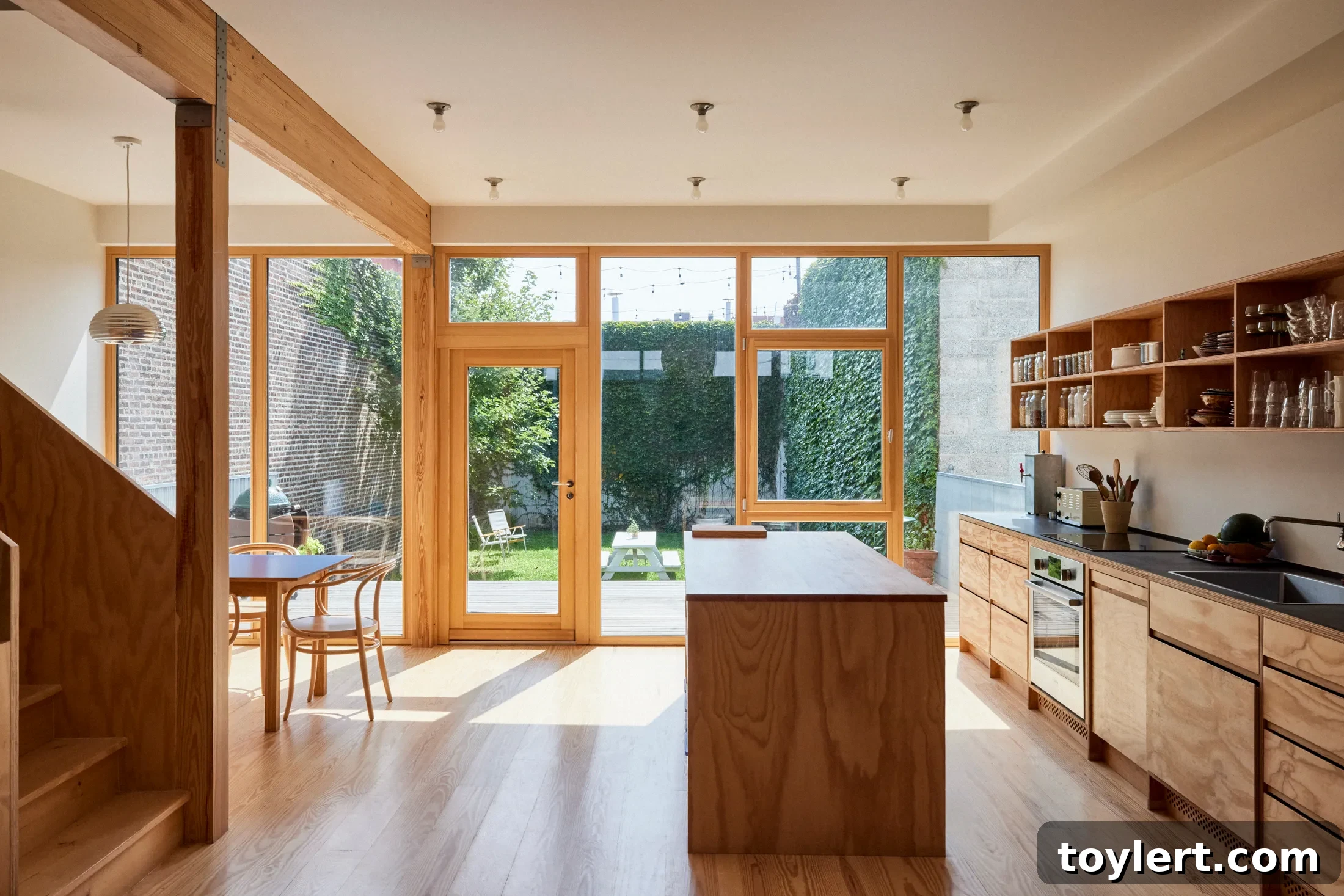
Reimagining Urban Living: A Modern Transformation in Long Island City by Keith Burns
In the vibrant, ever-evolving landscape of Long Island City, a remarkable architectural project by Brooklyn-based architect Keith Burns stands as a testament to the power of vision and adaptive reuse. Nestled amidst a predominantly commercial block, a dilapidated 19th-century wood-frame house has been spectacularly reborn. This isn’t just any renovation; it’s a thoughtful, energy-efficient, three-bedroom, 2.5-bath home that marries an unconventional modern aesthetic with the rich history of its urban surroundings.
From Derelict to Dream Home: A Bold Vision in a Unique Setting
The clients, drawn to the intriguing character of the area and the surprising generosity of a large backyard, approached architect Keith Burns with a challenge: to transform the derelict remains of an old house into a vibrant, contemporary living space. “They found the area interesting, and they liked the big backyard,” Burns recounted, highlighting the initial spark that ignited the project. The location itself presented a unique dichotomy. While a two-family townhouse offered a residential hint to one side, the property was largely hemmed in by manufacturing facilities and warehouses. This distinct urban context became a powerful muse for Burns, informing every decision made during the design process.
Burns’s approach was not about fighting the environment but embracing it, allowing the industrial backdrop to shape a residential haven. The goal was to create a home that felt both connected to its surroundings and yet offered a serene, private retreat. This intricate balance of integrating with the urban fabric while establishing a distinct residential identity became a cornerstone of the project’s success, turning what many might see as a limitation into a defining feature of the design.
The Collaborative Journey: Defining Needs and Sculpting Space
The journey from initial concept to a completed home is often dynamic, and this project was no exception. Burns recalled the early meetings with his clients: “When they came to me, they didn’t know what they wanted. At first they thought they’d tear down and build something new.” This initial uncertainty allowed for a thorough exploration of possibilities. Burns meticulously guided them through the implications of a complete demolition versus the benefits of adaptive reuse, a process that underscored his commitment to finding the most sustainable and contextually appropriate solution. They explored various interventions, including the addition of a third floor or a rear extension, each idea subjected to careful scrutiny and preliminary pricing.
What makes this renovation particularly compelling is the evolution of the client’s needs throughout the project – a common, yet often complex, reality in long-term renovations. Over the course of the design and construction, the homeowners welcomed two new babies, fundamentally shifting their spatial requirements. Despite this expansion in family, Burns emphasizes the clients’ pragmatic approach: “They weren’t trying to add space just to add space. They needed what they needed, and didn’t want more.” This philosophy of intentionality guided the entire design, ensuring that every square foot served a purpose, promoting a sense of functional efficiency and thoughtful living over gratuitous expansion.
Architectural Alchemy: Blending History with Modernity
The transformation of a 19th-century wood-frame structure into a contemporary, energy-efficient home required more than just cosmetic changes; it demanded a deep understanding of structural integrity, historical context, and modern building science. Burns’s design philosophy centered on respecting the existing bones of the house while infusing it with 21st-century functionality and aesthetic appeal. This adaptive reuse strategy not only preserved a piece of Long Island City’s architectural past but also offered a more sustainable alternative to new construction, minimizing waste and harnessing the embodied energy of the original structure.
The “unconventional modern aesthetic” is evident in the careful selection of materials and the innovative use of light. To achieve a bright interior within a block surrounded by larger structures, Burns strategically employed large windows, particularly facing the generous backyard, and considered vertical light shafts or skylights where appropriate. The material palette likely featured durable, low-maintenance options, possibly including Richlite, a sustainable paper-composite material hinted at by the project’s online presence. Such choices would contribute to both the modern look and the home’s long-term sustainability and ease of care, perfectly aligning with the pragmatic needs of a growing family.
Navigating the Urban Landscape: Privacy, Light, and Sound
One of the primary challenges of building in a commercially-dense area is managing privacy, natural light, and ambient noise. Burns’s design had to be ingeniously responsive to these factors. For privacy, strategic window placement and the potential use of frosted or textured glass on certain elevations would be key, allowing light in without sacrificing seclusion. The backyard, a cherished asset for the clients, likely became a private oasis, seamlessly integrated into the home’s living spaces through large sliding doors or expansive glazing, blurring the lines between indoor and outdoor living.
Addressing sound pollution from the surrounding manufacturing and warehouses would have involved robust insulation strategies, high-performance windows, and thoughtful material choices in the building envelope. These considerations are crucial for transforming an otherwise bustling urban environment into a peaceful domestic setting. The home’s three bedrooms and 2.5 baths were laid out to maximize comfort and functionality, with particular attention paid to creating quiet zones for sleeping and relaxation, away from the potential hum of the city.
The Heart of the Home: Energy Efficiency and Sustainable Living
A core tenet of this renovation was its commitment to energy efficiency. Beyond the aesthetic transformation, Burns focused on creating a home that was high-performing and environmentally conscious. This would have involved a comprehensive upgrade of the building envelope, incorporating advanced insulation techniques in the walls, roof, and floor to drastically reduce heat loss in winter and heat gain in summer. High-performance, energy-efficient windows and doors would not only enhance the home’s thermal performance but also contribute to sound attenuation.
Further sustainable features might have included an efficient HVAC system, such as a multi-zone mini-split system, for optimized heating and cooling. Natural ventilation strategies, carefully designed to capitalize on cross-breezes, would minimize reliance on air conditioning during milder months. The integration of LED lighting throughout the home would reduce electricity consumption, while water-saving fixtures in the 2.5 bathrooms would contribute to overall water conservation. These elements collectively transform the historic structure into a beacon of modern, sustainable urban living, reflecting a forward-thinking approach to residential development in Long Island City.
A Home for a Growing Family: Functionality Meets Flexibility
The arrival of two new children mid-project underscored the need for a design that was not only aesthetically pleasing but also highly functional and adaptable. The three-bedroom layout was carefully planned to accommodate the evolving needs of the family, providing comfortable private spaces alongside generous communal areas. The 2.5 baths offer practicality and convenience, essential for a busy household. Burns’s design philosophy, prioritizing genuine need over excessive space, meant that every room was thoughtfully considered for its purpose and potential for multi-functionality. This might include open-plan living areas that can be reconfigured, built-in storage solutions to keep clutter at bay, and durable finishes that can withstand the rigors of family life.
The “unconventional modern aesthetic” likely translates into interiors that are both visually stimulating and incredibly livable. Perhaps industrial elements are softened by warm wood tones, or minimalist forms are enlivened by unexpected pops of color or texture. The large backyard, a key draw for the clients, would become an extension of the living space, offering a safe and stimulating environment for children to play and for the family to relax outdoors, a true luxury in urban settings like Long Island City. This careful balance of modern design, functional planning, and family-centric considerations ensures the home is not just a structure, but a nurturing environment for its inhabitants.
The End Result: A Testament to Thoughtful Urban Renovation
The transformation of this 19th-century house by Keith Burns is a compelling narrative of urban renewal and architectural ingenuity. It demonstrates that even in the most challenging and unexpected locations, with careful planning and a clear vision, a derelict property can be reimagined as a bright, energy-efficient, and deeply personal home. The project serves as an inspiring example of how historic structures can be given a second life, embracing modern aesthetics and sustainable practices without losing their inherent character. For the family, it is more than just a house; it is a meticulously crafted home that meets their evolving needs, offers a sanctuary from the bustling city, and stands as a unique architectural statement in the heart of Long Island City, redefining urban living one thoughtful renovation at a time.