Discovering 851 Jefferson Avenue: A Queen Anne Brownstone Masterpiece in Bed-Stuy Awaiting Revival
Steeped in history and architectural splendor, the brownstone at 851 Jefferson Avenue in Brooklyn’s storied Bedford-Stuyvesant neighborhood stands as a testament to late 19th-century craftsmanship and design ambition. Heralded as “one of the best built houses in the city” upon its completion in 1893, this impressive Queen Anne brownstone, with its distinctive Gothic embellishments, offers a rare glimpse into a bygone era of urban elegance. While it currently presents an exciting opportunity for comprehensive renovation, its extraordinary original details remain largely intact, promising a magnificent return to its former glory for the right visionary.
This remarkable property is much more than just a house; it’s a living piece of Brooklyn’s architectural heritage. Its exterior, adorned with intricate Gothic ornamentation, immediately captivates the eye, while the interior boasts an astonishing seven elaborate mantels, each a unique work of art reflecting the opulence of the Victorian age. For those with a passion for historic preservation and a desire to create a truly bespoke living space, 851 Jefferson Avenue represents an unparalleled prospect to own and restore a true Brooklyn gem.
A Glimpse into 19th-Century Grandeur: The 851 Jefferson Avenue Legacy
The year 1893 marked a significant period of growth and architectural innovation in Brooklyn. To be advertised as “one of the best built houses in the city” at this time was a profound commendation, signifying exceptional construction quality, superior materials, and meticulous craftsmanship. This distinction speaks volumes about the original intent behind 851 Jefferson Avenue: to create not merely a dwelling, but an enduring statement of affluence and artistic taste. The house embodies the popular Queen Anne style, celebrated for its picturesque charm, asymmetry, and rich decorative flourishes, yet it also masterfully incorporates elements of the Gothic Revival, creating a unique and compelling aesthetic.
The enduring appeal of brownstones, particularly those from the late 19th century, lies in their robust construction and the character imbued by their age. While a renovation is required to modernize the home for contemporary living, the fundamental integrity of its structure and the preserved period details offer an incredible foundation. Imagine restoring grand original woodwork, polishing intricate mantels, and re-imagining spaces while respecting the historical context. This is not just a house; it’s an investment in history, artistry, and the vibrant future of Bed-Stuy.
Architectural Pedigree: Otto J. Gette and Charles Palmer’s Vision
The distinguished row of brownstones, encompassing 849-855 Jefferson Avenue, of which 851 is a prominent member, was the brainchild of two notable figures in Brooklyn’s development landscape. The architectural design was skillfully executed by Otto J. Gette, a prominent architect known for his contributions to the city’s streetscapes. Gette’s work often featured a blend of popular Victorian styles, always with an emphasis on detailed ornamentation and structural integrity. His ability to fuse different architectural languages, as evidenced by the Queen Anne and Gothic elements here, made his designs stand out.
The construction of this impressive row in 1893 was undertaken by developer Charles Palmer, a name synonymous with quality housing in Bed-Stuy. Palmer was responsible for a multitude of houses throughout the neighborhood, playing a pivotal role in shaping its residential character. His collaboration with architects like Gette ensured that the homes he developed were not only well-built but also aesthetically significant. This particular row on Jefferson Avenue showcases a harmonious blend of individual grandeur and cohesive urban design, a hallmark of their combined efforts. The meticulous planning and execution by Gette and Palmer instilled these homes with a lasting architectural value that continues to define the block today.
The Majestic Queen Anne Style: A Detailed Examination
Defining Queen Anne Architecture
The Queen Anne style, prevalent in American architecture from roughly 1880 to 1910, is celebrated for its whimsical charm and dramatic visual impact. It marked a distinct departure from the more rigid classical styles, embracing asymmetry, varied textures, and an abundance of decorative elements. Key characteristics often include steeply pitched roofs, dominant front-facing gables, bay windows, polygonal turrets, and often, intricate spindlework on porches. Builders and architects of the era often incorporated a mix of materials such such as brick, stone, wood shingles, and terra cotta to create a dynamic and visually stimulating facade.
At 851 Jefferson Avenue, the Queen Anne influence is evident in its overall form and the playful use of ornamentation. This style allowed for a certain freedom of expression, resulting in houses that felt both grand and inviting. The choice of Queen Anne for this prestigious property in 1893 reflected the period’s desire for homes that conveyed status through elaborate and often eclectic detailing, moving beyond simple elegance to something truly unique and eye-catching.
The Gothic Revival Influence
What makes 851 Jefferson Avenue particularly captivating is its sophisticated blend of Queen Anne exuberance with the more historic and often dramatic motifs of the Gothic Revival. Popularized earlier in the 19th century, Gothic Revival drew inspiration from medieval architecture, characterized by pointed arches, ribbed vaults, and rich, often symbolic ornamentation. While primarily seen in ecclesiastical buildings, its influence permeated domestic architecture, lending a sense of timeless grandeur and gravitas.
In this brownstone, elements like the “Gothic ornament on the exterior” and the “Gothic tracery” are direct nods to this revivalist movement. This fusion creates a house that is simultaneously picturesque and historically resonant, a fascinating interplay between the romanticism of the Queen Anne and the gravitas of the Gothic. It speaks to a sophisticated design sensibility, where historic references are not merely copied but integrated to enhance the overall aesthetic and narrative of the building.
Exterior Embellishments: A Symphony of Historic Detail
The facade of 851 Jefferson Avenue is a masterclass in ornamental design, a rich tapestry of textures and motifs that beckon closer inspection. As noted by Brownstoner columnist Suzanne Spellen, the row boasts an impressive array of features:
- Grand Decorated Gable: Dominating the upper portion of the facade, the gable at No. 851 is not merely functional but serves as a canvas for elaborate decoration. These gables often feature carved panels, decorative shingles, or intricate patterns that draw the eye upwards, contributing to the picturesque quality of the Queen Anne style.
- Ornamental Frieze: Positioned just beneath the cornice, the ornamental frieze acts as a horizontal band of sculpted or molded decoration. In Queen Anne homes, these friezes frequently incorporate classical motifs, floral patterns, or geometric designs, adding another layer of visual interest and luxury.
- Rough-Faced Stone Facade: The choice of a rough-faced stone facade, particularly brownstone, gives the building a robust, earthy texture that contrasts beautifully with the finer details of the ornamentation. Brownstone, a reddish-brown sandstone, was a material of choice for many prominent Brooklyn homes, valued for its durability and distinctive color, providing a sense of solidity and timelessness.
- High Stoop: A quintessential feature of Brooklyn brownstones, the high stoop is both practical and symbolic. It elevates the main living floor above street level, offering privacy and a sense of grandeur. Functionally, it often allowed for a service entrance at the basement level and served as an important social space where residents could interact with neighbors.
- Gothic Tracery: Intricate stonework forming decorative patterns, typically found in windows and panels, Gothic tracery is a direct inheritance from medieval cathedrals. Its presence here imbues the house with a sense of historic weight and artistic refinement.
- Quatrefoil Elements: A quatrefoil is a classic architectural ornament composed of four overlapping circles or lobes, resembling a four-leaf clover. This ancient symbol, often seen in Gothic design, adds a touch of intricate elegance and historical depth to the facade.
- Shield-Holding Dragonettes: These whimsical, often menacing, yet finely crafted figures are small, stylized dragons or gargoyles typically found guarding architectural features. Their inclusion speaks to the imaginative and often mythological influences within Victorian design, adding a fantastical element to the building’s narrative.
- Tiny Turret Dormers: Suggesting miniature castles or towers, turret dormers are small, round projections often capped with a cone-shaped roof. They contribute to the picturesque and asymmetrical profile characteristic of Queen Anne homes, enhancing the roofline and adding visual drama.
- Ornate Pressed Metal Fleur-de-lis: The fleur-de-lis, a stylized lily or iris, is a traditional French motif, often associated with royalty. Rendered in ornate pressed metal, these elements would have shimmered in the sunlight, adding a delicate yet prominent decorative accent, showcasing the era’s appreciation for intricate metalwork.
- Scallop Shells with Cartouches: Scallop shells are classical motifs often linked to pilgrimage and prosperity, while cartouches are ornamental frames, typically oval or scroll-like, designed to enclose inscriptions or emblems. Their combination on the facade speaks to a sophisticated blend of classical and historical references, adding a layer of refined artistry.
Together, these diverse elements create a facade that is not merely decorative but tells a story of architectural evolution, artistic inspiration, and the boundless creativity of the late 19th century. The intricate details ensure that 851 Jefferson Avenue remains a captivating presence on its historic street.
An Interior Wonderland: Woodwork, Mantels, and Duplex Living
Beyond its magnificent exterior, the interior of 851 Jefferson Avenue unfolds into a realm of rich historic detail. The house’s current configuration as two duplexes speaks to adaptive reuse over its long history, allowing for flexible living arrangements while preserving the grandeur of its original design.
The Allure of Original Woodwork
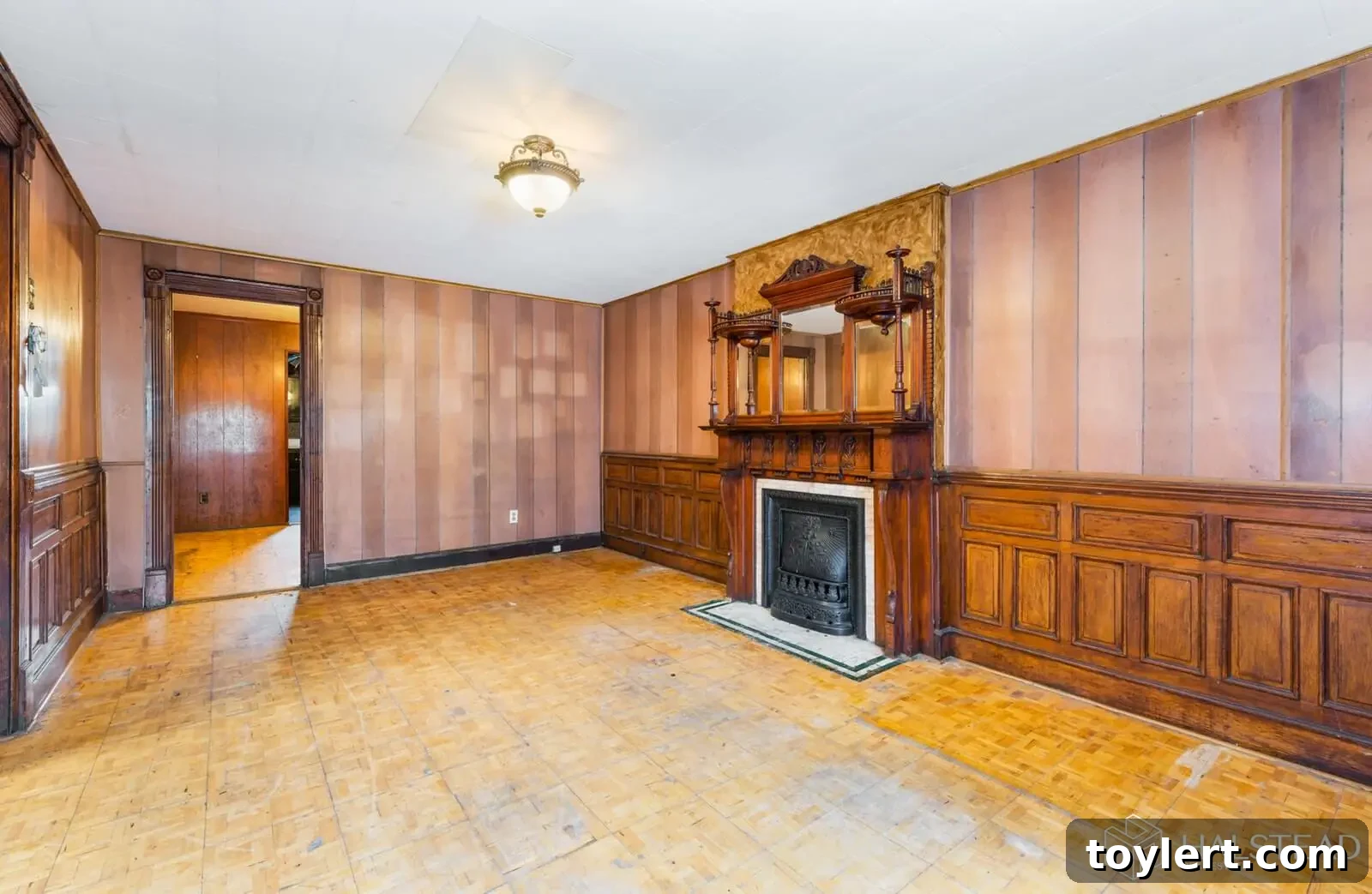
Upon entering, one is immediately struck by the “oodles of woodwork” that adorn the interior. This is a defining characteristic of Victorian-era luxury homes, where fine wood was extensively used to create a warm and opulent atmosphere. Expect to find:
- Elaborate Wainscoting: Decorative wood paneling typically extending part-way up the walls, adding texture and sophistication.
- Intricate Staircases: Grand staircases with richly carved balusters, newel posts, and handrails, often serving as a central focal point.
- Pocket Doors: Elegant sliding doors that disappear into the wall, offering flexible room configurations and preserving open sightlines when desired.
- Built-in Cabinetry: Custom-designed bookcases, china cabinets, or window seats that showcase exceptional craftsmanship and provide practical storage.
- Ornate Door and Window Trim: Decorative moldings around openings that elevate the aesthetic from simple functionality to artistic embellishment.
The type of wood, likely oak, cherry, or mahogany, would have been carefully selected for its beauty and durability, and its restoration would reveal the stunning natural grain and craftsmanship of over a century ago.
The Seven Elaborate Mantels
Perhaps one of the most astonishing features of the interior is the presence of “seven elaborate mantels.” In Victorian homes, fireplaces were not just sources of heat; they were statements of wealth and artistic taste, serving as the focal point of each room. These mantels would likely vary in style and material, showcasing the diversity of design trends of the period:
- Some might be grand, carved wooden structures, possibly in the Neo-Gothic or Eastlake style, featuring intricate carvings, columns, and built-in mirrors.
- Others could be crafted from exquisite marble, displaying elegant veining and polished surfaces, reflecting a more classical sensibility.
- Still others might incorporate decorative tiles, depicting pastoral scenes, geometric patterns, or floral motifs, adding bursts of color and narrative to the hearth.
Each mantel tells its own story, contributing to the unique character of the room it inhabits. Preserving and restoring these original mantels is crucial to honoring the home’s historical integrity and re-establishing its luxurious ambiance.
The Duplex Configuration
The current layout, yielding “two duplexes,” offers a modern adaptation to an historic structure. This configuration could appeal to various homeowners: those seeking an income-generating property, multi-generational families desiring separate living spaces, or even a discerning buyer looking to convert it back into a magnificent single-family residence. While this setup suggests some modifications from the original single-family grand dwelling, it highlights the adaptability of these robust brownstones. A renovation project could either enhance the existing duplex arrangement with modern amenities or meticulously restore the property to its original palatial dimensions, allowing for immense flexibility in tailoring the home to individual needs and aspirations.
A Renovation Journey: Unlocking Future Potential
The phrase “in need of renovation” should not deter but rather excite prospective owners. It signifies an unparalleled opportunity to imprint one’s vision onto a historic canvas. A renovation of 851 Jefferson Avenue is more than just an upgrade; it’s an act of stewardship and artistic creation. The goal would be to respectfully modernize the home while meticulously restoring its cherished original features.
Imagine integrating state-of-the-art kitchens and bathrooms that blend seamlessly with the home’s historic charm. Modern HVAC, electrical, and plumbing systems can be discreetly installed to ensure comfort and efficiency without compromising the aesthetic integrity. The challenge lies in balancing contemporary conveniences with the preservation of exquisite details like the seven mantels, the intricate woodwork, and the unique exterior ornamentation. This is where the true reward lies: in bringing a piece of Brooklyn’s past vibrantly into the 21st century, creating a home that is both historically significant and supremely livable. The potential for a truly bespoke, luxurious residence is immense, offering a lifestyle defined by elegance, history, and modern comfort.
Bedford-Stuyvesant: A Neighborhood Steeped in History
851 Jefferson Avenue is ideally situated in Bedford-Stuyvesant, one of Brooklyn’s most architecturally rich and culturally vibrant neighborhoods. Bed-Stuy is renowned for its tree-lined streets and majestic brownstone rows, which narrate a rich history spanning over a century. Originally developed as a residential haven for Brooklyn’s middle and upper-middle classes in the late 19th and early 20th centuries, it has evolved into a diverse and dynamic community.
Today, Bed-Stuy continues to attract residents drawn to its distinctive architecture, strong community spirit, and burgeoning cultural scene. The neighborhood boasts an array of charming cafes, acclaimed restaurants, boutique shops, and lush community gardens. Its excellent transportation links provide easy access to Manhattan and other parts of Brooklyn, making it a highly desirable location for urban dwellers. Living on Jefferson Avenue means being part of a historic fabric, surrounded by similar architectural marvels, and immersed in a neighborhood that values its heritage while embracing its future.
Why 851 Jefferson Avenue Stands Out
In a city filled with brownstones, 851 Jefferson Avenue distinguishes itself through its unique combination of factors: its “best built” reputation from 1893, the rare blend of Queen Anne and Gothic Revival styles, the visionary collaboration of Otto J. Gette and Charles Palmer, and the astonishing preservation of its original interior and exterior details. It’s a property that offers more than just square footage; it offers a narrative, a connection to history, and the profound satisfaction of restoring a masterpiece.
For the discerning buyer, this is an opportunity not merely to purchase a house, but to acquire a piece of Brooklyn’s soul, to become the next steward of a home that has stood for over 130 years. With thoughtful renovation, 851 Jefferson Avenue will undoubtedly reclaim its status as one of the city’s most impressive and cherished residences, continuing its legacy for generations to come.