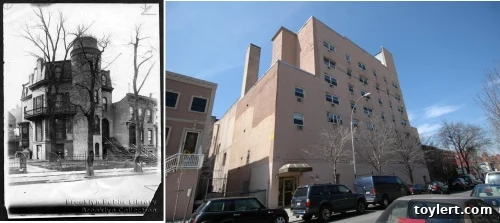
The Tower House: A Journey Through Brooklyn’s Past in Park Slope
A captivating look at Brooklyn’s architectural heritage, contrasting its storied past with its vibrant present.
Unveiling Park Slope’s Architectural Gem: The Tower House
In the bustling landscape of modern Brooklyn, where historic brownstones stand testament to bygone eras, some structures hold particularly unique stories. Among them is a property at 300 8th Street, near 5th Avenue, in the heart of Park Slope. This distinct residence, with its commanding presence and intriguing past, was once heralded as the oldest standing house in the entire Park Slope neighborhood, a claim documented by the revered Brooklyn Eagle newspaper in 1914. Its unique character, deeply intertwined with the development of one of Brooklyn’s most iconic neighborhoods, offers a fascinating window into the borough’s rich architectural and social history.
The photograph, dating back to 1913, captures the house in its prime, a snapshot from an era when horse-drawn carriages still navigated cobblestone streets and the sounds of industrial Brooklyn permeated the air. At that time, it was the cherished home of the late Asa B. Richardson, a figure whose life encompassed a diverse range of entrepreneurial pursuits. From his days as a successful hops merchant to his involvement in what the Brooklyn Eagle vaguely described as “the commission business” – likely indicating a role as a versatile salesman or broker – Richardson was clearly a man of ambition and influence. His ownership of such a distinctive property underscores his standing within the burgeoning Brooklyn community of the mid-19th century.
The Enigmatic Origins of a Park Slope Landmark
Asa B. Richardson and the 1850 Acquisition
Asa B. Richardson’s connection to the Tower House began in 1850 when he acquired the property. This was a pivotal moment not just for him, but for the evolving area. Back then, the neighborhood’s identity was fluid. While local residents often referred to their community as Gowanus, reflecting its historical and industrial ties, the astute reporters of the Brooklyn Eagle were already beginning to coin and popularize the more refined designation of “the Park Slope” – a name that would soon become synonymous with picturesque streets and grand residences. Richardson’s purchase marked him as an early settler and an integral part of this transition, cementing his legacy in the area’s foundational years.
The house itself was a marvel of its time, christened, quite fittingly, “The Tower House.” Its striking features included a large, octagonal main structure crowned by a prominent tower, a design that set it apart from typical residential architecture of the era. The Brooklyn Eagle, ever the purveyor of local lore, added an intriguing anecdote about its origins. According to the paper, the house had been constructed just a few years prior to Richardson’s purchase by a German immigrant who purportedly modeled its design after his ancestral castle nestled along the scenic Rhine River. While this romantic tale might stretch the bounds of architectural probability – the practicalities of replicating European castle grandeur in mid-19th century Brooklyn seem daunting – it undeniably adds a captivating layer to the house’s legend. Such stories, whether wholly factual or embellished over time, underscore the unique charm and perceived grandeur of early Park Slope residences.
Park Slope’s Transformation: From Rural Outpost to Urban Oasis
The Evolution of a Brooklyn Neighborhood
The story of the Tower House cannot be fully appreciated without understanding the dramatic transformation of Park Slope itself. In the mid-19th century, when the Tower House was built and acquired by Asa B. Richardson, the area was a far cry from the densely populated, architecturally rich neighborhood we know today. It was primarily rural, characterized by rolling hills, farms, and scattered estates. The moniker “Gowanus,” often used by residents, referred to the nearby creek and canal, an area that was rapidly industrializing. This contrast between the bucolic landscape of the higher ground and the burgeoning industrial activity along the waterway shaped the early identity of what would become Park Slope.
The true catalyst for Park Slope’s development was the creation of Prospect Park in the 1860s. Designed by Frederick Law Olmsted and Calvert Vaux, the same landscape architects behind Central Park, Prospect Park transformed the adjacent lands into highly desirable residential property. Speculators and developers quickly moved in, laying out streets and constructing the magnificent rows of brownstones and mansions that define Park Slope’s aesthetic today. The “Park Slope” designation, initially a journalistic invention, gradually gained traction, signifying an upscale residential district with direct access to the city’s premier park. The Tower House, with its unique design and prominent location, stood as a precursor to this grand architectural wave, a testament to the early visionaries who saw the potential in these verdant hills.
The Tower House: Then and Now
A Legacy of Architectural Uniqueness and Historical Preservation
The claim by the Brooklyn Eagle in 1914 that 300 8th Street was the “oldest standing house in Park Slope” is a powerful statement, indicative of the rapid pace of development and the often-ephemeral nature of early structures in a rapidly growing city. While verifying such a claim definitively today might be challenging without extensive historical records, it highlights the perceived age and historical significance of the Tower House at the time. Many older wooden structures were replaced by more substantial brick and brownstone buildings as the neighborhood prospered. The survival of the Tower House, especially with its distinctive design, made it a local landmark and a subject of historical interest even a century ago.
What does the Tower House represent in contemporary Park Slope? Its presence, whether still standing in its original form or having undergone significant alterations, speaks to the enduring appeal of unique architecture and the importance of preserving historical narratives. Modern Park Slope is a vibrant, highly sought-after neighborhood known for its tree-lined streets, diverse community, and continued architectural integrity. The value placed on historical preservation is immense, with many blocks designated as historic districts. Structures like the Tower House serve as tangible links to this rich past, reminding residents and visitors alike of the layers of history beneath the modern veneer.
The “then and now” comparison for the Tower House is more than just an architectural study; it’s a reflection of Brooklyn’s continuous evolution. The house, in its distinct octagonal form and with its towering presence, emerged at a time when Brooklyn was transitioning from independent city to an integral part of New York City, a hub of commerce, culture, and residential development. Its story, entwined with figures like Asa B. Richardson and the narrative of the Brooklyn Eagle, encapsulates the spirit of innovation, ambition, and community building that characterized 19th-century Brooklyn. It stands as a silent sentinel, observing the ebb and flow of generations, a testament to the enduring charm and historical depth of Park Slope.
The Enduring Appeal of Brooklyn’s Historic Homes
The Tower House, whether still gracing 8th Street in its original glory or reimagined over time, serves as a poignant reminder of Brooklyn’s deep historical roots and the stories etched into its very foundations. Its intriguing blend of unique architecture, the possibly mythical tale of its Rhine castle inspiration, and its association with early Brooklyn entrepreneurs like Asa B. Richardson, makes it a compelling subject. These stories are not just about individual buildings; they are about the people who built them, lived in them, and shaped the neighborhoods around them.
In an era where urban development often prioritizes newness, the preservation and appreciation of structures like the Tower House are more crucial than ever. They offer invaluable insights into the social, economic, and architectural trends that defined past centuries. They provide a tangible connection to the origins of communities and contribute significantly to the unique character and charm that draws so many to Brooklyn today. The legacy of the Tower House is a testament to the vibrant history that continues to live within the brownstones and tree-lined avenues of Park Slope, inviting us all to look a little closer at the stories waiting to be discovered.