Landmarks Commission Backs Preservation, Rejects Striking Modern Facade for Dumbo’s 10 Jay Street
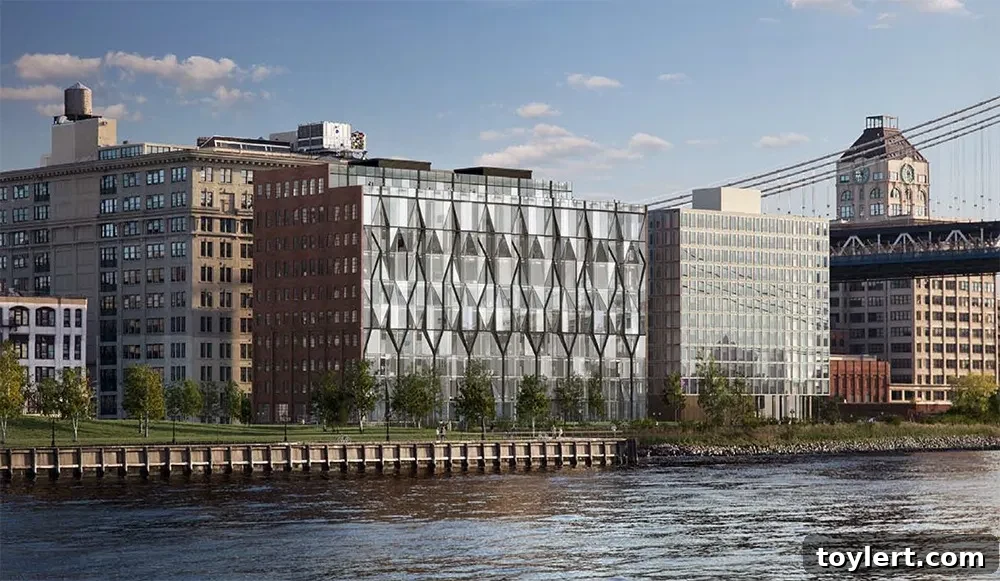
In a decision that underscores the ongoing tension between contemporary architectural vision and historic preservation, New York City’s Landmarks Preservation Commission (LPC) recently sent a bold, modern facade design for a significant 19th-century industrial building at 10 Jay Street in Dumbo, Brooklyn, back to the drawing board. The proposal, spearheaded by the renowned ODA Architecture, aimed to transform a historic brick factory into a vibrant mixed-use development, but its avant-garde exterior proved to be a step too far for the guardians of the city’s heritage.
The design, lauded by several commissioners, including chair Meenakshi Srinivasan, as “exceptional,” ultimately failed to secure approval. Despite its innovative appeal, the board concluded that the proposed “sugar crystal-inspired” approach was not the appropriate fit for the Dumbo Historic District, a neighborhood celebrated for its distinctive industrial architecture and cobblestone streets. This ruling highlights the delicate balance the LPC strives to maintain: fostering new development while safeguarding the irreplaceable character of New York City’s designated historic areas.
The Vision for 10 Jay Street: Blending Past and Present
The building at 10 Jay Street holds a rich history, dating back to 1898 when it was originally constructed as a brick factory for the Arbuckle Brothers sugar refinery. Designed by the George M. Newhall Engineering Co., the structure is characterized by its robust brickwork and distinctive arched windows, hallmarks of late 19th-century industrial architecture. For decades, it served as a vital part of Dumbo’s bustling industrial waterfront, contributing to the area’s economic engine before transitioning into a warehouse in the 1940s.
During the same decade, the building underwent a significant alteration: it lost its original facade on the north side, which faces the majestic East River and offers panoramic views of the Manhattan skyline and Brooklyn Bridge. This historical modification complicated the current adaptive reuse project, as the developer sought to address this missing piece of the building’s original design while also modernizing the structure for contemporary use.
Glacier Global Partners’ Ambitious Plans
Owner and developer Glacier Global Partners envisioned a comprehensive transformation for 10 Jay Street. Their plan included converting the expansive industrial space into 46 residential apartments, complemented by dynamic retail spaces on the ground floor. The specific nature of the residential units – whether condos or rentals – remained undisclosed at the time of the proposal, but the intent was clear: to capitalize on Dumbo’s immense popularity as a residential and commercial hub.
Crucially, Glacier Global Partners’ application to the LPC included a commitment to meticulously restore the three original facades of the building that remained intact. This aspect of their plan received unanimous approval from the Landmarks Preservation Commission, underscoring the LPC’s willingness to endorse projects that prioritize the faithful restoration of historic elements. However, the proposed new facade for the previously altered north side was where the design encountered significant resistance. In anticipation of the project moving forward, ODA Architecture had already filed an application for a building permit in December, prior to the LPC’s ultimate rejection of the modern facade.
The Landmarks Preservation Commission: Stewards of NYC Heritage
The Landmarks Preservation Commission plays a pivotal role in New York City’s urban fabric. Established in 1965, following the demolition of Pennsylvania Station, its primary mission is to protect the city’s architectural, historical, and cultural heritage. This responsibility involves designating individual landmarks, scenic landmarks, and historic districts, and then regulating changes to these protected properties to ensure their special character is preserved for future generations.
For buildings situated within a historic district, like 10 Jay Street in Dumbo, any exterior modifications, including renovations, additions, or even facade repairs, must undergo a rigorous review process by the LPC. The Commission evaluates proposals based on a set of stringent criteria, which often include:
- Contextual Harmony: How well the proposed design relates to the architectural style, scale, materials, and overall character of its surroundings within the historic district.
- Material Appropriateness: The suitability of materials in terms of their historical accuracy, durability, and aesthetic contribution to the existing structure and neighborhood.
- Preservation of Historic Features: The extent to which original architectural details and elements are retained, restored, or sensitively integrated into new designs.
- Public View and Impact: The visual impact of the proposed changes from public thoroughfares and their effect on the district’s overall appearance.
- Design Excellence: While innovation is appreciated, it must align with the preservation goals for the specific site and district.
In the case of ODA’s “sugar crystal-inspired” facade, despite its acknowledged design excellence, the commission determined it did not adequately harmonize with the industrial-era aesthetic that defines the Dumbo Historic District. This decision reflects the LPC’s commitment to maintaining the integrity of these protected areas, even when faced with highly creative contemporary proposals.
Dumbo’s Transformation: A Battleground for Modernity and History
The Dumbo neighborhood, an acronym for “Down Under the Manhattan Bridge Overpass,” has undergone a remarkable metamorphosis over the past few decades. Once a gritty industrial and manufacturing zone, it has transformed into one of Brooklyn’s most sought-after residential and commercial enclaves. Its historic loft buildings, cobblestone streets, and unparalleled waterfront views have attracted a diverse community of artists, tech entrepreneurs, and families, driving a surge in adaptive reuse projects.
This rapid gentrification and redevelopment, while bringing new life and investment to the area, also presents unique challenges for preservation. Developers are eager to introduce cutting-edge architecture and amenities, while preservationists advocate for designs that respect Dumbo’s unique industrial heritage. The 10 Jay Street case is a microcosm of this broader urban dilemma: how to accommodate modern needs and aesthetic sensibilities within the confines of a protected historic environment.
The “Exceptional” But “Not Right” Paradox
Chair Meenakshi Srinivasan’s description of ODA’s design as “exceptional” yet ultimately “not the right one” perfectly encapsulates the nuanced position of the LPC. This paradox highlights that a design can be architecturally brilliant and innovative in its own right, yet still deemed unsuitable for a specific historic context. The LPC’s role isn’t merely to judge the aesthetic quality of a design in isolation, but to assess its compatibility with the distinct character and historical significance of its surroundings.
The “sugar crystal-inspired” facade, presumably featuring geometric patterns, reflective surfaces, or a fragmented appearance, likely aimed to evoke Dumbo’s industrial past while presenting a strikingly modern face. While such a design might thrive in a contemporary setting, its perceived dissonance with the robust, unadorned brickwork and utilitarian aesthetic of Dumbo’s late 19th and early 20th-century factory buildings led to its rejection. The Commission likely sought a design that, while potentially modern, would “dialogue” more subtly with the existing historical fabric rather than stand in stark contrast.
What’s Next for 10 Jay Street?
The LPC’s decision to send ODA Architecture and Glacier Global Partners “back to the drawing board” signifies a mandatory rethinking of the proposed north facade. This typically means the architectural team will need to revise their plans significantly, taking into account the Commission’s feedback regarding contextual appropriateness and material palette. The challenge now for ODA will be to craft a design that is both innovative and respectful of the Dumbo Historic District’s unique character.
Future iterations of the design might explore:
- More traditional materials: Incorporating materials like brick, terracotta, or metal panels that complement the existing industrial aesthetic.
- Subtler geometries: Moving away from highly fragmented or overtly crystalline forms towards more restrained, classical proportions or industrial-inspired fenestration.
- Evocative rather than literal interpretations: Drawing inspiration from the building’s industrial past in a more abstract or understated manner, rather than a literal interpretation that might clash with the district’s overall feel.
- A phased approach: Potentially a design that initially presents a more subdued appearance, with possibilities for subtle modern accents.
The process underscores the rigorous standards for development in New York City’s historic districts. It’s a testament to the fact that even with acclaimed architects and developers, preservation takes precedence when the character of a landmarked neighborhood is at stake. The ultimate design for 10 Jay Street will undoubtedly be a compromise, striving to achieve a harmonious balance between contemporary living and a cherished historical legacy.
Conclusion: The Enduring Debate
The rejection of ODA Architecture’s initial facade design for 10 Jay Street serves as a powerful reminder of the complex and often contentious relationship between urban development and historic preservation in New York City. While modern architecture plays a crucial role in evolving urban landscapes, its integration into historic districts demands a profound respect for context and heritage.
Dumbo’s journey from an industrial powerhouse to a vibrant modern neighborhood continues, shaped by decisions like these. The future facade of 10 Jay Street will eventually emerge as a symbol of this ongoing dialogue, illustrating the city’s commitment to both innovation and the careful stewardship of its irreplaceable past. The expectation now is for a revised proposal that can marry contemporary living with the timeless charm of Dumbo’s industrial heritage, satisfying both the demands of modern residents and the vigilant eyes of the Landmarks Preservation Commission.