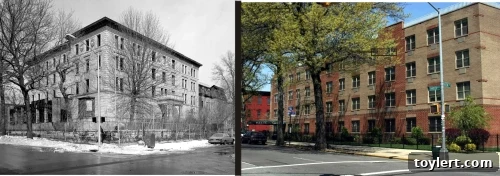
Brooklyn’s Enduring Legacy: A Glimpse into the Past and Present of the Baptist Home
The urban landscape is a living testament to time, constantly evolving yet holding echoes of its past. Few cities encapsulate this dynamic interplay as vividly as Brooklyn, New York. Its streets, buildings, and neighborhoods tell stories of bygone eras, often standing in stark contrast to their modern incarnations. This exploration into “Brooklyn, then and now” unearths the fascinating narrative of the Baptist Home, an institution whose very existence, location, and architectural grandeur speak volumes about the borough’s rich history, philanthropic spirit, and continuous transformation.
For many residents and enthusiasts of Brooklyn’s historical fabric, specific landmarks trigger personal memories and connect them directly to the city’s layered past. The Baptist Home is one such iconic structure. Recalled from as early as 1983 by long-term residents, this venerable institution was a prominent feature of the Bedford-Stuyvesant and Crown Heights area. Its enduring presence, even as the neighborhoods around it underwent significant changes, makes it a perfect focal point for understanding the historical trajectory of this vibrant part of Brooklyn.
The Baptist Home: A Beacon of 19th-Century Charity in Brooklyn
Emerging in the latter half of the 19th century, a period marked by rapid industrialization, immigration, and burgeoning social reform movements, the Baptist Home stood as one of Brooklyn’s many charitable institutions. These homes, orphanages, and hospitals dotted the landscape of what would become the densely populated and historically rich neighborhoods of Bedford-Stuyvesant and Crown Heights. Their establishment reflected a profound civic and religious commitment to social welfare, providing essential services to the community’s most vulnerable. The Baptist Home, specifically designed as an old age home, offered refuge, care, and dignity to elderly members of the community, rooted deeply in the compassionate values of its Baptist founders and benefactors.
The chosen location for such an esteemed institution was strategic. Positioned elegantly on the corner of Throop Avenue, nestled between Greene Avenue and Van Buren Street, it occupied a significant urban footprint. This part of Brooklyn, then as now, was accessible yet offered ample space for large-scale construction, reflecting the ambition and forward-thinking nature of its patrons. The architectural prominence of the building itself was a statement of its importance, designed not just for function but also to inspire reverence and provide a sense of comfort and stability to its residents.
Architectural Splendor and Visionary Design: The Hand of E.L. Roberts
The Baptist Home was not merely a building; it was an architectural masterpiece, realized in three distinct stages, each envisioned by one of Brooklyn’s most esteemed architects. The main edifice, a testament to the era’s grand vision, was meticulously crafted by E.L. Roberts between 1873 and 1875. Roberts was a name synonymous with architectural excellence in Brooklyn, particularly noted for his pragmatic yet aesthetically rich designs that blended functionality with Victorian-era grandeur.
E.L. Roberts’ portfolio extended far beyond the Baptist Home, solidifying his reputation as a favored architect among Brooklyn’s elite, most notably Charles Pratt. His designs include Charles Pratt’s own magnificent Clinton Avenue residence, a structure that epitomized the wealth and taste of Brooklyn’s industrial magnates. Furthermore, Roberts was responsible for the chapel of Emmanuel Baptist Church, among other significant ecclesiastical and residential projects across the borough. His architectural language, characterized by robust construction, intricate detailing, and an imposing yet inviting presence, was perfectly suited for institutions like the Baptist Home, which required both durability and an atmosphere of dignified care. The multi-stage construction hints at the evolving needs and expansions of the home, showcasing a thoughtful approach to growth while maintaining a cohesive architectural identity.
The Philanthropic Pulse: Charles Pratt and the Spirit of Giving
The story of the Baptist Home is inextricably linked with the philanthropic giants of 19th-century Brooklyn, chief among them Charles Pratt. A titan of industry, known for founding the Pratt Institute and a significant figure in the petroleum industry, Pratt was also a man of profound faith. His devout Baptist beliefs were not confined to personal worship but actively translated into significant civic and charitable contributions. It is highly probable that Pratt, given his religious convictions and vast resources, was a substantial donor and an influential advisor in the establishment and construction of the Baptist Home.
Pratt’s involvement underscores a broader trend during this period: the emergence of a powerful philanthropic class driven by both religious principles and a sense of civic duty. These benefactors saw it as their responsibility to address the social challenges of a rapidly growing urban environment. Their contributions shaped much of Brooklyn’s institutional landscape, from educational facilities to healthcare and social welfare organizations. The Baptist Home stands as a lasting monument to this era of generous giving, where faith and fortune converged to create vital community services.
Brooklyn’s Institutional Landscape: A Tapestry of Care
The Baptist Home was not an isolated entity but rather part of a larger network of charitable institutions that defined Brooklyn in the late 19th century. Areas like Bedford-Stuyvesant and Crown Heights, with their spacious lots and developing infrastructure, became natural hubs for such endeavors. These institutions provided crucial safety nets for various segments of the population: orphanages cared for children without families, hospitals offered medical aid, and specialized homes catered to different needs, all contributing to a burgeoning social welfare system long before widespread government intervention. They represented a collective community effort to address the exigencies of an era marked by rapid social change and economic disparities.
This clustering of charitable homes also reflects the growth and character of these neighborhoods. They were areas of aspiration, where burgeoning middle classes established roots, and where grand institutions could project an image of stability and progress. The architectural styles of these buildings often mirrored the prevailing Victorian and Romanesque Revival tastes, lending a distinctive and often imposing aesthetic to the urban fabric. They became landmarks, deeply embedded in the identity of the communities they served.
Bedford-Stuyvesant and Crown Heights: A Changing Tapestry of Urban Life
The “then and now” aspect of the Baptist Home’s story is perhaps most evident in the transformation of its surrounding neighborhoods. In the late 19th century, Bedford-Stuyvesant and Crown Heights were burgeoning residential areas, attracting both wealthy industrialists and a growing professional class, alongside the institutions designed to support the community. The broad avenues, stately brownstones, and grand churches bespoke an era of prosperity and ordered development.
Fast forward to the present day, and while much of the architectural grandeur remains, these neighborhoods have undergone profound demographic, social, and economic shifts. From being vibrant African American cultural centers in the mid-20th century to experiencing periods of decline and subsequent revitalization, Bed-Stuy and Crown Heights are now synonymous with Brooklyn’s dynamic real estate market, cultural renaissance, and ongoing gentrification. Through all these changes, structures like the Baptist Home have often stood witness, sometimes adapting their purpose, sometimes simply enduring as historical markers. The ability to recall the building’s specific context from as recently as 1983 highlights a period of flux preceding the rapid changes of the late 20th and early 21st centuries, bridging the memory of residents with the deep history of the borough.
The Enduring Resonance of Urban History
The Baptist Home, whether still serving its original purpose or having been adaptively reused for modern needs, continues to be a powerful symbol. It represents not just a piece of architecture but a chapter in Brooklyn’s social history, a testament to the vision of its founders and the evolution of urban life. The memory of its original function, nestled within the contemporary vibrancy of Bedford-Stuyvesant and Crown Heights, offers a tangible link to the past. It invites us to consider how social values, architectural trends, and neighborhood identities have transformed over time, and how historical landmarks often serve as anchors in an ever-changing urban sea.
Understanding these historical layers enriches our appreciation of Brooklyn today. It reminds us that every street corner, every aged edifice, possesses a narrative waiting to be uncovered. The Baptist Home is more than just an old building; it is a repository of stories about care, community, design, and the relentless march of time in one of the world’s most captivating cities. Its journey from a 19th-century charitable institution to a modern-day historical touchstone perfectly encapsulates the enduring appeal of exploring Brooklyn, then and now.