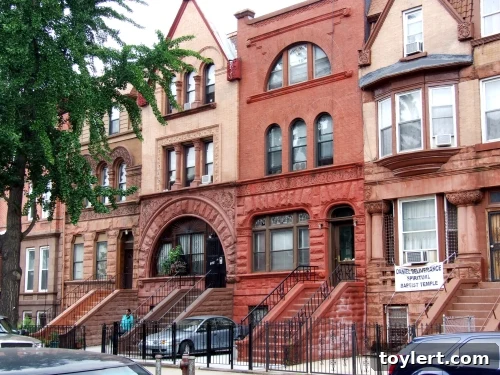
(A beautiful example of a Queen Anne style home on Herkimer Street, nestled between Nostrand and New York Avenues in Bedford Stuyvesant, Brooklyn.)
Unraveling the Mystery of Queen Anne Architecture: More Than Just a Catch-All Term
For many architecture enthusiasts and casual observers alike, attempting to pinpoint the exact style of a historical building can often feel like a delightful but challenging puzzle. Among the myriad of architectural periods, one name frequently emerges as a sort of default, a catch-all for anything that defies immediate classification: “Queen Anne.” It’s become an inside joke among fellow architecture aficionados: “What would you call that? I can’t quite put a name to it…must be Queen Anne.” “Yeah, Queen Anne.” This ubiquitous label, however, does a disservice to a distinct and fascinating architectural style that truly deserves a deeper understanding. But how did the name of a little-known (at least to Americans) 18th-century English monarch become so inextricably linked with a late 19th-century building boom, almost two centuries after her death? What exactly defines Queen Anne architecture, and why is it so often misidentified?
Before delving into the intricacies of the architectural style, it’s worth a moment to reflect on the actual Queen Anne herself. Born in 1665 as the second daughter of James, Duke of York (who later became King James II of England), Anne’s life was marked by considerable personal tragedy and political significance. While her reign, though impactful, holds no direct relevance to the architectural style that bears her name, a quick historical overview provides crucial context for understanding the eventual misnomer. Anne was the sister of Mary, co-monarch with her husband William of Orange (the famous “William and Mary” of constitutional monarchy fame). After Mary’s death in 1694 and William’s in 1702, Anne ascended to the throne, becoming Queen of Great Britain and Ireland. Her twelve-year reign, from 1702 until her death in 1714, was plagued by chronic illness, numerous miscarriages (a staggering 12), and the heartbreak of losing all five of her live-born children before they reached adulthood. She died without an heir, marking the end of the Stuart dynasty. It is clear that the sickly, often bedridden Queen Anne, reigning at the turn of the 18th century, had no direct hand in influencing the elaborate, flamboyant designs that would later carry her name in the late 19th century.
The Genesis of a Misnomer: How Richard Norman Shaw Sparked a Style
The intriguing disconnect between the real Queen Anne and the architectural style named after her can be traced back to the late 1860s and early 1870s in England. The renowned British architect Richard Norman Shaw is largely credited with initiating what he termed the “Queen Anne style.” Shaw, and architects influenced by him, were not actually looking to the architecture of Queen Anne’s immediate reign (which was predominantly Baroque or early Georgian, characterized by classical symmetry and restrained ornamentation). Instead, they drew inspiration from a romanticized, idealized vision of vernacular English architecture from the late Elizabethan and Jacobean periods, combined with influences from Dutch and Flemish gabled houses – a period roughly spanning from the mid-16th to early 18th centuries, thus encompassing the time *around* Queen Anne’s life, rather than her direct influence. Shaw’s style was a reaction against the somber, heavy Classicism and Gothic Revival prevalent in earlier Victorian design, seeking a more picturesque, informal, and distinctly English aesthetic.
When this “Queen Anne” style crossed the Atlantic to the United States in the 1870s, it truly blossomed, becoming the most dominant and exuberant domestic architectural style of the Victorian era. American architects and builders embraced its flexibility and decorative potential, adapting it with a unique flair that often exaggerated its features. The style found particular favor between approximately 1880 and 1910, coinciding with a period of unprecedented economic growth and expansion in America, especially in burgeoning urban centers and new suburban developments. It was during this time that “lumber barons and railroad magnates,” as the delightful (and hilariously typo-ridden) description from antiquehome.org puts it, commissioned grand and spectacular homes, eager to display their newfound wealth and status. The original article’s mention of this amusing typo – “Beloved by lumber barons and railroad maggots alike, many of the largest and most spectacular homes of the early 20th century were built in this style” – perfectly captures the spirit of a period where lavish display was paramount.
Defining Characteristics: What Makes a Queen Anne Home?
So, if not directly from Queen Anne herself, what are the definitive characteristics that allow us to identify a true Queen Anne style building? The style is celebrated for its deliberate asymmetry, a stark contrast to the rigid symmetry of earlier classical styles. This asymmetry is expressed through a dynamic interplay of forms, textures, and colors, creating a visually rich and often whimsical composition. Key features include:
- Irregular Rooflines: A hallmark of Queen Anne is its complex and often dramatic roofline, featuring multiple gables, turrets, towers, and dormers. These varied roof forms contribute significantly to the style’s picturesque quality.
- Towers and Turrets: Perhaps the most iconic feature, round or polygonal towers and turrets, often capped with conical or pyramidal roofs, are frequently incorporated at corners or as prominent focal points. These add verticality and a sense of grandeur.
- Textural Variety: Queen Anne homes delight in the use of diverse exterior materials. It’s common to see a combination of brick on the first story, clapboard siding on the second, and patterned shingles (such as fish-scale, diamond, or scalloped) on upper gables or turrets. Terra cotta panels, carved wood, and stone accents also add to this rich tapestry of textures.
- Decorative Spindlework and Ornamentation: The late 19th century saw the rise of mass-produced architectural elements, making elaborate decoration more accessible. Queen Anne homes showcase an abundance of decorative spindlework, particularly on porches, balconies, and gables. Sunburst motifs, detailed carvings, and applied panels are also prevalent.
- Projecting Bays and Oriel Windows: Bay windows and their cantilevered cousins, oriel windows, are common. These projections break up flat wall surfaces, allowing for more light and offering expanded views from within. They often feature stained glass transoms or panels.
- Wrap-Around Porches: A defining characteristic, especially in American Queen Anne homes, is the expansive, often elaborately decorated, wrap-around porch. These provided a welcoming outdoor living space and further enhanced the building’s irregular silhouette.
- Large, Prominent Chimneys: Chimneys were not merely functional but often served as decorative elements, sometimes featuring intricate brickwork or detailing.
- Vibrant Color Palettes: While many original paint schemes have been lost or altered, Queen Anne homes were often painted in multi-color schemes, highlighting their various textures and architectural elements.
The Queen Anne style was, at its heart, a celebration of individuality and craftsmanship, enabled by new industrial capabilities. Its eclecticism allowed for a delightful blend of influences, from medieval half-timbering to classical columns, all combined with an almost playful disregard for strict rules. It reflects the Victorian era’s passion for ornamentation, comfort, and a picturesque ideal of domesticity.
Queen Anne’s Enduring Appeal and Legacy
The popularity of Queen Anne architecture began to wane in the early 20th century, as tastes shifted towards simpler, more restrained styles like the Colonial Revival or Arts and Crafts movement. However, its legacy remains deeply ingrained in the fabric of many American towns and cities. The example shown, a Queen Anne style home on Herkimer Street in Bedford Stuyvesant, Brooklyn, is a testament to the style’s widespread adoption in diverse urban landscapes. Bed-Stuy, like many historic neighborhoods, boasts a remarkable collection of these charming and distinctive homes, each telling a story of a bygone era of prosperity and architectural exuberance.
Despite the historical misnomer, the Queen Anne architectural style stands as a vibrant and beloved chapter in design history. Its intricate details, irregular forms, and emphasis on craftsmanship continue to captivate. It reminds us that architecture is not just about function, but about expression, aspiration, and the stories buildings tell. The next time you encounter a charming old house with a turret, a wrap-around porch, and a medley of textures, remember that you’re likely looking at a true Queen Anne, a style that, despite its name’s quirky origin, has firmly established its own unique and unforgettable identity.