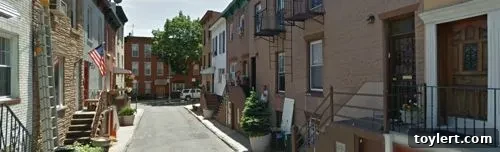
Dennet Place: Unraveling the Enigma of Carroll Gardens’ Miniature Street
In the bustling borough of Brooklyn, amidst the brownstone-lined streets and vibrant communities, lies a curious anomaly that has long captivated locals and historians alike: Dennet Place. This quaint cul-de-sac in Carroll Gardens, a neighborhood renowned for its charm and distinctive architecture, recently garnered attention in a feature by The New York Times, sparking renewed interest in its many mysteries. For many Brooklynites, the mention of Dennet Place, sometimes spelled Dennett Place and affectionately known as Cat’s Alley, might evoke a sense of unfamiliarity, a testament to its secluded nature and the quiet lives lived within its unique confines.
The Allure of Miniature Doors: A Glimpse into a Bygone Era
One of the most striking features that sets Dennet Place apart is its collection of diminutive street-level entrances. These doors, seemingly scaled for a fantasy world rather than a modern urban setting, instantly transport visitors to an earlier time. The New York Times reporter, intrigued by these “miniature street-level entrances, more appropriate for hobbits than humans,” took to the streets to gather theories from the long-standing residents. The responses offered a delightful glimpse into the community’s collective imagination, highlighting how locals weave narratives around their distinctive surroundings.
These charming, often unassuming doorways are more than just architectural quirks; they are windows into the past, prompting questions about the lives of those who first called Dennet Place home. Were the original inhabitants smaller? Was there a practical reason for their reduced size, or was it simply a stylistic choice of the era? The enigma of these doors is a central part of Dennet Place’s enduring appeal, making it a truly unique historical landmark within the bustling metropolis of New York City.
A Tapestry of Theories: Explaining the Unexplained
The residents of Dennet Place, accustomed to the curiosity their homes inspire, offered a fascinating array of theories regarding their pint-sized portals. One resident humorously suggested, “Maybe they had something to drink when they built it,” implying a whimsical, perhaps less-than-sober, design process. This lighthearted explanation speaks to the often-unpredictable nature of historical construction and the delightful imperfections that can arise.
Another theory leaned into the street’s unofficial moniker, “Cat’s Alley,” with a resident positing, “I always thought it was because of the cats.” While seemingly fanciful, the idea of doors designed for the convenience of feline inhabitants, or perhaps reflective of a local cat population, adds another layer of charm to the street’s lore. It evokes images of cats gracefully navigating their miniature domain, a quintessential detail in the tapestry of urban legends.
A third explanation focused on the demographic that once filled the street: “I thought it was because there were so many kids.” This theory hints at a past where large families were common, and perhaps the smaller doors were more accessible or simply reflected the overall modest scale of the homes built for working-class families. It paints a picture of a lively, child-filled street, where every entrance might have seen dozens of tiny feet pass through daily.
Beyond the architectural theories, the name “Cat’s Alley” itself is shrouded in a different kind of mystery. Yet another local attributed the moniker not to felines, but to a man named Katz, who reportedly hosted card games in his basement. This anecdote highlights how personal histories and local figures can profoundly influence the informal naming conventions of a neighborhood, sometimes enduring for generations even as the original context fades. Such stories underscore the rich oral tradition that thrives in close-knit communities, preserving snippets of their unique heritage.
The Historical Conundrum: Dennet, Dennett, or Bennett Place?
Just when the narrative around Dennet Place seemed sufficiently layered with architectural curiosities and local folklore, a significant curveball was thrown by the blog Lost City. Their compelling theory suggests that the street’s widely accepted name might be a historical misunderstanding, proposing its true name is actually Bennett Place. This revelation adds a fascinating dimension to the street’s identity, transforming a simple historical inquiry into a genuine urban mystery.
The Lost City blog argues that this alternative naming makes more historical sense, pointing to the Bennetts as a highly active and influential real estate family in 19th-century Brooklyn. It’s not uncommon for streets, avenues, or squares in developing urban areas to be named after prominent local figures, especially those involved in land development. The presence of such a family with a strong historical footprint in the region lends considerable weight to the argument that “Bennett Place” could indeed be the original and correct designation.
Adding tangible evidence to this claim, the blog even reproduces a map from 1896 that distinctly labels the street as Bennett Place. This cartographical evidence serves as a powerful testament to the fluidity of historical records and the potential for official names to evolve, be misremembered, or even mistakenly altered over time. The existence of such a map challenges the contemporary understanding of Dennet Place, prompting a re-evaluation of its documented history.
The debate between Dennet and Bennett Place is more than a trivial semantic exercise; it speaks to the broader challenges of historical preservation and the interpretation of urban development. It highlights how the past can be obscured, forgotten, or simply misinterpreted through generations, making the work of local historians and community blogs invaluable in unearthing these hidden truths.
A Community’s Heartbeat: Italian-American Heritage
Beyond its architectural curiosities and naming controversies, Dennet Place holds deep historical significance as an Italian-American stronghold. This cultural identity traces back to its very origins, when the street was initially constructed to house the workers who were building the local church up the street. This foundational purpose created a close-knit community bound by shared faith, heritage, and the daily rhythms of immigrant life.
For decades, Dennet Place, like much of Carroll Gardens, has been a vibrant hub of Italian-American culture, where traditions are passed down through generations, and neighbors form extended families. This rich heritage is palpable in the community’s steadfastness, its strong social bonds, and the palpable sense of belonging that permeates the alley. The New York Times piece also underscored this aspect, recognizing Dennet Place as a prime example of a “tight-knit community” – a characteristic that has allowed its unique stories and quirks to persist through the decades.
The enduring presence of Italian-American families and their cultural legacy has shaped the very character of Dennet Place, fostering a sense of continuity and resilience in an ever-changing city. It’s a place where history isn’t just documented in archives, but lived out daily through communal interactions, shared memories, and the simple act of calling it home.
Delving Deeper: Insights from the Brooklyn Historical Society
An important update to the narrative, particularly relevant for those fascinated by the “Bennett Place” theory, emerged from a post on the Brooklyn Historical Society Blog. This blog post, published prior to the New York Times piece, offered a far more in-depth exploration of the topic, providing comprehensive historical context and analysis. It serves as a crucial resource for anyone seeking to understand the true historical landscape of this unique street.
The Brooklyn Historical Society (now Brooklyn Public Library, Center for Brooklyn History) is a treasure trove of local history, and its blog often features meticulous research that delves into the hidden corners of the borough. Their article on Dennet Place goes beyond surface-level observations, examining land records, historical maps, census data, and other primary sources to shed light on the street’s true origins and its various appellations. For serious history enthusiasts or anyone wishing to truly unravel the mystery of Dennet Place, consulting the Brooklyn Historical Society’s extensive research is not just recommended, but essential. It provides a robust framework for understanding the complexities of urban nomenclature and the dedicated efforts involved in uncovering historical truths.
This invaluable historical account underscores the importance of local institutions in preserving and disseminating the rich, intricate narratives that define our neighborhoods. It reminds us that behind every street name, every architectural detail, there lies a story waiting to be discovered, often with layers of historical data to support or refute prevailing beliefs.
Why Dennet Place Continues to Fascinate
Dennet Place, whether you call it Dennett Place, Cat’s Alley, or even Bennett Place, remains one of Carroll Gardens’ most captivating and endearing secrets. It embodies the spirit of Brooklyn – a borough where historical depth, community spirit, and quirky charm intertwine to create spaces that feel both intimately local and globally unique. Its miniature doors, diverse theories, and disputed name make it a living piece of history, constantly inviting new interpretation and appreciation.
The stories emanating from this one-block (or two, if you count Nelson Street) alley, from the origins of its distinctive architecture to the vibrant Italian-American community it houses, offer a microcosm of urban evolution. It’s a reminder that even in the most developed cities, hidden histories and unanswered questions abound, waiting for curious minds to explore them. Dennet Place stands as a testament to the enduring power of local lore and the tangible connection we feel to places that hold secrets and stories within their very foundations.
On Dennet Place in Brooklyn, a Tight-Knit Community [NY Times]
The Mystery of Dennet Place in Carroll Gardens [Brooklyn Historical Society Blog]
Is Dennett Place Really Bennett Place? [Lost City Blog]