Unearthing Brooklyn’s Hidden Past: The Monastery of the Precious Blood in Bedford
Brooklyn, a borough celebrated for its vibrant culture, iconic brownstones, and rich history, often holds secrets beneath its bustling streets. Layers of time, development, and forgotten narratives lie waiting to be rediscovered by those willing to delve into its archives. This is precisely the kind of serendipitous journey that recently led to the uncovering of a fascinating piece of Bedford’s past: the Monastery of the Precious Blood.
The journey began, as many historical quests do, with an unrelated inquiry. While engrossed in research concerning another aspect of Brooklyn’s heritage, a detailed Sanborn insurance map of Bedford, dating back to 1908, captured my attention. These maps, meticulously detailing urban structures for fire insurance purposes, are invaluable historical documents, offering precise blueprints of neighborhoods long past. And there it was, an unexpected revelation:
A Cloistered Enigma in the Heart of Bedford
Nestled firmly in the middle of a block, bordered by Jefferson Avenue to the north and Hancock Street to the south, and flanked by the busy arteries of Bedford and Nostrand Avenues, was a cloistered Catholic monastery. For someone who had lived merely two blocks away from this very location for years, and who had undertaken extensive research into the history of Bedford, this discovery was startling. The monastery was entirely unknown to me; its existence had never surfaced in any prior study, nor had its name been uttered in any local historical accounts I had encountered.
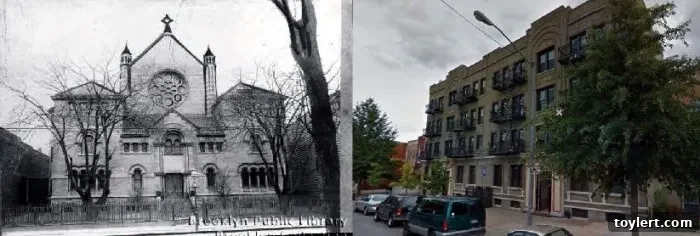
The immediate questions that arose were profound: What was its story? Who were the cloistered nuns who resided within its walls? And perhaps most crucially for a visual historian, were there any photographs or architectural records that could bring this forgotten edifice back to life? Fortunately, the answers, though challenging to unearth, were ultimately rewarding. A painstaking search through historical archives yielded a significant find: the Brooklyn Eagle, a venerable newspaper of its time, had indeed published a photograph. The same image, a testament to the monastery’s past grandeur, was also preserved within the vast collections of the Brooklyn Public Library. The visual evidence was striking: a magnificent church building, formidable 10-foot walls signifying its cloistered nature, and the undeniable presence of an order of nuns living a life dedicated to prayer and contemplation. The realization was profound: a truly remarkable piece of Brooklyn’s spiritual and architectural heritage had been hidden in plain sight, waiting for rediscovery.
Sanborn Maps: Windows to a Bygone Era
The pivotal role of the Sanborn Maps in this discovery cannot be overstated. For those unfamiliar, the Sanborn Map Company began publishing detailed maps of U.S. cities and towns in the mid-19th century, primarily for fire insurance underwriters. These maps provided an astonishing level of detail: building footprints, construction materials, heights, street widths, and even the uses of individual structures. They are a historian’s dream, offering a freeze-frame of urban landscapes at specific moments in time. In the case of Bedford in 1908, the map didn’t just show a building; it outlined the distinct shape of a monastery, complete with features indicating its religious purpose and its secluded nature, an architectural anomaly amidst a rapidly urbanizing neighborhood. This level of detail allowed for precise triangulation of its location, paving the way for further research into its specific plot of land and the eventual fate of the site.
The Monastery of the Precious Blood: A Deeper Look into Cloistered Life
The Order of the Most Precious Blood, or similar cloistered orders, are dedicated to a life of strict enclosure, prayer, and penance. Their monasteries, by design, are self-contained worlds, insulated from the distractions and secular concerns of the outside. The 10-foot walls mentioned in the historical accounts were not merely architectural features but symbolic and functional barriers, reinforcing the nuns’ commitment to perpetual prayer and separation from the world. Life within these walls was governed by a strict horarium—a schedule of daily prayers, liturgies, spiritual readings, and manual labor, all observed in silence and solitude. The nuns would have engaged in various domestic tasks, from cooking and cleaning to gardening and needlework, often creating liturgical vestments or sacred art to sustain their community. Their days were a rhythmic cycle of devotion, their voices rarely heard beyond the chapel and the communal areas, their faces seldom seen by outsiders, even their own families. This profound dedication to a contemplative existence provided a spiritual anchor, not just for the nuns themselves, but, in their belief, for the wider community through their intercessory prayers.
Bedford in 1908: A Thriving, Transforming Neighborhood
To truly appreciate the context of the Monastery of the Precious Blood, one must envision Bedford-Stuyvesant (specifically Bedford) at the turn of the 20th century. By 1908, Brooklyn was a rapidly growing borough, having consolidated with New York City a decade prior. Bedford was a vibrant, middle-class neighborhood, characterized by its elegant brownstones and tree-lined streets, a testament to late 19th-century urban development. It was home to a diverse population, with a mix of Irish, German, and Italian immigrants alongside established African American communities. The area buzzed with the energy of commerce, social activity, and an expanding infrastructure of public services and transportation. Within this dynamic urban landscape, the silent, cloistered monastery presented a stark contrast. It was a serene island of spiritual devotion amidst the cacophony of city life, a place where time seemed to slow, governed by ancient rituals rather than the relentless pace of modernity. Its presence speaks volumes about the religious piety and diverse spiritual landscape that characterized Brooklyn at the time, offering solace and spiritual grounding to many, even if unseen.
The Vanishing Act: What Became of the Monastery?
The disappearance of the Monastery of the Precious Blood from Brooklyn’s collective memory is a common fate for many historical structures in rapidly developing urban centers. While the precise reasons for its eventual demolition or repurposing are often complex and multifactorial, several general patterns typically emerge. Shifting demographics, declining vocations within religious orders, financial pressures, and the ever-present demand for urban land are all contributing factors. As communities evolve, so too do their needs and priorities. Often, religious institutions find it increasingly difficult to maintain aging buildings, especially large, specialized structures like monasteries, in areas where property values escalate. It is plausible that the nuns either relocated to a more secluded, less urban environment or that the order itself consolidated with another, leading to the sale of the valuable Bedford property. The site, once consecrated to a life of quiet devotion, likely succumbed to the pressures of urban redevelopment, giving way to more modern residential or commercial structures. Today, the physical memory of those 10-foot walls and the sacred life they enclosed has been entirely erased from the physical landscape, replaced by newer buildings that offer no hint of the spiritual sanctuary that once stood there.
The Power of Archival Research: Piecing Together the Past
The discovery of the Monastery of the Precious Blood underscores the enduring importance of archival research and historical documentation. Without the meticulous details captured by the Sanborn Maps, the photographic evidence preserved by the Brooklyn Eagle, and the curatorial efforts of the Brooklyn Public Library, this chapter of Bedford’s history might have remained forever lost. These institutions are not merely repositories of old documents; they are vital gateways to understanding our past, offering fragments that, when pieced together, can reconstruct entire worlds. The thrill of connecting these disparate pieces—a map reference, an old newspaper photograph, a library catalog entry—is what drives historical inquiry. Each discovery is a triumph over oblivion, a reminder that even the most seemingly insignificant details can unlock profound insights into the evolution of our cities and communities. It highlights the indispensable role of librarians, archivists, and local historians in preserving and making accessible the threads of our collective memory.
Preserving Brooklyn’s Layers: Why Forgotten Histories Matter
The story of the Monastery of the Precious Blood is more than just an anecdote about a forgotten building; it is a powerful reminder of the ephemeral nature of urban landscapes and the importance of actively engaging with our history. Cities like Brooklyn are palimpsests, with countless layers of human experience, architecture, and memory built upon one another. Each demolition, each new construction, erases a part of what came before, making the work of historical preservation and documentation critically important. Understanding these lost narratives helps us to grasp the full complexity of our urban identity, to appreciate the diverse forces that have shaped our neighborhoods, and to recognize the often-unseen spiritual and cultural foundations upon which our modern lives are built. The cloistered nuns of Bedford, living their lives behind 10-foot walls, may have been largely invisible to their contemporaries, but their story, once rediscovered, becomes a powerful testament to Brooklyn’s profound depth and enduring capacity for housing remarkable, sometimes secret, histories.
By shining a light on forgotten places like the Monastery of the Precious Blood, we not only honor the past but also enrich our understanding of the present, ensuring that the echoes of those who came before us continue to resonate within the vibrant tapestry of Brooklyn’s ever-evolving story.