In a recent series of pivotal decisions that underscore the ongoing dynamic between urban development, commercial ambition, and residential quality of life in Brooklyn, Community Board 6 weighed in on two significant liquor license applications. While the much-anticipated Barclays Center secured an endorsement for its liquor license, a proposed upscale venue named Kemistry Lounge faced a unanimous thumbs-down from the board’s committee. These outcomes highlight the intricate process by which new establishments navigate local regulations and community concerns, particularly in rapidly evolving neighborhoods like those surrounding the Flatbush Avenue corridor.
Brooklyn Nightlife: Barclays Center Secures Liquor License Amid Community Dialogue, Kemistry Lounge Faces Rejection
The dual decisions, though distinct in their outcomes, collectively paint a vivid picture of the challenges and compromises inherent in shaping Brooklyn’s future. On one hand, the approval for Barclays Center reflects a necessary alignment with large-scale urban planning, albeit with specific community safeguards. On the other, the rejection of Kemistry Lounge underscores the formidable power of organized residential opposition when a proposed business is perceived to directly threaten the fabric of a neighborhood. This article delves into the specifics of both applications, exploring the justifications, community sentiments, and broader implications for Brooklyn’s burgeoning entertainment landscape.
Barclays Center’s Liquor License: A Smooth Path with Stipulations
The application for a liquor license for the Barclays Center, submitted by Levy Premium Foodservice and Brooklyn Events Center, received a supportive nod from Community Board 6’s committee. This endorsement was not entirely unexpected, given the scale and strategic importance of the arena project. Prior to this, the application had already successfully navigated the review process with Community Board 2, signaling a relatively smooth journey through the initial stages of approval. The nature of Barclays Center as a major entertainment and sports venue necessitates comprehensive planning, which includes provisions for serving alcoholic beverages to its patrons.
Crucially, the committee’s approval came with several key stipulations designed to integrate the arena seamlessly into its urban environment and mitigate potential negative impacts. These conditions mandated that the applicant establish a dedicated community liaison, ensuring an open channel for communication with local residents and businesses. Furthermore, the arena was required to demonstrate robust plans for security, sanitation, and transportation. These measures are vital for any large-scale venue, aiming to manage crowd control, maintain cleanliness in the surrounding areas, and alleviate traffic congestion, particularly on event nights. For the State Liquor Authority (SLA), which holds the final say on such licenses, these stipulations likely presented a solid framework, making a denial of the application seem improbable.
The Role of Community Boards in Major Developments
The swift progress of the Barclays Center application, especially compared to the contentious Kemistry Lounge proposal, highlights a critical aspect of urban governance: the advisory role of Community Boards. While their recommendations carry significant weight, particularly when reflecting unified community sentiment, large-scale projects like the Barclays Center often involve broader economic and political considerations that can smooth their path. The absence of public comments taken on the Barclays matter, in contrast to the heated debate surrounding Kemistry Lounge, also suggests that many of the community concerns for the arena had either been addressed in earlier planning phases or were perceived as manageable given the venue’s purpose and operational scale. Community Boards serve as crucial conduits between residents and regulatory bodies, advocating for local interests and ensuring that new developments align with the character and needs of their neighborhoods.
Kemistry Lounge: A Neighborhood Battle Over Nightlife Expansion
In stark contrast to the Barclays Center’s relatively uncontested path, Kemistry Lounge’s liquor license application became a flashpoint for community activism. This marked the second time the proposed nightclub had appeared before Community Board 6, a clear indication of ongoing tension and unresolved issues. The lounge sought approval for a license that would facilitate the construction of a new nightlife establishment at 260 Flatbush Avenue, situated between Prospect Place and St Marks Avenue. The debate surrounding Kemistry Lounge encapsulated the perennial struggle between commercial aspiration and the desire of residents to preserve their neighborhood’s peace and quiet.
The Proposed Vision: Upscale Lounge Meets Residential Street
As described in its application, Kemistry Lounge envisioned itself as a 225-person upscale lounge, offering bottle service at tables, a private party room complete with a dance floor in the basement, and a program featuring live music and DJs. The concept aimed to cater to a discerning clientele, adding a new dimension to central Brooklyn’s nightlife scene. On paper, such an establishment could contribute to the vibrancy and economic dynamism of Flatbush Avenue. However, the physical layout and location of the proposed lounge proved to be its most significant hurdle, sparking intense opposition from local residents.
The design of the establishment, which stretched from Flatbush Avenue to Prospect Place, featuring three large plate glass windows and an exit directly onto the residential street of Prospect Place, became the primary point of contention. For the residents of Prospect Place, this layout presented an unacceptable intrusion. They feared that a nightclub of this scale, operating late into the night, would inevitably bring noise pollution, increased traffic, potential for public disturbance, and parking woes directly to their doorsteps. The perception was that a commercial enterprise with a direct residential interface would compromise the tranquility and safety of their homes.
Unanimous Community Opposition from Prospect Place Neighbors
The community’s response was swift and unified. Around 50 residents from Prospect Place, organized under the banner of “Prospect Place Neighbors,” voiced their vehement opposition during a heated public comment period. Their collective belief was unequivocal: their residential street was simply not the appropriate location for a nightclub, especially one of the magnitude proposed by Kemistry Lounge. Concerns ranged from the purely practical—such as late-night revelry, excessive noise, and trash—to broader anxieties about the erosion of their neighborhood’s character and potential impacts on property values and public safety.
One resident reportedly articulated a compelling objection, highlighting that Kemistry Lounge, with its 225-person capacity, would become the largest nightclub in central Brooklyn and only the second to offer bottle service. This particular detail amplified the residents’ fears, suggesting that the venue would attract a significant crowd and operate with a higher intensity than typical bars or restaurants. The community board committee, taking these concerns seriously, ultimately voted unanimously to deny the application, with two abstentions, sending a clear message to both the applicant and the State Liquor Authority about the strong local sentiment against the proposal.
The Community Board’s Stance and the Owner’s Dilemma
During the deliberations, the community board committee did explore potential compromises, indicating a willingness to support the application if certain conditions were met. Specifically, the board moved to approve the license if the owner agreed to modify operating hours, closing by midnight on weeknights and 2 a.m. on weekends. This proposal aimed to strike a balance between allowing the business to operate and mitigating the late-night impact on residents. However, one of Kemistry Lounge’s co-owners rejected this compromise, stating that such restricted hours would render the business financially unsustainable. This impasse underscored the fundamental conflict: the residents’ demand for peace and quiet clashed directly with the economic realities of running a late-night entertainment venue, where peak hours often extend well into the early morning.
The State Liquor Authority: The Final Arbiter of Brooklyn’s Nightlife Scene
It is important to remember that a community board’s decision, while influential, is ultimately a recommendation to the State Liquor Authority (SLA). The SLA is the final arbiter in the liquor licensing process, and it considers a wide range of factors beyond just local board opinions. These factors typically include public convenience and advantage, the peace and good order of the neighborhood, and the general character of the area. While the unanimous denial from Community Board 6 for Kemistry Lounge sends a strong signal, it does not automatically spell the end for the establishment. The SLA could, in theory, still approve the club’s request despite the community board’s vote, particularly if the applicant presents a compelling case or if the SLA identifies loopholes in the board’s rationale, or if the applicant proposes new, more acceptable mitigation measures. This potential for an override adds another layer of complexity to the licensing process and keeps the Prospect Place Neighbors on alert, highlighting the continuing uncertainty for proposed nightlife venues in residential adjacency.
Navigating Brooklyn’s Evolving Urban Landscape: Commerce vs. Community
The contrasting outcomes for Barclays Center and Kemistry Lounge serve as potent examples of the ongoing dialogue between urban development, commercial vitality, and the preservation of residential quality of life in Brooklyn. As neighborhoods like Park Slope and Atlantic Yards continue to gentrify and densify, the tension between fostering a vibrant commercial scene and protecting the inherent character of residential areas will only intensify. These decisions are more than just about liquor licenses; they are about defining what kind of city Brooklyn will become—one that embraces its role as a cultural and entertainment hub while also safeguarding the peace and livability of its diverse communities. The involvement of community boards in such matters remains crucial, providing a democratic platform for residents to voice their concerns and play an active role in shaping their urban environment, ensuring that growth is balanced with local needs.
Further Insights and Community Perspectives:
- Community Board 6 Committee Supports Arena Liquor License with Stipulations [Atlantic Yards Report]
- Community Board 6 Rejects Kemistry Lounge’s Liquor License Application [Park Slope Patch]
- Community Board 6 Committee Disapproves Kemistry Lounge Liquor License Application [Atlantic Yards Report]
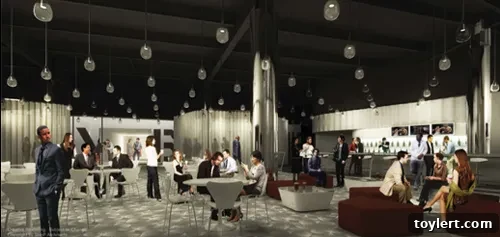
Rendering of one of the Barclays Center’s clubs