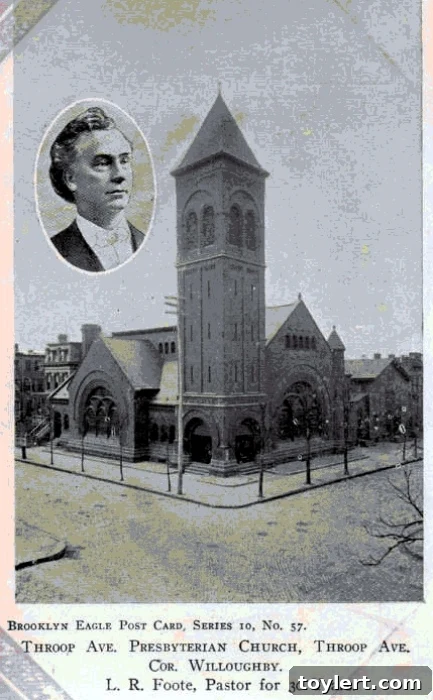
This article is the first installment in a compelling series chronicling the history of the Throop Avenue Presbyterian Church. Dive deeper into its rich narrative by exploring Part 2 and Part 3.
In the vibrant tapestry of Brooklyn’s 19th-century urban expansion, the Throop Avenue Presbyterian Church emerged as a significant landmark, embodying the borough’s dynamic growth and its evolving religious landscape. Established in 1852, this venerable institution was founded by a dedicated group of Presbyterians seeking a spiritual sanctuary within the rapidly developing region known as the Eastern District. This expansive and historically rich part of Brooklyn covered a substantial area, encompassing much of modern-day Bushwick, the eastern sections of Bedford-Stuyvesant, and key portions of East Williamsburg. The story of the Throop Avenue Presbyterian Church is not merely the history of a building, but a fascinating glimpse into the social, cultural, and spiritual life of a burgeoning metropolis.
The mid-19th century was a transformative era for Brooklyn. What were once quiet agricultural lands and nascent villages were swiftly becoming bustling neighborhoods, fueled by waves of immigration, industrial innovation, and a burgeoning population. The Eastern District stood at the forefront of this transformation, attracting diverse communities eager to establish roots in a land of opportunity. While the demographic tides would eventually shift, leading to a strong prevalence of German Catholic and Lutheran communities in this very area, the year 1852 saw a substantial and eager Presbyterian population. These pioneers were resolute in their desire to forge a strong, supportive congregation and a permanent house of worship that would serve as both a spiritual beacon and a community hub.
The vision for the Throop Avenue Presbyterian Church began with earnest. The Presbyterians of the Eastern District, driven by a shared faith and a commitment to their growing community, meticulously organized their efforts. They demonstrated sufficient enthusiasm and a robust congregational base, which was a critical first step. Their dedication was recognized and formally approved by the Presbyterian General Assembly, a pivotal moment that legitimized their initiative and provided the necessary ecclesiastical framework for their endeavors. This approval was more than a mere formality; it was an affirmation of their collective dream and a green light to proceed with the ambitious undertaking of constructing a significant church building.
The years following the church’s founding were characterized by fervent community activity. Fundraising efforts were launched with considerable zeal, and meticulous plans were laid out for the church’s construction. The congregation, though still in its formative stages, was vibrant and deeply engaged, reflecting the optimistic and industrious spirit prevalent across Brooklyn during this period of unprecedented expansion. Every donation, every committee meeting, and every blueprint brought them closer to their goal. This collective endeavor underscored the profound importance of religious institutions as cornerstones of social life, offering not just spiritual solace but also fostering a powerful sense of unity and shared purpose.
A decade and a half after its founding, the community’s perseverance bore fruit. By 1867, a distinctive and impressive church edifice proudly stood on the prominent corner of Throop and Willoughby Avenues. This strategic location was carefully chosen, ensuring visibility and accessibility for the rapidly expanding neighborhood it was destined to serve. While detailed architectural records from its earliest days may be scarce, it is highly probable that the building incorporated popular architectural styles of the mid-19th century, such as Gothic Revival or Romanesque Revival, both known for their grandeur, robust construction, and ability to inspire awe and reverence. These styles typically featured strong masonry, pointed arches, and ornate detailing, creating a profound sense of permanence and spiritual gravitas.
Leading the congregation through this significant phase, and particularly during the complex construction period, was Pastor-Elect John Lowry. His leadership was instrumental in guiding the nascent church from its conceptual phase to its physical manifestation. Pastor Lowry played a crucial role not only in the spiritual development of his flock but also in overseeing the practical challenges and triumphs of erecting such a substantial structure. His dedication, combined with the tireless efforts of the parishioners, culminated in a truly landmark event for the Eastern District: the church’s official dedication.
The dedication ceremony of the Throop Avenue Presbyterian Church, held on October 18, 1867, was a momentous occasion, drawing together not only its congregants but also prominent religious figures and members of the wider Brooklyn community. This event was a powerful symbol of progress and faith in a rapidly evolving urban landscape. The ceremonies were officiated by the highly respected Rev. R. S. Storrs of the Lafayette Avenue Presbyterian Church, another esteemed Presbyterian institution in Brooklyn. Rev. Storrs’ involvement lent considerable prestige to the dedication, highlighting the broader interconnectedness and strength of the Presbyterian faith throughout the borough and beyond.
The dedication was more than a mere formal opening; it was a jubilant celebration of the vision, perseverance, and communal spirit that had guided the church’s journey for over fifteen years. For the Presbyterians of the Eastern District, their new church was far more than a building of brick and mortar; it was a sacred space for worship, a vibrant center for educational programs, and an indispensable hub for social gatherings. In the 19th century, churches frequently served as multifaceted community institutions, offering spiritual guidance, comprehensive educational initiatives for both children and adults, and vital social support networks that were essential for navigating the complexities of burgeoning urban life. The Throop Avenue Presbyterian Church quickly assumed this central role, becoming a cornerstone of its community.
As Brooklyn continued its extraordinary ascent throughout the latter half of the 19th century, the Throop Avenue Presbyterian Church played an indispensable role in shaping the moral and social fabric of its surrounding neighborhood. It offered a crucial sense of stability and familiarity amidst the relentless pace of urban development and constant change. The church became a welcoming beacon for new arrivals and a comforting anchor for established residents, fostering a strong sense of collective identity among its members. Its strategic establishment was part of a broader trend across Brooklyn, where various religious denominations erected impressive houses of worship, each contributing significantly to the borough’s rich architectural heritage and its diverse cultural identity.
The narrative of the Throop Avenue Presbyterian Church is, in many respects, a microcosm of Brooklyn’s own captivating history – a story defined by remarkable growth, profound demographic shifts, and the enduring human quest for community and spiritual connection. While this initial account focuses on its optimistic beginnings and the unwavering dedication that brought its physical structure to life, the church’s story, like that of many venerable urban institutions, would naturally unfold with its own unique set of triumphs, unforeseen challenges, and defining moments. These early years, however, laid an exceptionally strong foundation, setting the stage for a rich and complex legacy that would continue to evolve and resonate for decades to come within the bustling, vibrant tapestry of Brooklyn history.
The meticulous planning and fervent commitment demonstrated by the early congregation of Throop Avenue Presbyterian Church offer valuable insights into the social and religious dynamics of 19th-century Brooklyn. It vividly illustrates how religious institutions were not just places of spiritual worship but central pillars of community development, actively fostering social cohesion and providing essential services that extended far beyond the purely spiritual realm. The church’s strategic placement at the bustling intersection of Throop and Willoughby Avenues ensured its prominence within the rapidly urbanizing Eastern District, allowing it to become a visible landmark and an accessible hub for its growing membership. This initial success story firmly established the precedent for the church’s long-standing and significant role in the community life of Brooklyn.
Furthermore, the formal approval from the Presbyterian General Assembly underscored the organized and hierarchical nature of religious expansion during this period. It signified a rigorous process that ensured new congregations were not only well-supported but also doctrinally aligned with the broader principles and practices of the Presbyterian faith. Pastor-Elect John Lowry’s leadership during this foundational phase was particularly crucial, as he deftly navigated both the spiritual needs of his burgeoning flock and the demanding practicalities of building a new church from the ground up. His dedication, coupled with the active and enthusiastic participation of countless parishioners, transformed a collective spiritual vision into a tangible architectural reality, culminating in the grand dedication ceremony. This unwavering commitment to faith, community, and forward-thinking development became the solid bedrock upon which the Throop Avenue Presbyterian Church was built, promising a future of spiritual guidance and communal strength within the bustling and ever-evolving borough of Brooklyn.