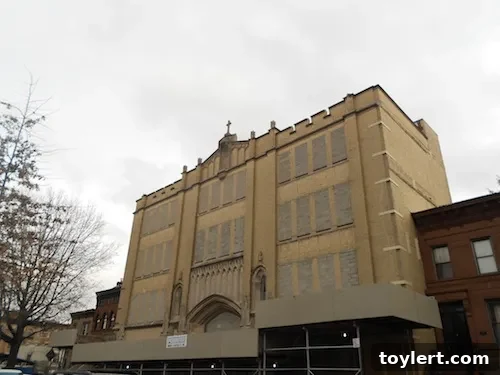
The Evolving Saga of 180 Bainbridge Street: A Bed-Stuy Landmark in Transition
The urban tapestry of Brooklyn is constantly being rewoven, with historic structures often at the center of profound transformations. One such property, 180 Bainbridge Street in the vibrant heart of Bed-Stuy, recently underwent a significant change in ownership, sparking both curiosity and concern within the community. This former Catholic school, a building imbued with decades of local history and community memory, was sold by the NYC Partnership Housing Development Fund to an entity identified as “Bainbridge Realty Holdings LLC” for $2.4 million. The transaction has ignited conversations about the future of this pivotal site, its potential for preservation, and the ongoing evolution of one of Brooklyn’s most dynamic neighborhoods.
Initially featured as a Building of the Day, the property had already captured the attention of local residents and preservationists. Their efforts were aimed at securing an individual landmark designation for the structure, hoping to protect its architectural integrity and historical significance. Simultaneously, there was a strong desire for the NYC Partnership to rehabilitate the building into much-needed housing, aligning with its mission. The sale to a private holding company, however, introduces new variables into this delicate equation, prompting a collective inquiry into the destiny of this cherished Bed-Stuy edifice. As Brooklyn’s real estate market continues its relentless ascent, the fate of properties like 180 Bainbridge Street often encapsulates the broader struggle between development, preservation, and community aspirations.
A Glimpse into Bed-Stuy’s Heart: The Significance of 180 Bainbridge Street
Bedford-Stuyvesant, affectionately known as Bed-Stuy, is more than just a neighborhood; it’s a cultural cornerstone of Brooklyn, rich with history, architectural marvels, and a strong sense of community. Its streets are lined with iconic brownstones, historic churches, and public institutions that have shaped generations. Amidst this vibrant backdrop, 180 Bainbridge Street stands as a silent sentinel, a former Catholic school that once served as an educational and social hub for countless families. For decades, it was a place of learning, growth, and community gathering, embedding itself deeply into the local psyche. The building’s presence is a tangible link to Bed-Stuy’s past, reflecting the area’s strong religious and community-oriented foundations.
The significance of such a property extends beyond its bricks and mortar. It represents a vital piece of the neighborhood’s collective memory and cultural heritage. In a rapidly gentrifying area like Bed-Stuy, where new developments often overshadow historic structures, the preservation of buildings like 180 Bainbridge Street becomes increasingly critical. Its architectural style, while perhaps not unique in the grand scheme of NYC architecture, contributes to the distinctive charm and character of the immediate streetscape. Losing such a building, or seeing it drastically altered without consideration for its past, would mean erasing a piece of the neighborhood’s soul, diminishing the rich narrative that makes Bed-Stuy so special. The community’s attachment to this building is a testament to its enduring legacy, highlighting its role not just as a structure, but as a landmark of community identity and historical resilience.
The $2.4 Million Transaction: Unpacking the Sale and its Implications
The sale of 180 Bainbridge Street for $2.4 million from the NYC Partnership Housing Development Fund to Bainbridge Realty Holdings LLC represents a pivotal moment for the property. Understanding the entities involved offers crucial insight into the potential trajectory of the site. The NYC Partnership Housing Development Fund typically operates with a mandate focused on affordable housing initiatives and community development. Their sale of a property, especially one that locals hoped would be converted into housing, suggests a strategic decision, possibly to reallocate resources or because the costs/complexities of rehabilitation for their specific mission were prohibitive. This decision itself raises questions about the challenges of developing affordable housing in an expensive market like Brooklyn, even for dedicated non-profit organizations.
On the other hand, Bainbridge Realty Holdings LLC, a name that evokes a specific, localized interest, is shrouded in relative anonymity. The lack of readily available public information about such an entity is not uncommon in New York’s competitive real estate landscape. Typically, limited liability companies (LLCs) like this are formed by investors or developers for specific projects, often to shield individual identities and limit liability. This opaqueness naturally fuels speculation about their intentions. Will they pursue an aggressive commercial development, convert it into luxury condominiums, or perhaps honor some aspect of its past? The $2.4 million price tag, while substantial, is also indicative of the value of land and potential development in a highly sought-after area like Bed-Stuy, suggesting that the new owners see significant potential for a profitable venture. The sale underscores the intense market pressures in Brooklyn, where even community-oriented properties can command high prices, challenging the aspirations of those who wish to see them preserved for public good.
Community Voices and the Drive for Landmarking
The efforts by local residents to designate 180 Bainbridge Street as an individual landmark underscore a profound commitment to preserving Bed-Stuy’s unique architectural and cultural heritage. Landmarking in New York City is a rigorous process, designed to protect buildings and sites that possess significant historical, aesthetic, or cultural value. It’s not merely about preventing demolition; it’s about recognizing and preserving the tangible links to the city’s past. When a property is “calendered for landmarking,” as DOB records indicate for 180 Bainbridge Street, it means the Landmarks Preservation Commission (LPC) has officially acknowledged its potential significance and has begun the formal evaluation process. This status provides a temporary layer of protection, as any changes or demolition plans for the building during this period would face intense scrutiny from the LPC.
For the Bed-Stuy community, landmark status for the former Catholic school would offer several crucial benefits. Primarily, it would shield the building from indiscriminate demolition and ensure that any future renovations or developments adhere to strict guidelines, preserving its historic character. This protection is vital in a neighborhood experiencing rapid development, where older structures are often targeted for replacement with modern, often out-of-character, constructions. Moreover, landmarking acknowledges the building’s narrative as a former educational institution, a focal point for generations of area residents. It legitimizes the community’s desire to see its history respected and integrated into its future. However, landmarking also presents challenges for developers, as it can impose limitations on alteration and new construction, potentially affecting profitability. The ongoing process for 180 Bainbridge Street highlights the constant tension between development interests and the powerful, deeply rooted desire of communities to protect their tangible heritage, ensuring that the essence of Bed-Stuy endures amidst change.
The Future Unwritten: Potential Paths for 180 Bainbridge Street
The sale of 180 Bainbridge Street to a new holding company opens up a range of possibilities for its future, each carrying different implications for the Bed-Stuy neighborhood. The most optimistic scenario, and one favored by local residents, involves adaptive reuse. This approach would transform the former school building into a new function, perhaps residential units or a community-focused space, while meticulously preserving its distinctive architectural shell. Adaptive reuse not only honors the building’s historical presence but also offers a sustainable way to meet contemporary needs without erasing the past. Imagine the grand classrooms reconfigured into unique apartments, or communal areas repurposed for local businesses or cultural centers – all while the facade retains its classic charm, contributing to Bed-Stuy’s aesthetic.
Another potential path, driven by market demand and developer incentives, could involve a complete redevelopment. This might entail demolition, a prospect that deeply concerns the community, as the article originally noted: “Here’s hoping it doesn’t have a date with the wrecking ball.” Should this occur, the historic structure would be replaced by a new construction, likely a multi-story residential building, capitalizing on the prime location and Brooklyn’s insatiable demand for housing. While such developments can bring new residents and economic activity, they often lead to a loss of neighborhood character and exacerbate gentrification concerns. The challenge lies in balancing the economic imperatives of urban development with the equally vital need to maintain the unique cultural and historical identity of Bed-Stuy. The new owners, Bainbridge Realty Holdings LLC, hold the key to this future, and their vision will ultimately dictate whether 180 Bainbridge Street continues to stand as a testament to its past or becomes a symbol of irreversible change. The community’s vigilance and the ongoing landmarking process will undoubtedly play a crucial role in shaping this outcome, advocating for a future that respects both heritage and progress.
Navigating Brooklyn’s Dynamic Real Estate Landscape
The saga of 180 Bainbridge Street is intrinsically linked to the broader narrative of Brooklyn’s explosive real estate market. Over the past two decades, Brooklyn has transformed from a collection of distinct neighborhoods into one of the most coveted urban centers globally. Areas like Bed-Stuy, once considered underserved, have become hotspots for investment, attracting a diverse influx of residents and developers alike. This dynamic environment is characterized by soaring property values, intense competition for land, and a constant push for new development to meet an ever-growing demand for housing. The $2.4 million sale of a former school building in Bed-Stuy is a direct reflection of this robust market, where even properties requiring significant rehabilitation are seen as valuable assets with immense potential.
However, this rapid development comes with its own set of complexities. The balance between fostering growth and preserving the unique historical and cultural fabric of neighborhoods like Bed-Stuy is a constant challenge. Historic properties, while offering character and a link to the past, can sometimes be seen as obstacles to maximizing development potential. Developers often face higher costs and stricter regulations when working with older buildings, especially those with landmark status or community advocacy. The demand for housing in New York City is undeniable, yet the way this demand is met can have lasting consequences on a community’s identity. The future of 180 Bainbridge Street will serve as a micro-example of this macro-trend, illustrating how individual property decisions contribute to the larger mosaic of urban transformation in Brooklyn. It’s a testament to the fact that in this competitive market, every historic building represents not just an asset, but also a story, a memory, and a piece of the evolving urban landscape.
Call to Action and Community Vigilance
The unfolding story of 180 Bainbridge Street serves as a powerful reminder of the importance of community engagement and vigilant advocacy in shaping the future of cherished local landmarks. As the original article concluded, the lingering question remains: “Does anybody know what may be in store for it?” This uncertainty underscores the critical need for transparency from the new owners, Bainbridge Realty Holdings LLC, and continued proactive involvement from residents, local organizations, and preservation groups. The “calendered for landmarking” status, as confirmed by DOB records, provides a window of opportunity for the community to solidify protective measures and influence the building’s destiny.
For those invested in Bed-Stuy’s future, staying informed and participating in public hearings related to the landmarking process or any proposed development plans is crucial. Engaging with local council members, community boards, and preservation societies can amplify the collective voice, advocating for adaptive reuse solutions that respect the building’s heritage while meeting contemporary needs. The former Catholic school at 180 Bainbridge Street is more than just a real estate transaction; it’s a symbol of Bed-Stuy’s rich past and its aspirations for a future that balances growth with reverence for its distinctive character. Ultimately, the hope is that this historic property will continue to contribute positively to the neighborhood’s fabric, avoiding the fate of the “wrecking ball” and instead embarking on a new chapter that honors its legacy. Community action today will undoubtedly dictate the legacy of 180 Bainbridge Street for generations to come, ensuring that the heart of Bed-Stuy continues to beat strong. For a geographical perspective, refer to the GMAP location.