The Crescent Athletic Club: Unveiling Brooklyn’s Elite Past
Brooklyn, a borough celebrated for its rich tapestry of history and diverse communities, once harbored an institution that epitomized luxury, athleticism, and social eminence: The Crescent Athletic Club. For decades, this esteemed establishment reigned as Brooklyn’s most prestigious sports and social club, a shining example of Gilded Age extravagance and ambition. It was a cherished sanctuary where the borough’s most influential men – from burgeoning athletes to established titans of industry – convened to pursue sporting excellence, forge powerful connections, and indulge in the finest recreational and social pursuits. The club’s narrative offers a compelling window into the socio-economic landscape of turn-of-the-century Brooklyn, shedding light on the aspirations and daily routines of its most prominent citizens.
Far more than just a facility for physical training or casual socializing, the Crescent Athletic Club played a pivotal role in shaping the identity of Brooklyn’s elite. It served as a vital hub where personal networks intersected with professional opportunities, where leisure seamlessly blended with high-stakes business. Its story is integral to understanding a specific period of Brooklyn’s development, a time when wealth and status were meticulously cultivated, and exclusive private clubs were indispensable conduits for both leisure and the consolidation of power.
The Genesis of an Institution: Founding and Early Vision (1884)
The roots of the Crescent Athletic Club trace back to 1884, born from the collective vision of a spirited group of Brooklyn-based Yale alumni. Their initial, singular aim was to form a competitive football team, channeling their athletic vigor into a structured pursuit. However, the energy and camaraderie fostered by this early endeavor swiftly captivated a broader segment of Brooklyn’s affluent society. The club’s appeal expanded rapidly, attracting not only “youngish rich athletes” but also their fathers and other distinguished gentlemen of means. These influential individuals quickly recognized the immense potential for a sprawling, opulent club capable of catering to an extensive array of interests, harmoniously blending vigorous physical activity with sophisticated social engagement.
Under their guidance, the club quickly evolved into a formidable institution, transcending its initial focus on athletic competition to become a paramount social and business hub. Members sought a refined sanctuary where they could engage in gourmet dining and wine tasting among their peers, partake in spirited card games or challenging billiards tournaments, and unwind with fine drinks and cigars. Crucially, the club’s relaxed yet exclusive atmosphere made it an ideal, unofficial boardroom. Here, away from the formalities of the office, some of the era’s most significant business “deal making” often transpired, facilitating alliances and ventures that would profoundly shape Brooklyn’s burgeoning economy. This unique amalgamation of athletic pursuit, refined leisure, and strategic networking firmly cemented the Crescent Athletic Club’s position at the apex of Brooklyn’s social and economic hierarchy.
Architectural Splendor: The Clubhouses of Brooklyn Heights
The Original Clubhouse on Clinton Street
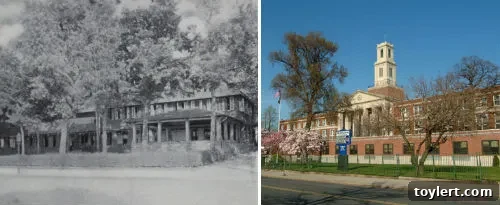
From its very inception, the Crescent Athletic Club understood the profound importance of a distinguished physical presence that mirrored its members’ prestige. Its initial impressive clubhouse, strategically located on Clinton Street in the vibrant heart of Brooklyn Heights, was far more than a mere building; it was a powerful architectural statement. While perhaps less expansive than its future successor, this early structure was a prominent neighborhood landmark, meticulously designed to embody the prestige and elevated aspirations of its elite membership. A notable architectural feature was its distinctive large dome, an elegant flourish that immediately set it apart from its surroundings. Perched majestically atop this dome, rising prominently against the skyline, was the club’s enduring symbol: a large crescent moon. This iconic emblem not only bestowed the club with its evocative name but also served as a visible testament to its exclusivity and a subtle nod to its soaring ambitions, easily visible from various points within the affluent neighborhood.
Within its distinguished walls, the Clinton Street clubhouse provided the essential infrastructure to support the club’s dual mission of sport and socialization. It housed a variety of meticulously appointed rooms dedicated to individual and team sports, complete with state-of-the-art training facilities and comfortable locker rooms, ensuring members had access to superior amenities for their athletic endeavors. Concurrently, opulent lounges, private dining areas, and elegantly furnished card and billiards rooms offered abundant opportunities for leisurely indulgence and sophisticated social interaction. This inaugural clubhouse was instrumental in forging the club’s reputation, successfully attracting a discerning membership that valued both physical vigor and intellectual stimulation within an atmosphere of unparalleled refinement.
The Zenith of Grandeur: Frank Freeman’s 1902 Masterpiece
As the Crescent Athletic Club’s influence, membership numbers, and collective wealth continued their astonishing ascent, it became unequivocally clear that an even larger, more magnificent edifice was required to commensurate with its burgeoning stature. The year 1902 marked a watershed moment in the club’s illustrious history with the grand inauguration of its new clubhouse, strategically positioned at the prominent corner of Pierrepont and Clinton Streets. This architectural marvel was the realized vision of Frank Freeman, widely celebrated as one of Brooklyn’s most distinguished and prolific architects of his era. Freeman, renowned for his robust Romanesque Revival and elegant Beaux-Arts designs that profoundly shaped much of Brooklyn’s Gilded Age streetscape, crafted a structure that stood as an undeniable testament to the club’s immense opulence and resounding success.
The new clubhouse was a colossal limestone edifice, its commanding façade and intricate detailing immediately broadcasting its significance and grandeur. Freeman’s design was not merely aesthetically captivating; it was a meticulously planned functional masterpiece, conceived to fulfill every conceivable need and desire of the club’s elite members. Upon entering, one was ushered into a world of unparalleled luxury and comfort. The building proudly showcased an expansive swimming pool, an extraordinarily advanced amenity for its time, offering members cutting-edge recreational opportunities. Beyond the aquatic facilities, a multitude of meticulously designed club rooms provided diverse spaces for quiet contemplation, intimate conversations, or vibrant social gatherings. The grand dining rooms hosted lavish banquets and private meals, serving exquisite cuisine to the most discerning palates. Dedicated gaming rooms, exquisitely equipped for everything from strategic poker to chess, offered avenues for competitive recreation and intellectual engagement. Indeed, the 1902 clubhouse was a meticulously crafted microcosm of sophisticated living, offering an environment where every desire, from rigorous athletic training to refined social entertainment, was met with impeccable style, unparalleled service, and undeniable prestige.
Expanding Horizons: Dedicated Athletic Facilities in Bay Ridge
While the lavish clubhouses in Brooklyn Heights provided unparalleled amenities for individual sports and sophisticated social gatherings, the burgeoning interest and growing prominence of team sports within the club necessitated dedicated, expansive facilities beyond the urban core. In its formative years, the Crescent Athletic Club’s formidable teams—esteemed for their prowess in football, hockey, baseball, and various other collective sports—were compelled to rely on rented arenas and disparate fields scattered across the borough. This arrangement, while functional, inherently lacked the exclusivity, control, and sense of ownership that such a prestigious institution desired. The ambition for their own comprehensive athletic complex grew steadily, fueled by a desire to consolidate their burgeoning sporting empire and provide members with world-class venues for training and competition.
The Nereid Rowing Club Merger and the Bay Ridge Boathouse
A truly pivotal moment in the club’s strategic expansion occurred in 1889 with the historic merger between the Crescent Athletic Club and the Nereid Rowing Club. This strategic alliance proved to be transformative, as it brought into the Crescent’s burgeoning fold an invaluable asset: a large, purpose-built boathouse strategically situated on the picturesque shores of Bay Ridge’s renowned “Gold Coast,” along the famed Shore Road. The merger immediately and significantly elevated the Crescent’s athletic capabilities, particularly within the realm of water sports, and granted them direct, unobstructed access to the expansive waters of New York Bay for rowing and a host of other aquatic activities.
The acquisition and integration of the Bay Ridge boathouse marked the true inception of the Crescent Athletic Club’s dedicated, comprehensive athletic complex. This facility was far more than a mere storage space for boats; it rapidly evolved into a vibrant, bustling center for rigorous physical training and intense competition. Beyond its primary function for rowing, the expansive grounds encompassing the boathouse were meticulously developed and maintained to accommodate a wide array of team sports. Pristine football fields, precisely manicured baseball diamonds, and carefully prepared hockey rinks (during their respective appropriate seasons) were all available, offering members and teams state-of-the-art playing surfaces. This unparalleled complex allowed the Crescent Athletic Club to not only host prestigious inter-club competitions but also to consistently showcase their athletic dominance, further cultivating a vibrant culture of physical excellence and competitive spirit among its elite membership. The Bay Ridge facilities thus perfectly complemented the social grandeur and refined elegance of the Brooklyn Heights clubhouses, collectively creating a truly holistic and exceptional experience for the discerning sportsmen of Brooklyn.
The Enduring Legacy of the Crescent Athletic Club: A Social and Economic Nexus
Beyond its striking architecture and impressive athletic achievements, the Crescent Athletic Club played an indispensable role in shaping the social and economic fabric of Brooklyn’s elite society. It was a hallowed ground where influential families forged lasting connections, where groundbreaking business ventures were conceived and nurtured over a friendly game of cards, and where the next generation of Brooklyn’s leaders were subtly groomed for their future roles. The consistent emphasis on “deal making” within the club’s confines vividly underscores its function as a central nexus of power and influence, serving as an unofficial yet highly effective extension of the boardroom. Here, amidst an atmosphere of mutual trust and camaraderie, transactions were smoothly facilitated, and partnerships were strategically forged, all contributing to the dynamic growth and prosperity of the borough.
The very existence and flourishing of the club were a clear reflection of the broader societal trends characteristic of the Gilded Age, a period where private clubs served as formidable bastions of exclusivity. These institutions allowed the wealthy to meticulously define and curate their social circles, thereby reinforcing their elevated status and societal position. Membership in the Crescent Athletic Club was a highly coveted privilege, an unambiguous indicator of one’s standing within Brooklyn’s upper echelons. The club expertly fostered a profound sense of community and shared identity among its members, providing a unique platform for collective leisure pursuits and the collective pursuit of ambition, solidifying its place as a cornerstone of Brooklyn’s turn-of-the-century elite.
Decline and Transformation: Echoes of the Crescent in Modern Brooklyn
Like many grand institutions born of the Gilded Age’s opulence, the Crescent Athletic Club eventually faced the inevitable forces of change that swept through the early to mid-20th century. Societal shifts, profound economic upheavals such as the Great Depression, and evolving public attitudes towards exclusive private clubs gradually eroded its foundational pillars. Membership numbers dwindled, financial pressures mounted inexorably, and the grand era of opulent, private sports clubs began its gradual wane. While precise details of its eventual dissolution or transformation may vary in brief historical accounts, its magnificent buildings were destined to find new purposes, enduring as tangible testaments to their past grandeur and historical significance.
Today, the former clubhouses and expansive athletic grounds that once defined the Crescent Athletic Club continue to shape Brooklyn’s vibrant landscape, though in vastly different capacities. The magnificent Frank Freeman-designed clubhouse at Pierrepont and Clinton, a true architectural jewel, has been thoughtfully repurposed over the decades, serving various community and residential functions. Its distinctive limestone facade and iconic architecture remain a cherished landmark within Brooklyn Heights, standing as a visible, enduring link to a bygone era of unparalleled elegance, social prominence, and architectural mastery. Similarly, the extensive Bay Ridge athletic facilities likely underwent their own transformations, perhaps giving way to cherished public parks, modern residential developments, or other vital community spaces, with each new iteration adding another intricate layer to Brooklyn’s rich and ever-evolving urban tapestry.
The profound legacy of the Crescent Athletic Club extends far beyond its impressive architectural remnants or the faded photographs of its champion teams. It resides deeply in its indelible contribution to Brooklyn’s unique identity, its pivotal role in fostering a vibrant athletic culture, and its lasting influence on the social and economic dynamics of an ambitious and rapidly developing borough. The club stands as a powerful and poignant reminder of how institutions, even those built initially on the foundations of exclusivity, can leave an enduring and significant mark on a city’s history, showcasing a fascinating and transformative chapter of Brooklyn’s compelling “then and now.”