Bushwick Avenue: A Nexus of Historic Preservation and Modern Development
Bushwick Avenue in Brooklyn continues its vibrant transformation, embodying the dynamic interplay between preserving rich architectural heritage and embracing forward-thinking urban development. A prime example of this evolution is unfolding across a significant block, where new construction rises alongside the meticulous restoration of historic landmarks. This compelling narrative of change is particularly evident at 616, 626, and 628 Bushwick Avenue, locations that collectively paint a picture of the neighborhood’s intricate growth.
The skyline of Bushwick is constantly being reshaped, and recent milestones highlight the rapid pace of change. At 616 Bushwick Avenue, a new structure, described in permits as a “horizontal addition,” has officially “topped out.” This significant construction phase marks a pivotal moment, signaling that the building has reached its maximum intended height. Once completed, this contemporary addition promises to add seven stories to the avenue’s fabric, contributing to the area’s increasing density and modern aesthetic.
Adjacent to this new development, the former St. Mark’s Lutheran School and Evangelical Church at 626 and 628 Bushwick Avenue, respectively, are undergoing a different kind of transformation. Under the diligent stewardship of developer Cayuga Capital Management, these historic edifices are being carefully preserved and adapted for new purposes. While the scale and speed of their renovation differ from the new build next door, tangible progress and subtle changes are increasingly visible from the street, hinting at the extensive work taking place within.
616 Bushwick Avenue: Reaching for the Sky with Modern Design
The “topping out” of the seven-story structure at 616 Bushwick Avenue represents a crucial juncture in its development lifecycle. This construction milestone signifies that the primary structural framework is complete, and the focus will now shift towards interior build-out and exterior finishing. The concept of a “horizontal addition” suggests a thoughtful integration with existing urban patterns, potentially extending the footprint of an adjacent property or thoughtfully utilizing a previously underutilized lot to maximize space and functionality. Such projects are characteristic of Brooklyn’s evolving real estate market, where developers are adept at finding innovative ways to expand within established urban landscapes.
The addition of seven stories will undoubtedly impact the visual corridor of Bushwick Avenue, introducing contemporary architectural elements that contrast with, yet hopefully complement, the historic buildings nearby. While specific details regarding its future use are often revealed later in the development process, new multi-story buildings in Bushwick frequently house a mix of residential units, catering to the ever-growing demand for housing in this vibrant Brooklyn neighborhood. They may also include ground-floor retail or commercial spaces, further enhancing the street-level vibrancy and offering new amenities to residents and visitors alike. This blend of uses is a common strategy to create dynamic, self-sustaining urban environments that contribute positively to the local economy and community life.
The Heritage Anchor: St. Mark’s Lutheran School and Evangelical Church
The properties at 626 and 628 Bushwick Avenue stand as enduring testaments to Bushwick’s rich past. The St. Mark’s Lutheran School and Evangelical Church complex is an architectural and historical gem, dating back to a period when churches served as vital community anchors, often accompanied by schools to provide education and spiritual guidance. These structures, with their distinctive architectural styles, offer a glimpse into the neighborhood’s socio-cultural history and religious heritage. Preserving such buildings is not merely about maintaining old facades; it is about honoring the narrative of a community, its architectural craftsmanship, and the stories embedded within its walls.
Adaptive Reuse by Cayuga Capital Management
Developer Cayuga Capital Management has undertaken the challenging yet rewarding task of preserving these significant landmarks. Adaptive reuse projects, like the one at St. Mark’s, require a delicate balance of respect for the original design and innovative vision for future utility. It involves transforming functionally obsolete buildings into modern, usable spaces while retaining their character and historical integrity. This approach is highly valued in rapidly gentrifying areas like Bushwick, where there’s a strong desire to retain the neighborhood’s unique identity amidst new construction. Cayuga Capital Management’s commitment to this intricate process underscores a broader trend in urban development towards sustainable and culturally sensitive growth.
Visible Progress at the Former School (626 Bushwick Avenue)
At 626 Bushwick Avenue, the former St. Mark’s Lutheran School continues its meticulous renovation. From an external vantage point, the building still appears to be a “shell without windows,” a common phase in large-scale historic renovations where the exterior envelope is carefully restored before new windows are installed. This stage often involves extensive façade cleaning, masonry repair, and structural stabilization to ensure the building’s long-term viability. However, subtle but significant internal progress is evident: the visibility of a newly constructed brick wall just a few feet in from the outside suggests that a comprehensive build-out is actively taking place within. This internal compartmentalization indicates that new floor layouts are being defined, and the building is transitioning from a raw shell to a structured interior ready for utilities and finishing touches. This could pave the way for modern residential units, creative office spaces, or a unique community facility, each option carefully designed to respect the building’s original volume and architectural features.
Ongoing Restoration at the Church (628 Bushwick Avenue)
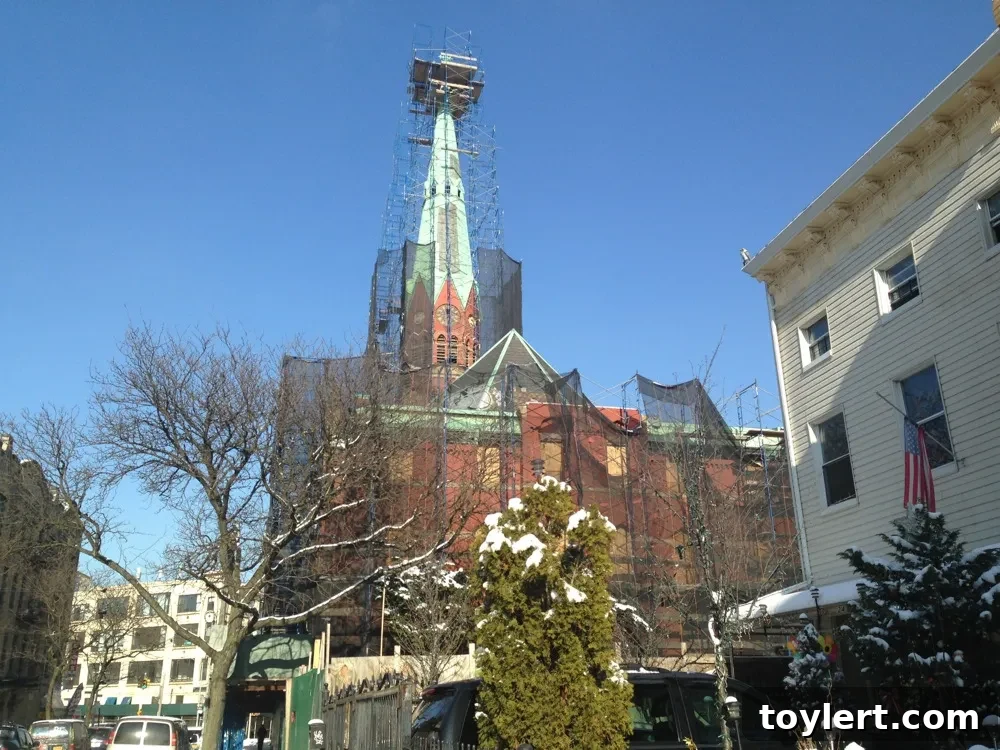
Next door at the majestic Evangelical Church at 628 Bushwick Avenue, restoration efforts are also progressing. One notable change is the removal of the protective netting from the uppermost part of the spire. This indicates that significant exterior work on this iconic architectural feature, likely involving repairs to the stonework or repointing of the brick, has been completed. The spire, a defining element of the church’s silhouette, is now one step closer to its fully restored glory, once again gracing the Bushwick skyline without obstruction. However, the continued presence of scaffolding on other parts of the church suggests that the broader restoration project is still underway. Scaffolding is typically kept in place for comprehensive façade repairs, roof work, window restoration, or intricate detailing on lower sections of the building. The methodical approach to preserving such a complex structure highlights the dedication required to bring these historic buildings into the 21st century while honoring their past.
Bushwick’s Evolving Urban Fabric: A Blend of Old and New
The parallel developments at 616, 626, and 628 Bushwick Avenue encapsulate the broader narrative of Bushwick’s evolution. Once an industrial and working-class neighborhood, Bushwick has transformed into a vibrant hub for artists, young professionals, and families, drawn by its unique character, thriving arts scene, and relatively more affordable housing compared to other parts of Brooklyn. This influx of new residents and businesses fuels the demand for both new construction and innovative adaptive reuse projects.
The dynamic interplay between new developments and historic preservation is crucial for maintaining Bushwick’s distinct identity. While new buildings provide essential housing and commercial space, the preservation of structures like the St. Mark’s complex ensures that the neighborhood’s rich history and architectural beauty are not erased. These preserved buildings often become cultural landmarks or provide unique spaces that cannot be replicated by modern construction, adding layers of authenticity and charm that are increasingly sought after in urban environments.
The Future Landscape of Bushwick Avenue
As these projects move towards completion, Bushwick Avenue will emerge with an even more defined and diverse urban landscape. The new building at 616 Bushwick Avenue will contribute to the contemporary architectural language of the street, offering modern amenities and potentially a fresh perspective on urban living. Simultaneously, the revitalized St. Mark’s complex will continue to anchor the block with its historical presence, albeit with a renewed purpose. Whether these spaces evolve into residential lofts, creative workspaces, retail establishments, or community centers, they are poised to inject new life into existing structures, demonstrating the viability and value of adaptive reuse.
The ongoing development along Bushwick Avenue serves as a microcosm of urban revitalization in Brooklyn. It highlights the challenges and rewards of balancing growth with heritage, catering to modern needs while respecting the roots of a community. These projects are more than just construction sites; they are evolving chapters in Bushwick’s story, shaping its future while celebrating its past, and ultimately contributing to the continued vibrancy and allure of this iconic Brooklyn neighborhood.