Brooklyn’s Evolving Skyline: Unpacking the Future of Cadman Plaza and Public Library Sites
Brooklyn, a borough synonymous with vibrant communities and architectural heritage, stands at a pivotal moment in its urban development narrative. The city’s recent announcement regarding the proposed sale of two prime public library sites has ignited considerable debate and speculation. These highly coveted locations, one situated at Pacific Street and Fourth Avenue and the other at the iconic Cadman Plaza and Clinton Street, are slated for sale to private developers. While the initial announcement focused on the transactions, it notably omitted crucial details about the potential scale and design of the replacement buildings. This ambiguity has naturally spurred public interest and concern about how these developments will reshape Brooklyn’s landscape.
The implications of such major land sales extend far beyond mere financial transactions. They touch upon issues of urban planning, community resources, architectural integrity, and the very character of Brooklyn itself. Understanding the potential scope of these projects, particularly the Cadman Plaza site due to its prominent location, is essential for all stakeholders invested in the borough’s future. The discussion delves into the intricate world of zoning regulations, development rights, and the delicate balance between maximizing urban density and preserving community charm.
Cadman Plaza: A Vision of Height on the Horizon
The Cadman Plaza site, in particular, has become a focal point of discussion. Renowned urban observer Michael D. D. White, writing on his influential blog Noticing New York, undertook a detailed analysis to project the potential dimensions of the development. His insights offer a compelling, albeit speculative, glimpse into what could become a significant new landmark on Brooklyn’s skyline. White’s meticulous examination of zoning regulations provides a crucial framework for understanding the immense development potential inherent in this location.
Decoding the Zoning: C6-4 and Floor Area Ratio
White notes that the Cadman Plaza site is designated with a C6-4 zoning classification. This specific zoning district is typical for high-density commercial and mixed-use areas within New York City, permitting substantial development. A key metric in urban planning is the Floor Area Ratio (FAR), which dictates the total square footage a building can occupy relative to the size of its lot. For a C6-4 zone, the base FAR is 10. Given that the Cadman Plaza lot spans an estimated 25,000 square feet, a developer could initially erect a building with a staggering 250,000 square feet of floor area (25,000 sq ft lot x 10 FAR).
However, the potential for development at Cadman Plaza extends far beyond this base calculation. New York City’s zoning laws are designed to incentivize certain public benefits through additional development rights. These often include provisions for incorporating public outdoor spaces, which enhance the urban environment, or dedicating space for community facilities, such as the very library that the development is intended to replace. Each of these additions allows developers to increase the overall allowable building area, further expanding the project’s footprint and height.
Unlocking Further Density: Transferable Development Rights (TDRs)
Perhaps the most significant factor contributing to the site’s immense development potential lies in the ability to transfer development rights from nearby landmarked buildings. Transferable Development Rights (TDRs) are a crucial tool in New York City’s preservation efforts, allowing owners of landmarked properties to sell unused development potential to developers of other sites within a designated transfer zone. This mechanism protects historic structures by providing an economic incentive for their maintenance, while simultaneously allowing for increased density in other areas. Given Cadman Plaza’s proximity to several historically significant districts and landmarked buildings in Brooklyn Heights, the acquisition of TDRs could significantly augment the buildable square footage for the new development, potentially pushing its scale to unprecedented levels for the immediate area.
Projected Heights: A New Brooklyn Icon?
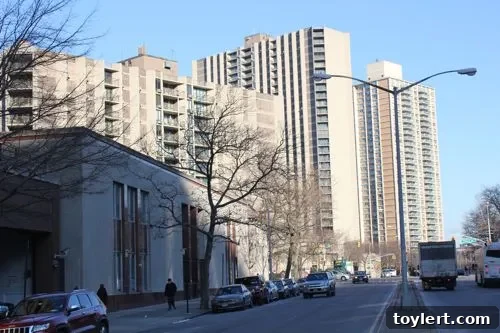
Considering all these factors—the base FAR, additional rights for public amenities, and the influx of TDRs—Michael D. D. White postulates that the resulting structure could be a largely residential tower significantly taller than the 14-story Federal courthouse located directly across Cadman Plaza. The sheer volume of potential square footage points towards a building that would dramatically alter the existing skyline. Moreover, White reports an intriguing off-the-record revelation from a library spokesman, suggesting the tower could soar to an astonishing 40 stories. To put this into perspective, a 40-story building would be nearly twice the height of the well-known office building at 26 Court Street and approximately 100 feet taller than the 30-story residential building just north of Clark Street, which is visible in the background of the image accompanying this article. Such a building would not merely be another addition to Brooklyn’s growing roster of high-rises; it would become an undeniable, towering presence, casting a new silhouette against the backdrop of Brooklyn Heights and the civic center.
The Pacific Street Site and Broader Development Context
While the focus remains largely on Cadman Plaza due to its visual prominence, it’s important not to overlook the second site at Pacific Street and Fourth Avenue. This location also holds significant development potential and is geographically situated to become part of a larger urban transformation. Concerns have been raised by some, including White, about the possibility of this site being integrated into the larger Atlantic Yards (now Pacific Park) complex, potentially leading to further large-scale development and even street closures, such as sections of Pacific Street, to connect these vast developments. This possibility underscores a broader apprehension among community members regarding the ongoing expansion of mega-projects and their impact on local infrastructure and neighborhood character.
Navigating Public Skepticism: The Shadow of Forest City Ratner
White’s analytical piece on Noticing New York also delves into what he frames as “conspiracy theories” surrounding the land sales, suggesting this entire process might be a deliberate setup for yet another significant land acquisition by Forest City Ratner. This powerful developer has been a dominant force in Brooklyn’s recent transformation, notably with the controversial Atlantic Yards/Pacific Park project. While the veracity of such claims remains open to individual interpretation, the underlying public skepticism is palpable. Past large-scale developments have often been met with mixed public reactions, fueled by concerns over transparency, community benefit, and the influence of powerful corporate interests. The public is right to demand a clear and equitable process when public assets are involved, ensuring that any development serves the broader interests of Brooklyn residents, not just private profit.
A Call for Transparency, Vision, and World-Class Design
Irrespective of any speculative theories, the imperative for a transparent and scrupulously fair process cannot be overstated. It is critical that there be an open, competitive bidding process for both the Cadman Plaza and Pacific Street sites. This ensures that the city secures the best possible outcome, not just in terms of financial return, but also in urban planning, architectural quality, and community integration. A transparent process builds public trust and fosters confidence that such significant public assets are being handled responsibly.
Should Brooklyn indeed embrace the development of a giant tower on Cadman Plaza, this represents an unparalleled opportunity—and perhaps a moral obligation—for the borough to commission truly first-class new construction. The architectural output during the last real estate boom in Brooklyn, while prolific, was often characterized by mediocrity. Many new buildings, though functional, lacked distinctive design, innovative materials, or a deeper connection to Brooklyn’s unique identity. This era saw a proliferation of generic towers that failed to inspire or contribute meaningfully to the borough’s aesthetic legacy.
The Cadman Plaza site is not merely another plot of land; it is an iconic location, a gateway to historic Brooklyn Heights and a central civic area. The surrounding real estate values are exceptionally high, reflecting the desirability and strategic importance of the area. These high values should serve as a clear indicator that the financial backing exists to underwrite a project of exceptional quality. This isn’t just about building tall; it’s about building well. An investment in truly groundbreaking architecture at Cadman Plaza could elevate Brooklyn’s design profile onto the international stage, aligning it with the borough’s globally recognized achievements in art, food, and culture.
Imagine a building that not only provides much-needed library facilities and residential or commercial space but also becomes a symbol of Brooklyn’s contemporary ambition and design prowess. Such a project should incorporate sustainable practices, innovative public spaces, and an aesthetic that is both forward-looking and respectful of its historic context. Furthermore, this development could present a golden opportunity for Brooklyn to finally secure its first truly Class A office building. Class A office spaces are characterized by their prime locations, superior quality construction, state-of-the-art systems, and comprehensive amenities. Establishing such a benchmark office building would attract top-tier businesses, create new job opportunities, and further cement Brooklyn’s status as a dynamic economic hub, capable of competing with Manhattan and other global cities.
The Future of Brooklyn’s Libraries and Urban Fabric
Beyond the architectural spectacle, the core of these developments involves the future of public libraries, vital community anchors that serve as educational centers, social hubs, and digital access points. Any new development must ensure that the replacement library facilities are not just adequate, but vastly improved, offering modern resources and expanded services that meet the evolving needs of Brooklyn’s diverse population. This includes flexible spaces for learning, enhanced technological infrastructure, and comfortable environments that encourage community engagement and intellectual growth.
The sale of these library sites thus embodies a complex negotiation: leveraging valuable urban land to fund essential public services, while simultaneously shaping the physical and social fabric of one of the world’s most vibrant urban centers. The challenge lies in ensuring that these ambitious developments contribute positively to Brooklyn’s growth, enhance its civic life, and uphold its reputation for innovation and cultural richness. The decisions made regarding Cadman Plaza and Pacific Street will resonate for generations, defining a new chapter in Brooklyn’s remarkable story.