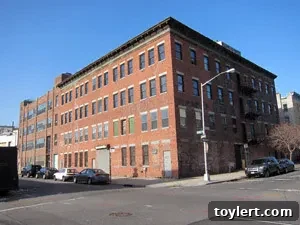
Greenpoint, Brooklyn, with its vibrant community, burgeoning culinary scene, and stunning waterfront views, has long been a magnet for those seeking the quintessential New York experience. However, beneath the surface of this desirable neighborhood lies a cautionary tale for prospective renters and buyers: the persistent saga of 239 Banker Street, infamously known as the “Sweater Factory Lofts.” For years, this address has been a focal point for housing rights advocates and local journalists, particularly Miss Heather of New York Shitty, who has diligently documented its troubled history. The building serves as a stark reminder of the dangers lurking in the unregulated corners of New York City’s highly competitive housing market, where the promise of a dream apartment can quickly turn into a nightmare of illegal living conditions and exploitation.
The story of 239 Banker Street is not new; it’s a deeply entrenched issue that has plagued Greenpoint for over a decade. The building first gained widespread notoriety in 2009 when the city, responding to glaring safety and zoning violations, executed a series of forced evacuations, displacing numerous residents. The fundamental problem was, and remains, that the structure was never legally approved for residential use. Designed and zoned for commercial or industrial purposes, its conversion into multi-unit apartments was carried out without proper permits, inspections, or adherence to crucial safety codes. Despite these repeated interventions by the Department of Buildings (DOB) and other municipal agencies, the building’s owners and unscrupulous brokers have seemingly continued to market it for residential occupancy, preying on the high demand for housing in Greenpoint and the wider Brooklyn area.
The ongoing saga highlights a critical systemic flaw: the tenacity with which illegal conversions persist, often putting unsuspecting tenants at severe risk. Miss Heather’s meticulous reporting, often fueled by community tips and firsthand accounts, has been instrumental in shining a light on these illicit practices. Her blog posts have detailed the repeated cycles of residents moving in, authorities intervening, and the property reverting to its legally non-residential status, only for new advertisements to mysteriously appear, luring the next wave of hopeful but misinformed tenants. This cycle of deception and disregard for tenant safety underscores the challenges faced by city officials in enforcing housing regulations against persistent offenders and the vital role of local media in civic accountability.
The latest chapter in this troubling narrative comes from a reader of New York Shitty, who recently shared their alarming experience after responding to a Craigslist advertisement for an apartment at 239 Banker Street. The account details a series of red flags that should serve as an urgent warning to anyone searching for an apartment in New York City. The prospective tenant was instructed to meet at an alternative location rather than the building itself, a classic tactic used to obscure the true nature of an illegal property. Tellingly, the advertisement itself deliberately omitted the address, a clear indication that those marketing the property are fully aware of its legal status and are actively attempting to evade detection. This deliberate lack of transparency is a cornerstone of fraudulent real estate schemes, designed to prevent potential renters from performing necessary due diligence and verifying the property’s legitimacy.
Upon finally gaining access to the purported apartments, the conditions described were nothing short of shocking and severely hazardous. The spaces, advertised as “2-3 bedrooms,” were revealed to be rudimentary divisions within a larger commercial shell. Legally, any bedroom must have a window to ensure adequate light and ventilation, and to serve as an emergency egress. The proposed layouts at 239 Banker Street failed this fundamental requirement, rendering them illegal from the outset. Beyond the structural non-compliance, the lack of basic amenities was appalling: “there is no toilet, no heat, no stove, no appliances, the windows are unsealed, the doors don’t have locks, floors unfinished.” These are not minor imperfections; they represent a complete absence of liveability and a profound disregard for human dignity and safety. Such conditions are not only uncomfortable but pose serious health risks, from exposure to cold and lack of sanitation to potential fire hazards due to makeshift utility setups. The promise of building out the space “for move in” is a hollow one, as any such construction would likely be performed without permits, further entrenching the property’s illegal status and endangering future occupants.
Perhaps the most egregious aspect of this whole situation is the astronomical rent being demanded for these uninhabitable and illegal spaces. Miss Heather’s investigations, cross-referencing listings, revealed rents ranging from an astonishing $2,800 to $3,800. It is crucial to emphasize that these prices are being quoted for residential units, not for commercial spaces which might justify such figures in Greenpoint. This pricing strategy highlights the sheer audacity of those exploiting the housing crunch in desirable neighborhoods. Tenants, desperate to secure an apartment in a competitive market, are often pressured into overlooking serious red flags, or worse, are completely unaware of the dangers until it’s too late. Paying premium rent for a property lacking basic necessities, legal approval, and safety features is not just a bad deal; it’s an active financial and personal risk. Renters signing leases for such properties have virtually no tenant rights, are vulnerable to sudden forced evacuations, and could lose their deposits and rent without recourse.
The case of 239 Banker Street transcends a single building; it symbolizes a broader issue of illegal residential conversions prevalent across New York City. These conversions often involve splitting up commercial spaces, basements, or attics into sub-standard living units, all done without the necessary permits and inspections. The consequences for tenants can be dire, ranging from inadequate light and ventilation to severe fire hazards due to non-compliant electrical wiring and lack of proper exits. Furthermore, these illegal units often lack proper heating, plumbing, and sanitation, creating unsanitary and uncomfortable living environments. Tenants in such situations are often unprotected by tenant laws, making it difficult to enforce their rights or seek remediation for hazardous conditions. It underscores the critical need for prospective renters to conduct thorough due diligence before committing to any lease.
To protect themselves, apartment hunters should always verify a property’s legal residential status through official channels like the Department of Buildings (DOB) website. The DOB’s online Building Information System (BIS) provides detailed records of a property’s permits, violations, and certificate of occupancy, which clearly states its legal use. Additionally, tools like PropertyShark can offer invaluable insights into a building’s history, ownership, and zoning. Any landlord or broker who insists on meeting off-site, refuses to provide the exact address in advertisements, or pressures tenants to sign leases without allowing proper inspection or due diligence should immediately raise suspicions. Transparency is paramount in real estate, and its absence is a glaring warning sign.
In conclusion, the ongoing saga of 239 Banker Street in Greenpoint serves as a powerful and unfortunate testament to the persistent challenges of illegal residential conversions in New York City. While the allure of desirable neighborhoods like Greenpoint is undeniable, the story of the “Sweater Factory Lofts” is a critical reminder for renters to exercise extreme caution and perform rigorous due diligence. The diligent reporting by individuals like Miss Heather of New York Shitty, and the experiences shared by community members, are invaluable resources in exposing such exploitative practices. Ultimately, ensuring tenant safety and upholding housing regulations requires continuous vigilance from both regulatory bodies and an informed, empowered community. Always verify, always question, and prioritize safety and legality over a seemingly enticing, yet ultimately perilous, deal in the urban jungle.
From The New York Shitty Inbox: Gratitude [NYS]
GMAP
P*Shark
DOB