The Enduring Legacy of 815 Flatbush Avenue: A Brooklyn Icon’s Journey from Bank to Bargain Store
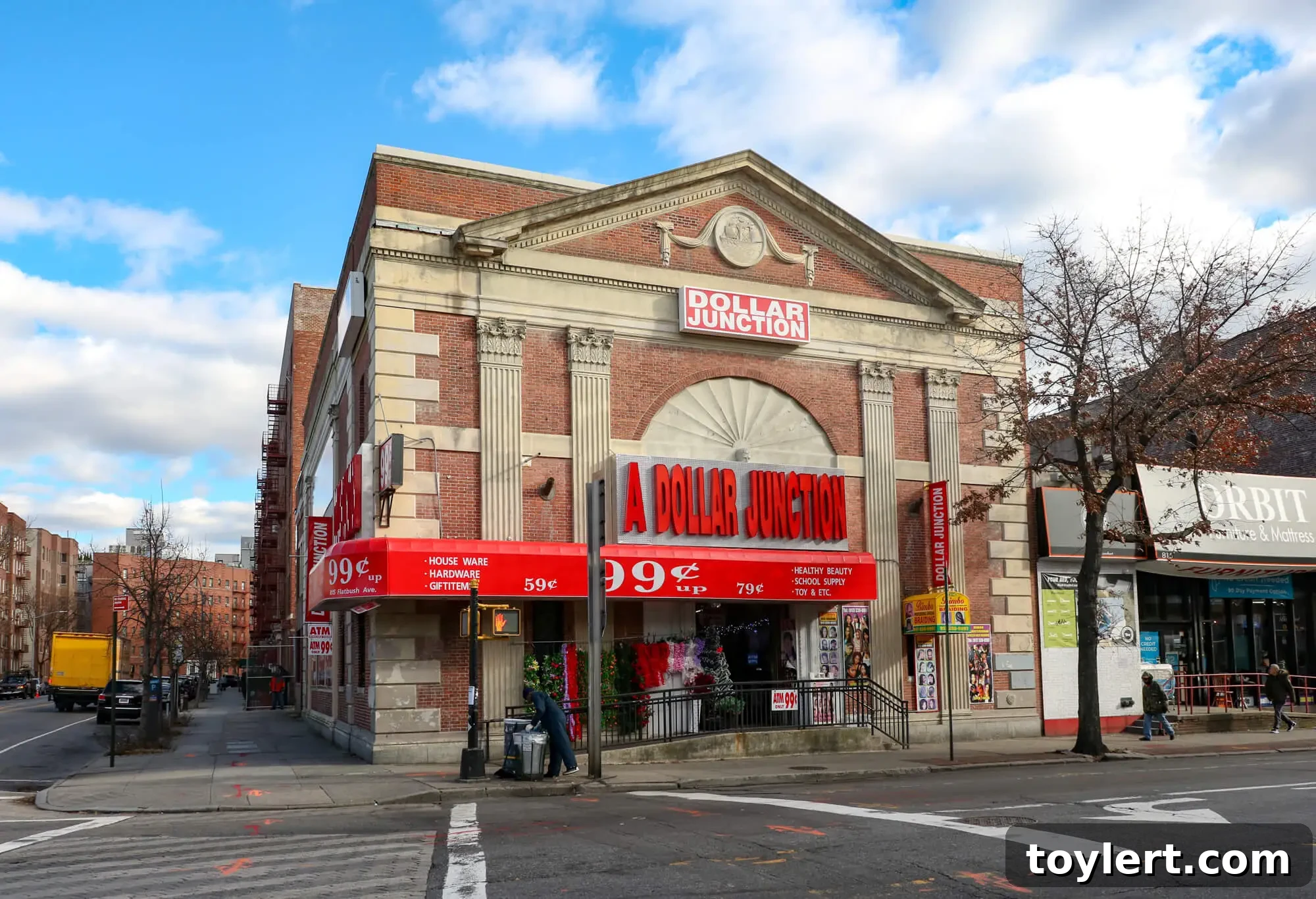
In the bustling heart of Flatbush, Brooklyn, an unassuming building at 815 Flatbush Avenue holds more stories than its present-day facade might suggest. Beneath the vibrant, modern signage that now adorns its elegant exterior, a pair of watchful eyes peer out from above the main entrance, silently observing the ceaseless rhythm of the street. This subtle architectural detail is just one of many clues to the building’s remarkable past, inviting curious passersby to look beyond its current commercial use and delve into its rich historical narrative. Today, it serves the community as a vibrant 99-cent store, a testament to the dynamic nature of urban spaces and the enduring adaptability of historic architecture.
This striking red brick and limestone structure, completed in 1931, originally stood as a distinguished branch of the Fulton Savings Bank. Its design, a compelling blend of Classical Revival influences with subtle touches of the emerging Art Deco style, reflects the architectural trends of its era. High above the entrance, where the aforementioned eyes reside within a finely sculpted bust, an intricate medallion depicts a steamboat. This distinctive emblem serves as a crucial historical marker, not only hinting at the identity of the male figure portrayed but also illuminating the building’s initial purpose and its deep connection to a pivotal figure in American innovation.

Architectural Grandeur: Uncovering the Details of 815 Flatbush Avenue
The architecture of 815 Flatbush Avenue is a compelling study in early 20th-century design, offering a glimpse into the period’s preference for robust, dignified structures that conveyed stability and trust. Constructed with high-quality red brick and accented with finely carved limestone, the building exudes a sense of permanence that was typical for financial institutions of its time. The facade is thoughtfully proportioned, featuring strong vertical lines and meticulously crafted details that draw the eye upwards. Even amidst the visual clutter of modern storefronts, the building’s original design integrity shines through, making it a noteworthy piece of Brooklyn’s architectural tapestry.
Symbolism Cast in Stone: The Bust and Medallion
One of the most captivating features of 815 Flatbush Avenue is the elaborate sculptural work above its entrance. The carved bust of a male figure, whose gaze seems to follow those who approach, is a classic architectural element designed to imbue a sense of authority and tradition. However, it is the medallion directly above this bust that truly unlocks the building’s historical identity. The depiction of a steamboat, rendered with intricate detail, is an unmistakable reference to Robert Fulton, the pioneering engineer credited with developing the first commercially successful steamboat, the Clermont.
The choice to adorn the bank with Fulton’s likeness and his most famous invention was deliberate. The Fulton Savings Bank, much like many institutions of its era, sought to associate itself with figures of innovation, progress, and American ingenuity. Robert Fulton, a name synonymous with advancing transportation and commerce, provided the perfect symbolic patron. This artistic detail not only celebrates a historical figure but also subtly communicated the bank’s commitment to progress and reliability to its clientele. It’s a powerful example of how architecture can tell a story, embedding historical context and corporate identity directly into the urban fabric.
The Legacy of Fulton Savings Bank in Brooklyn
The Fulton Savings Bank played a significant role in the financial landscape of Brooklyn during the early to mid-20th century. Established with the aim of serving the community’s banking needs, it provided essential services such as savings accounts, loans, and other financial instruments that helped foster economic growth and stability for countless Brooklynites. The decision to open a branch at 815 Flatbush Avenue in 1931 was a strategic one, reflecting the growing prosperity and demographic expansion of the Flatbush neighborhood.
During the Great Depression, when economic uncertainty loomed large, banks like Fulton Savings Bank were crucial anchors in their communities. Their solid, often ornate, buildings were designed to project an image of unwavering financial strength and trustworthiness. The construction of a new branch, even during challenging economic times, underscored the bank’s confidence in the future of Flatbush and its commitment to the local residents and businesses. These branches were more than just transaction centers; they were symbols of local pride and community development.
Robert Fulton: The Visionary Behind the Name
To fully appreciate the significance of the steamboat medallion, one must understand the man it honors: Robert Fulton. Born in 1765, Fulton was an American engineer and inventor who made groundbreaking contributions to naval technology and, most famously, to steam navigation. While he didn’t invent the steamboat itself, his pioneering work on the North River Steamboat (later known as the Clermont) in 1807 revolutionized river travel and commerce, connecting major cities and facilitating the movement of goods and people across vast distances.
Fulton’s innovations were transformative, drastically reducing travel times and opening up new avenues for trade and industrial growth. His legacy extended beyond just steamboats; he also contributed to the development of submarines and canals. For a savings bank in Brooklyn, an industrial and commercial hub, to bear his name and feature his invention was a clear statement of its aspirations: to be a catalyst for progress, stability, and prosperity, much like Fulton himself had been for the nation’s economy and infrastructure. His name represented a forward-thinking spirit and a solid foundation, qualities a bank would certainly wish to embody.
Adaptive Reuse: 815 Flatbush Avenue’s Modern Transformation
Fast forward to today, and 815 Flatbush Avenue stands as a prime example of adaptive reuse, a common and increasingly vital practice in urban centers worldwide. Adaptive reuse involves repurposing an existing building for a use other than that for which it was originally designed, while often retaining its historic features. The transition of this grand bank building into a 99-cent store reflects the changing economic landscape and consumer needs of the Flatbush neighborhood.
This transformation is not just a commercial shift; it’s a testament to the resilience and versatility of well-constructed historic buildings. While the interior has undoubtedly been reconfigured to suit its current retail function, the exterior of 815 Flatbush Avenue largely retains its original architectural character. This preservation of the facade is crucial, as it allows the building to continue contributing to the street’s historical aesthetic and provides a tangible link to Brooklyn’s past, even as its purpose evolves.
The Importance of Preserving Historic Facades
The preservation of historic facades, as seen at 815 Flatbush Avenue, offers numerous benefits. Aesthetically, it maintains the unique character and visual diversity of a streetscape, preventing urban areas from becoming monotonous. Environmentally, adaptive reuse is a sustainable practice, as it reduces the need for new construction materials and minimizes demolition waste. Culturally, these buildings serve as reminders of previous eras, helping to educate future generations about architectural styles, historical events, and the evolution of urban life.
Moreover, retaining historic elements can add significant value to a property and its surrounding area. Buildings with character and a story often attract more attention and can become local landmarks, fostering a sense of community pride. The subtle details, like the peering eyes and the steamboat medallion at 815 Flatbush Avenue, become points of interest, sparking conversations and encouraging a deeper appreciation for the architectural heritage that surrounds us.
Flatbush: A Neighborhood of Rich History and Dynamic Change
The setting of 815 Flatbush Avenue is as historically rich as the building itself. Flatbush, one of Brooklyn’s oldest and most diverse neighborhoods, boasts a history dating back to its Dutch colonial roots. Over the centuries, it has evolved from an agricultural settlement into a vibrant urban community, characterized by its stately Victorian homes, bustling commercial corridors, and a diverse population.
Flatbush Avenue itself is one of Brooklyn’s most iconic thoroughfares, a commercial artery that stretches through various neighborhoods, each with its own distinct character. The section of Flatbush Avenue where 815 is located has always been a hub of activity, reflecting the changing fortunes and demographics of Brooklyn. The presence of grand old buildings like the former Fulton Savings Bank speaks to a time of significant investment and growth in this area, positioning it as a vital center for trade and community life.
Today, Flatbush continues its dynamic evolution, welcoming new businesses, residents, and cultural influences while striving to maintain its unique identity. Buildings like 815 Flatbush Avenue serve as physical anchors to this history, silently narrating tales of past ambitions, architectural styles, and community development amidst the constant flux of modern urban life.
Conclusion: A Silent Sentinel of Brooklyn’s Past and Present
815 Flatbush Avenue is more than just a commercial building; it’s a living artifact of Brooklyn’s history. From its origins as a grand financial institution in 1931, designed to embody stability and progress, to its present-day role as a convenient retail outlet, the building has witnessed nearly a century of change in Flatbush. Its elegant red brick and limestone facade, adorned with the symbolic bust and steamboat medallion, stands as a testament to the meticulous craftsmanship and thoughtful design principles of its era.
This structure exemplifies the concept of adaptive reuse, showcasing how historic architecture can successfully evolve to meet contemporary needs while retaining its aesthetic and cultural value. The hidden details of 815 Flatbush Avenue encourage us to pause, look closely, and appreciate the layers of history embedded in our urban environment. It reminds us that even in the most functional of modern settings, the echoes of the past can still be heard, telling stories of innovation, community, and the enduring spirit of Brooklyn.